Ottoman Sultan Abdulaziz
Sultan Abdulaziz was the 32nd ruler of the Ottoman Empire, reigning from 1861 to 1876. His life and reign were marked by significant modernization efforts in the empire, particularly in the military, administration, and education.
However, his rule also coincided with growing financial crises, internal strife, and rising tensions in the Balkans, which ultimately contributed to his deposition and mysterious death.
This exploration of Abdulaziz’s life, reign, and death will highlight his contributions to the empire and the challenges that defined his time on the throne.

Sultan Abdulaziz was the son of Sultan Mahmud II and succeeded his brother, Abdulmejid I. His reign began during a period of Ottoman resurgence after the Crimean War and the Tanzimat reforms, though the empire remained dependent on European loans. Image: Abdulaziz in 1867.
Early Life and Background
Abdulaziz was born on 8 February 1830 at Eyüp Palace in Constantinople (modern-day Istanbul), the capital of the Ottoman Empire. He was the son of Sultan Mahmud II, one of the most reformist Ottoman rulers, and Pertevniyal Sultan, of Circassian origin. His birth came at a time when the Ottoman Empire was grappling with internal decay and external pressures, making reform efforts a necessity for its survival.
Abdulaziz’s paternal grandparents were Sultan Abdul Hamid I and Nakşidil Sultan. Some sources speculate that Nakşidil Sultan was Aimée du Buc de Rivéry, a Frenchwoman and cousin of Empress Joséphine of France. This possible French connection would later fuel diplomatic and cultural ties between the Ottoman Empire and France during Abdulaziz’s reign.
Abdulaziz was also related to Egypt’s ruler, Isma’il Pasha, through his maternal aunt, Hushiyar Qadin, who married Ibrahim Pasha of Egypt. This family connection strengthened ties with Egypt, a semi-autonomous province within the empire.
Education and Early Influences
Abdulaziz received a traditional Ottoman education, focusing on Islamic studies, Ottoman law, and military strategy. However, he also developed a keen interest in Western advancements, particularly in technology and culture.
His father, Mahmud II, had already initiated a series of reforms aimed at modernizing the empire, and Abdulaziz grew up in this environment of change. He was particularly influenced by the Tanzimat reforms, which began during the reign of his brother, Sultan Abdulmejid I, and aimed to reorganize the empire’s administration and modernize its institutions.
Abdulaziz’s fascination with Western culture extended to the arts, particularly literature and music. He was an admirer of European music and became a composer himself. Some of his compositions have been preserved in the album European Music at the Ottoman Court, recorded by the London Academy of Ottoman Court Music.
Accession to the Throne
Abdulaziz ascended the throne on 25 June 1861, following the death of his brother, Sultan Abdulmejid I. His reign began during a period of optimism in the empire, following the conclusion of the Crimean War (1853-1856), in which the Ottoman Empire allied with Britain and France against Russia.
Although the war had ended in victory for the Ottomans and their allies, it had left the empire deeply in debt, reliant on European financial support.
Despite these economic difficulties, the empire appeared resurgent. The Tanzimat reforms were in full swing, aimed at modernizing the state’s military, legal, and administrative systems. Abdulaziz inherited these reforms and sought to continue them, albeit with his own emphasis on military modernization, particularly the navy.

The early years of Sultan Abdulaziz’s rule saw further reforms, led by Fuad Pasha and Aali Pasha, including the Vilayet Law and changes to Ottoman law and the millets. However, the empire continued to struggle with the challenges of reform. Image: An 1869 portrait of Abdulaziz.
Reforms During Abdulaziz’s Reign
Abdulaziz’s reign was marked by significant reforms in several key areas: administration, education, infrastructure, and the military. These reforms were aimed at strengthening the empire internally while responding to the challenges posed by external powers.
Administrative Reforms
During the first decade of Abdulaziz’s reign (1861-1871), the Tanzimat reforms initiated under his predecessors continued. His chief ministers, Mehmed Fuad Pasha and Mehmed Emin Âli Pasha, played crucial roles in implementing these changes. In 1864, new administrative districts called vilayets were established to replace the old provincial system, creating a more efficient and centralized administration. This reform was aimed at improving governance and reducing corruption within the empire.
In 1868, the Council of State (Şura-yı Devlet) was established as part of a broader effort to modernize the bureaucracy. This council functioned as an advisory body, providing legal and administrative guidance. It was modeled after the French Conseil d’État, reflecting Abdulaziz’s admiration for European administrative systems.
Educational Reforms
Abdulaziz also prioritized education as a means of modernizing the empire. Under his reign, public education was organized along the French model, and efforts were made to improve literacy and technical education across the empire. One of his significant achievements was the reorganization of Istanbul University in 1861, transforming it into a modern educational institution that offered a wider range of subjects beyond traditional Islamic studies.
These educational reforms were designed to produce a new generation of Ottoman bureaucrats and military officers who were knowledgeable about modern sciences and technologies. The aim was to equip the empire with the skills needed to compete with European powers.
Infrastructure Development
One of the most notable aspects of Abdulaziz’s reign was his commitment to infrastructure development, particularly the expansion of the empire’s railway network. Although the first Ottoman railroads were built during the reign of his brother Abdulmejid I, it was Abdulaziz who established the first network of connected railways.
In 1869, he awarded the concession for the Rumelia Railway, which connected Istanbul to Vienna, to Baron Maurice de Hirsch, a Belgian banker. The railway facilitated trade and communication between the Ottoman Empire and Europe, helping to integrate the empire into the global economy.
In addition to the Rumelia Railway, Abdulaziz oversaw the construction of the Anatolia Railway, which connected Istanbul to Izmit and later to Ankara. These railway projects laid the groundwork for further expansion into Mesopotamia and Syria during the reign of his successor, Sultan Abdulhamid II.
Military Reforms
Abdulaziz placed particular emphasis on modernizing the Ottoman military, especially the navy. By 1875, the Ottoman Navy ranked as the third-largest in the world, boasting 21 battleships and 173 other vessels.
Abdulaziz’s passion for the navy and maritime affairs can be seen in his extensive investments in shipbuilding and naval technology. He constructed new shipyards and purchased advanced warships from European powers, particularly Britain and France.
However, this naval expansion came at a significant financial cost. The Ottoman government had to borrow heavily from European banks to fund these modernization efforts, contributing to the empire’s mounting public debt.
Foreign Policy and Diplomacy
Abdulaziz’s foreign policy was shaped by the need to maintain the Ottoman Empire’s territorial integrity in the face of growing external threats, particularly from Russia and nationalist movements within the empire’s Balkan provinces.
Relations with Europe
Abdulaziz sought to strengthen the empire’s ties with European powers, particularly Britain and France. In 1867, he became the first Ottoman sultan to visit Western Europe, embarking on a diplomatic tour that took him to Paris, London, and Vienna. The primary objective of this tour was to restore the Ottoman Empire’s financial credit and prevent Franco-Russian intervention in Crete, where a rebellion was brewing.
During his visit to London, Queen Victoria awarded Abdulaziz the prestigious Order of the Garter. His visit also included tours of military installations, museums, and factories, which further fueled his interest in Western technology and culture. One of the lasting legacies of this trip was the establishment of the Istanbul Archaeology Museum, inspired by the museums Abdulaziz had visited in Europe.
Queen Victoria’s grandsons who ruled Britain, Germany, and Russia
Relations with Egypt
Abdulaziz also maintained strong ties with Egypt, a semi-autonomous province of the Ottoman Empire. In 1867, he officially recognized the title of Khedive (viceroy) for the ruler of Egypt and Sudan, elevating the status of Isma’il Pasha, the then-governor of Egypt. In return, Isma’il agreed to increase Egypt’s annual tax revenues to the Ottoman treasury. The revenues from Egypt and Sudan were often used as collateral for the empire’s loans from European banks, making them crucial to the empire’s financial stability.
However, the growing autonomy of Egypt under Isma’il Pasha also posed a potential challenge to Ottoman authority. While the relationship remained stable during Abdulaziz’s reign, tensions between Egypt and the central Ottoman government would later resurface under subsequent sultans.

Financial Crisis and Internal Unrest
Despite Abdulaziz’s efforts to modernize the empire, his reign was plagued by financial difficulties. The empire’s ambitious modernization projects, particularly the expansion of the navy and the construction of railways, were financed through loans from European banks. By the mid-1870s, the empire was deeply in debt, with much of its revenue tied up in servicing these loans.
In 1873, a severe famine struck Anatolia, further straining the empire’s finances. The government’s tax revenues plummeted, and in October 1875, the Ottoman government declared bankruptcy. This financial crisis, known as the “Ramazan Kanunnamesi,” triggered widespread unrest, particularly in the empire’s Balkan provinces.
The economic collapse coincided with rising nationalist movements in the Balkans. In 1875, the Herzegovinian rebellion broke out, followed by the April Uprising in Bulgaria in 1876. These uprisings were fueled by growing discontent among the Christian populations of the empire, who sought independence or greater autonomy from Ottoman rule. The rebellions were also encouraged by Russia, which saw an opportunity to expand its influence in the region.
Deposition and Mysterious Death
As financial and political crises mounted, Abdulaziz’s popularity declined. His lavish spending on the navy and palaces, combined with crop failures and public debt, created an atmosphere of discontent. By 1876, the Ottoman elite had lost confidence in Abdulaziz’s ability to lead the empire through its mounting challenges.
On 30 May 1876, Abdulaziz was deposed in a coup led by his ministers. The coup was supported by the military and bureaucratic elite, who believed that a change in leadership was necessary to stabilize the empire. Abdulaziz was replaced by his nephew, Murad V, who was seen as a more progressive and reform-minded ruler.
Following his deposition, Abdulaziz was taken to Topkapı Palace, where he was placed in the same room where Sultan Selim III had been murdered decades earlier. This historical coincidence heightened Abdulaziz’s fears for his life. He requested to be moved to Beylerbeyi Palace, but his request was denied, and he was instead relocated to Feriye Palace.
On 4 June 1876, just six days after his deposition, Abdulaziz was found dead in Feriye Palace. He had suffered two deep wounds to his arms, and his body was discovered in a pool of blood. Shortly before his death, he had requested a pair of scissors to trim his beard, leading to speculation that the wounds were self-inflicted.
A group of physicians examined Abdulaziz’s body and concluded that his death was a suicide. However, rumors persisted that he had been murdered by his political enemies. The exact circumstances of his death remain a subject of debate among historians.
Legacy and Conclusion
Sultan Abdulaziz’s reign was a period of both progress and turmoil for the Ottoman Empire. His efforts to modernize the military, administration, and infrastructure helped lay the groundwork for future reforms, particularly under his successor, Sultan Abdulhamid II. However, his ambitious modernization projects came at a high financial cost, contributing to the empire’s economic decline and eventual bankruptcy.
Abdulaziz’s death marked the end of a turbulent chapter in Ottoman history, as the empire grappled with the challenges of modernization, rising nationalist movements, and external threats. His reign is often seen as a turning point in the empire’s gradual decline, setting the stage for the crises that would follow in the late 19th and early 20th centuries.
Despite the challenges he faced, Abdulaziz’s contributions to the empire’s military and infrastructure left a lasting impact. His vision of a modern, centralized Ottoman state continued to influence his successors, even as the empire struggled to maintain its territorial integrity in the face of growing external pressures.
Questions and Answers about Ottoman Sultan Abdulaziz
When and where was Abdulaziz born?
Abdulaziz was born on 8 February 1830 at Eyüp Palace in Constantinople (modern-day Istanbul).
Who were Abdulaziz’s parents?
His father was Sultan Mahmud II, and his mother was Pertevniyal Sultan, originally named Besime, of Circassian origin.
The Pertevniyal Valide Sultan Mosque, built between 1869 and 1871, was commissioned by his mother, Pertevniyal Sultan.
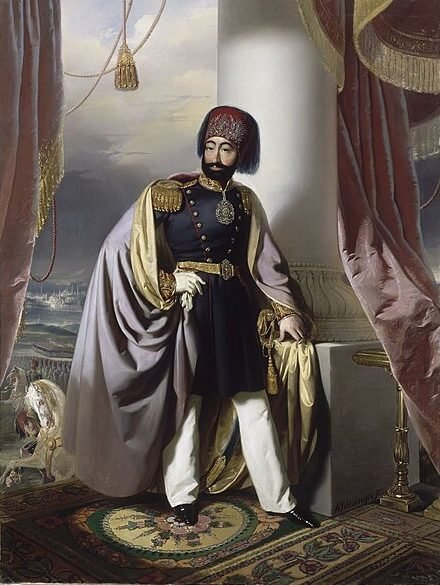
Image: Sultan Mahmud II, father of Abdulaziz
Who were Abdulaziz’s paternal grandparents, and how is his grandmother historically significant?
His paternal grandparents were Sultan Abdul Hamid I and Nakşidil Sultan. Some sources suggest Nakşidil Sultan may have been Aimée du Buc de Rivéry, a cousin of Empress Joséphine of France.
Abdulaziz was related to Isma’il Pasha through his maternal aunt, Hushiyar Qadin, who was married to Ibrahim Pasha of Egypt.
What was Abdulaziz’s interest in Western Europe, and how was he the first Ottoman sultan in this regard?
Abdulaziz had a keen interest in Western advancements and was the first Ottoman sultan to travel to Western Europe, visiting cities like Paris, London, and Vienna in 1867.
He was also interested in literature and music. His classical compositions are featured in the album European Music at the Ottoman Court by the London Academy of Ottoman Court Music.
What key reforms were continued during Abdulaziz’s reign, and under whose leadership?
The Tanzimat reforms were continued under the leadership of his chief ministers, Mehmed Fuad Pasha and Mehmed Emin Âli Pasha, including the establishment of new administrative districts and a Council of State in 1868.
Abdulaziz modernized the education system based on the French model, reorganized Istanbul University, and oversaw the creation of Turkey’s first civil code.
In 1863, the first Ottoman postage stamps were issued, and by 1875, the Ottoman Empire became a founding member of the Universal Postal Union.
Why did Abdulaziz visit Europe in 1867, and what was his broader goal?
Abdulaziz visited Paris for the 1867 Paris Exhibition, but his broader goal was to restore Ottoman financial credit and prevent Franco-Russian intervention in Crete.
Queen Victoria awarded him the Order of the Garter during his visit to London in 1867.

What were Abdulaziz’s key contributions to the development of the Ottoman railway system?
Abdulaziz established the first network of connected railways, including the Rumelia Railway from Istanbul to Vienna and the Anatolia Railway, which expanded the empire’s infrastructure.
What title did Abdulaziz officially recognize for Egypt’s ruler, and what was the exchange agreement?
Abdulaziz officially recognized the title of “Khedive” for the governor of Egypt and Sudan in 1867. In exchange, Isma’il Pasha agreed to increase annual tax revenues to the Ottoman treasury.
How did Abdulaziz modernize the Ottoman Navy, and what financial strain did this cause?
Abdulaziz expanded and modernized the Ottoman Navy, making it the third-largest in the world by 1875. However, this, along with the Anatolian famine, strained the empire’s finances.
What crisis did the financial strain lead to in 1875, and what impact did it have?
The financial strain led to the Great Eastern Crisis in 1875, exacerbating unrest in the Balkan provinces and setting the stage for the Russo-Turkish War (1877–78).
After the fall of the Second French Empire, Abdulaziz turned to Russia for support, as unrest in the Balkans continued to grow.
What factors contributed to Abdulaziz’s downfall in 1876?
Abdulaziz’s lavish spending on the navy, his palace construction projects, crop failures, financial mismanagement, and growing public debt contributed to his downfall.
What was the official cause of Abdulaziz’s death, and when did it occur?
Abdulaziz was found dead on 4 June 1876, with two deep wounds in his arms. His death was officially ruled as suicide.

Abdulaziz’s reign saw both modernization and the beginning of the empire’s decline, with financial troubles, political instability, and foreign interventions foreshadowing the Russo-Turkish War and the eventual dissolution of the empire. Image: Abdulaziz during the mid 1870s.