The Ottoman Public Debt Administration
The Ottoman Public Debt Administration (OPDA) was a European-controlled organization established in 1881 to manage and collect payments on the Ottoman Empire’s public debt. This debt primarily stemmed from loans owed to European creditors. The OPDA symbolized the extent of foreign influence on the Ottoman financial system during a period when the empire struggled with economic decline and political instability.

Flag used by the Ottoman Empire between 1844 and 1922.
Origins and Structure of the OPDA
The OPDA emerged as a solution following the financial crisis of the Ottoman Empire in the late 19th century. By the 1870s, the empire defaulted on its international loans due to chronic fiscal mismanagement, military expenditures, and the loss of tax revenues from territories ceded under various treaties. The Muharrem Decree of 1881 formalized the establishment of the OPDA, granting it significant powers over Ottoman state revenues.
The Ottoman Public Debt Administration (OPDA) was formally known in Ottoman Turkish as Düyun-u Umumiye-i Osmaniye Varidat-ı Muhassasa İdaresi.
The administration operated as an independent entity within the Ottoman bureaucracy but was primarily controlled by representatives of the empire’s European creditors. Its governing council included delegates from Britain, France, Germany, Austria, Italy, the Netherlands, and the Ottoman Empire. This structure reflected the broad international interest in recovering debts from the empire. Over time, the OPDA became one of the largest bureaucracies in the Ottoman Empire, employing up to 9,000 officials, surpassing the Ottoman finance ministry in size.
Powers and Revenue Sources
The OPDA’s authority extended over several critical revenue streams. It was granted monopolies on the production and sale of essential goods like salt and tobacco, which provided stable and lucrative income.
Additionally, it collected taxes on a range of goods and services, including alcohol, fishing, silk, and stamps, particularly in key regions such as Istanbul. Non-regional taxes on shops, customs duties, and foreign indemnities from Balkan states, as stipulated by the Treaty of Berlin (1878), also fell under its jurisdiction. These measures ensured that European creditors were prioritized in debt repayments.
However, the taxes and monopolies controlled by the OPDA often burdened the Ottoman population, exacerbating economic hardships. Despite this, the organization maintained a degree of efficiency that exceeded many Ottoman institutions, leading to advancements in accounting and financial practices.
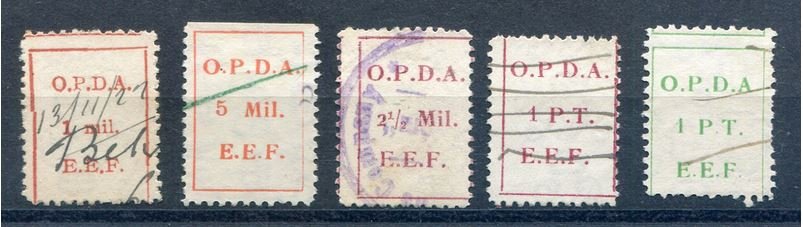
Duty stamps issued by the Ottoman Public Debt Administration.
Role in Ottoman Economic Affairs
The OPDA’s influence extended beyond debt collection. It acted as an intermediary between European investors and the Ottoman government, facilitating foreign investments in infrastructure and industrial projects.
By 1900, the OPDA was financing significant developments, including railway construction, which played a key role in modernizing the empire’s transportation network. The OPDA also contributed to the protection of commercial privileges for non-Muslim foreign investors, who benefited from the capitulations granted by the Ottoman government.
While the OPDA provided some stability to the empire’s finances, it was also a symbol of the empire’s diminished sovereignty. Its operations highlighted the dependency of the Ottoman state on foreign powers, further eroding domestic confidence in the central government.

A photo of the Istanbul High School, which originally served as the headquarters of the OPDA.
Aftermath and Legacy
The dissolution of the Ottoman Empire following World War I marked the end of the OPDA’s operations within the imperial framework. However, its impact persisted in the territories that emerged from the empire’s disintegration. Between 1918 and 1924, Ottoman revenue stamps overprinted with the initials “O.P.D.A.” or their French equivalent “A.D.P.O.” were used in Palestine, Transjordan, Syria, and Lebanon—a testament to the enduring legacy of the administration.
The OPDA also served as a prototype for later financial control mechanisms imposed on debtor nations. Its establishment underscored the extent to which foreign creditors could exert influence over a sovereign state’s fiscal policies when the latter was unable to meet its financial obligations. The administration’s efficiency, despite the controversies surrounding its existence, highlighted the potential for a technically advanced bureaucracy to function in a challenging and politically sensitive environment.
Criticism and Controversy
The OPDA was not without its critics. Many Ottomans viewed it as a violation of the empire’s sovereignty, with foreign powers effectively dictating significant aspects of domestic financial policy. The monopolies and tax burdens imposed by the administration often fueled public resentment, especially among those directly affected by its collection practices. Furthermore, uncertainties in accounting and discrepancies in debt calculations created tensions between the OPDA and its Ottoman counterparts.
Notably, British bondholders, who played a significant role in advocating for the OPDA’s creation, were sometimes perceived as disproportionately benefiting from its repayment schemes. These disputes reflected broader tensions between creditor nations and the empire over financial control and accountability.