Preamble to the United States Constitution
The Preamble to the United States Constitution serves as the introductory statement to one of the most important legal documents in history. Beginning with the words “We the People”, the Preamble outlines the fundamental purposes and guiding principles behind the Constitution. While it does not grant specific powers or impose direct limitations on government authority, it has been widely referenced by courts as evidence of our Founding Fathers’ intent.
In the article below, American historians at World History Edu explore the drafting, meaning, judicial interpretation, and application of the Preamble in the context of American law and governance.

US’ coat of arms.
Text of the Preamble
The full text of the Preamble reads:
We the People of the United States, in order to form a more perfect Union, establish Justice, insure domestic Tranquility, provide for the common defence, promote the general Welfare, and secure the Blessings of Liberty to ourselves and our Posterity, do ordain and establish this Constitution for the United States of America.
Each phrase in this statement reflects the aspirations and foundational goals of the Constitution, guiding the structure and function of the American government.
Drafting and Evolution of the Preamble
The Preamble was introduced during the final days of the Constitutional Convention in 1787 by the Committee on Style, led by Gouverneur Morris, a Pennsylvania delegate. Unlike other sections of the Constitution, it was not extensively debated or formally proposed beforehand.
Early drafts of the Preamble differed significantly, referring to the people of individual states rather than a collective “United States” identity. The final version, emphasizing a unified national government, reflected the shift from a confederation of states under the Articles of Confederation to a stronger federal union.
This change was necessitated by the Constitution’s ratification process. Unlike previous documents such as the 1778 Treaty of Alliance with France, the Articles of Confederation, and the 1783 Treaty of Paris, which listed individual states, the new Constitution would take effect upon ratification by just nine states, regardless of whether the others agreed. The wording of the Preamble symbolized a transition to a singular, unified nation, rather than a mere alliance of independent states.
Meaning and Application
While the Preamble outlines the Constitution’s objectives, it does not serve as a legal basis for government power or limitations. No section of the Preamble is independently enforceable in court, as it lacks direct legal authority. Instead, it provides interpretative guidance on the Constitution’s spirit and intent.

Close-up view of the official handwritten Preamble, penned by Jacob Shallus.
Judicial Interpretation and Relevance
Courts have used the Preamble to clarify the Constitution’s meaning, particularly in cases requiring broad interpretation. Judges often analyze historical context and the Founding Fathers’ intent to determine constitutional principles. The Preamble has been cited to emphasize themes such as national unity, justice, and the protection of liberties.
Despite its significance in understanding the Constitution’s spirit, courts have ruled that the Preamble cannot grant powers not explicitly stated elsewhere in the document. This principle ensures that constitutional authority is derived from specific provisions rather than broad interpretations of introductory statements.
Examples in Case Law
Ellis v. City of Grand Rapids (Eminent Domain)
In this case, the City of Grand Rapids sought to use eminent domain to acquire and transfer property for hospital development. The court referenced the Preamble’s phrase “promote the general Welfare” to support the argument that improving public health aligns with constitutional objectives. This interpretation reinforced the idea that government actions benefiting society as a whole are consistent with constitutional values.
United States v. Kinnebrew Motor Co. (Limits on Government Power)
During the Great Depression, Congress enacted the National Industrial Recovery Act, which included price regulations. When a car dealership violated these regulations, the government argued that the Preamble’s phrase “promote the general Welfare” justified federal intervention. The court rejected this argument, ruling that the Preamble cannot be used as an independent source of power. Instead, the case was decided based on the Commerce Clause, demonstrating that constitutional powers must be explicitly granted, not inferred from the Preamble.
Interpretation of Key Phrases
“We the People”
The phrase “We the People” affirms that the Constitution derives its authority from citizens rather than state governments. This marks a departure from the Articles of Confederation, which treated states as the primary sovereign entities. Over time, courts have interpreted this phrase to emphasize popular sovereignty and the principle that government authority stems from the governed.
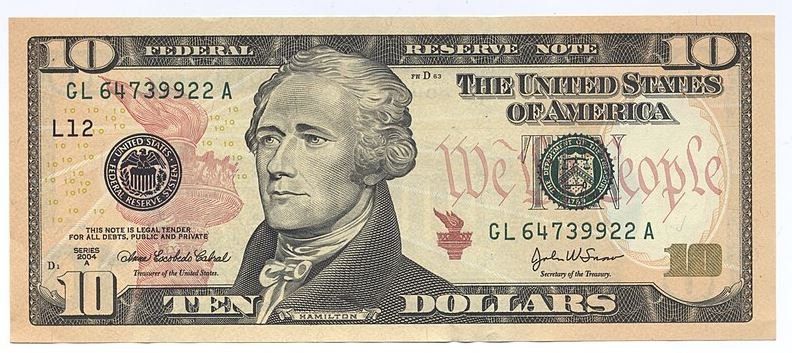
“We the People” is displayed on the US 10 Dollar bill.
“To Form a More Perfect Union”
This phrase acknowledges that the Constitution was created to improve upon the Articles of Confederation, which had proven inadequate in maintaining national unity. The term “more perfect” reflects the Founders’ intent to establish a stronger, more effective federal government while still allowing for further improvements over time.
“Establish Justice”
A key function of the Constitution is to create a legal framework ensuring fairness, rule of law, and protection of individual rights. This phrase has been cited in landmark Supreme Court cases concerning civil rights, due process, and equal protection under the law.
READ ALSO: 10 Landmark U.S. Supreme Court Decisions
“Insure Domestic Tranquility”
This phrase refers to the government’s role in maintaining peace and stability within the country. Historically, it has been used to justify federal intervention in crises such as the Civil War, racial conflicts, and law enforcement matters.
“Provide for the Common Defence”
The government is tasked with protecting the nation from external threats and military aggression. This principle has guided national security policies, military funding, and defense-related legislation throughout U.S. history.
“Promote the General Welfare”
This phrase supports the idea that the government should work toward the overall well-being of its citizens. It has been used to justify social programs, economic regulations, and public health initiatives, though courts have ruled that it does not grant unlimited government authority.
“Secure the Blessings of Liberty”
The Constitution aims to safeguard individual freedoms and civil rights for both present and future generations. This phrase has been foundational in legal arguments regarding free speech, voting rights, and personal autonomy.
National Sovereignty and Federal Power
The Preamble’s reference to the “United States of America” has implications for national sovereignty. Historically, it has been interpreted to mean that the federal government represents a single sovereign entity in international relations, distinct from individual states. The Supreme Court has upheld the federal government’s exclusive authority over foreign policy, treaty-making, and war powers, reinforcing the notion that sovereignty rests with the nation as a whole.
Federal vs. State Authority
While the federal government holds supreme power in areas explicitly granted by the Constitution, the Tenth Amendment reserves all remaining powers to the states. The balance of power between federal and state governments remains a contentious issue, with courts often referencing the Preamble when considering cases related to state sovereignty, federal supremacy, and individual rights.
History and Significance of the U.S. Bill of Rights (the First 10 Amendments)
The Preamble and Modern Interpretations
Expansion of Civil Rights
Throughout U.S. history, the Preamble has been invoked in discussions of civil rights and social progress. For instance, during the Civil Rights Movement, advocates argued that achieving a “more perfect Union” required eliminating racial discrimination and ensuring equal rights for all citizens.
READ MORE: 14 Major Events of the Civil Rights Movement
Contemporary Political Discourse
In modern times, the phrase “a more perfect Union” has been used in speeches and policy debates to highlight ongoing efforts to improve democracy, expand justice, and promote equality. Notably, President Barack Obama referenced this phrase in a landmark speech on race relations in 2008, underscoring the Constitution’s enduring relevance in addressing societal challenges.

FREQUENTLY ASKED QUESTIONS
Who wrote the Preamble to the U.S. Constitution?
Gouverneur Morris, a delegate from Pennsylvania, primarily wrote the Preamble as part of the final drafting process at the 1787 Constitutional Convention.

A portrait of Gouverneur Morris.
What is the main purpose of the Preamble?
It introduces the Constitution, stating its fundamental goals, including forming a more perfect union, establishing justice, ensuring domestic tranquility, providing for defense, promoting general welfare, and securing liberty.
Does the Preamble grant any powers to the government?
No, the Preamble does not assign powers or create legal obligations; it serves only as an introduction that reflects the Constitution’s objectives.

Excerpt from the Preamble in an original 1787 Dunlap & Claypoole printing of the U.S. Constitution.
Why does the Preamble say “We the People” instead of listing the states?
This change emphasized national unity and sovereignty, shifting from a confederation of states to a government deriving its authority from the people.
How do courts use the Preamble in legal cases?
Courts reference the Preamble to understand the Constitution’s intent but do not use it as a basis for granting powers or rights not explicitly stated in the document.

Can the government use the Preamble to justify new powers?
No, courts have ruled that the Preamble cannot be used to expand government authority beyond what is granted elsewhere in the Constitution.
What does “to form a more perfect Union” mean?
It signifies improving upon the Articles of Confederation by creating a stronger, more unified national government.
How does the Preamble influence constitutional interpretation?
It helps courts and scholars understand the Founders’ intent, supporting interpretations that align with the document’s overarching goals, such as promoting general welfare and protecting liberty.
Ratification of the U.S. Constitution: History and Major Facts
FACT CHECK: At World History Edu, we strive for utmost accuracy and objectivity. But if you come across something that doesn’t look right, don’t hesitate to leave a comment below.





