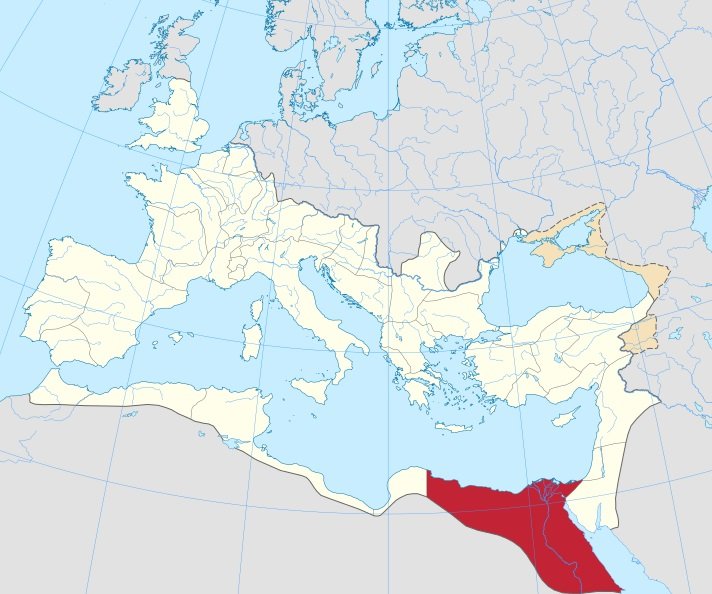
The Province of Aegyptus (125 AD).
Roman Egypt was one of the most significant provinces of the Roman Empire, serving as an essential economic, administrative, and cultural hub. Established in 30 BC following the defeat of Cleopatra VII and Mark Antony, Egypt remained a Roman province until its conquest by the Rashidun Caliphate in AD 641. Its strategic location, abundant resources, and developed urban centers made it a crucial part of the empire.
Below, World History Edu explores the history, administration, society, economy, and decline of Roman Egypt.
Formation and Early Roman Rule
The transition from the Ptolemaic Kingdom to a Roman province was marked by the defeat of Mark Antony and Cleopatra VII at the Battle of Actium in 31 BC. Octavian (later Augustus) took control of Egypt, marking the end of the Hellenistic rule. Unlike other provinces, Egypt was considered the personal domain of the emperor and was governed by a prefect rather than a senator.
Egypt was unique in the Roman administrative structure. It was governed by an equestrian prefect who reported directly to the emperor. The capital, Alexandria, was the empire’s second-largest city and a center of commerce, learning, and culture. Three legions initially garrisoned Egypt, but this number was later reduced to two as Rome consolidated control.
READ MORE: The True Extent of the Roman Empire
Administration and Governance of Roman Egypt
The Roman governor, known as the Praefectus Aegypti, was responsible for military security, taxation, and justice. He managed grain shipments from Egypt, which were vital for Rome’s food supply. Egypt was divided into several administrative regions called “nomes,” each overseen by a strategos.
While the Romans retained the Ptolemaic administrative framework, they introduced new legal systems. The major towns (mētropoleis) enjoyed privileges that granted them Greek-style municipal autonomy. Socially, Egyptian society remained stratified along ethnic lines, with Greek-speaking elites in cities and Egyptian-speaking farmers in rural areas.
Economy and Trade
Egypt was the “breadbasket” of the Roman Empire. The annual flooding of the Nile ensured a stable grain supply, which was exported in large quantities to Rome. Agricultural estates were a mix of imperial, temple-owned, and private holdings.
The province had a flourishing economy, with extensive trade networks connecting the Mediterranean, Africa, and India. The port of Berenike facilitated commerce with the Red Sea, while Alexandria became a hub for goods like papyrus, glassware, and textiles. Roman coinage replaced Ptolemaic currency, stabilizing economic transactions.

Roman trade with India began through Aegyptus, as stated in the “Periplus of the Erythraean Sea”.
Cultural and Religious Life
Despite Roman rule, Egyptian religious traditions persisted. The imperial cult coexisted with traditional deities like Isis, Serapis, and Osiris. Many temples continued to function, albeit under Roman oversight.
Christianity gained prominence in Egypt during the 3rd and 4th centuries. The conversion of Emperor Constantine I and the subsequent Christianization of the empire led to increased persecution of paganism. The destruction of the Serapeum of Alexandria in AD 391 symbolized this transition.
Roman Egypt blended Greco-Roman and Egyptian traditions, influencing art, language, and religious practices, with Coptic Christianity emerging as a lasting heritage.
Military and Defense
The Roman military presence in Egypt included two legions stationed primarily in Alexandria and the Thebaid. Auxiliary forces secured the desert frontiers and trade routes.
Revolts were common, including Jewish uprisings in Alexandria and the Bucolic War in the 2nd century. The 3rd-century Crisis saw Egypt briefly under the control of the Palmyrene Empire before being reconquered by Aurelian.
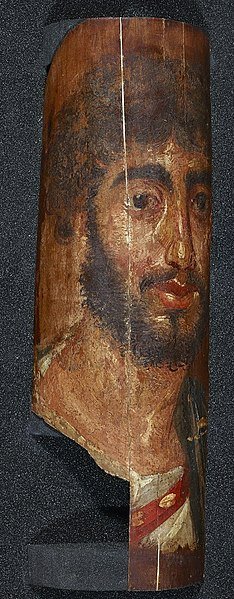
Encaustic and tempera-painted Fayum mummy portrait of a Roman officer (circa 160–170).

Decline and Fall
By the late 3rd century, administrative reforms by Diocletian and Constantine aimed to stabilize Egypt. However, increased taxation and land privatization weakened the rural economy.
The Sasanian Empire briefly occupied Egypt from 618 to 628 before Emperor Heraclius restored Roman rule. However, the Muslim conquest of Egypt in 641 marked the definitive end of Roman control.
What was the Tetrarchy and why was it established by Emperor Diocletian?





