Strategy used by the Greeks at the Battle of Salamis in 480 BCE
The Battle of Salamis in 480 BCE was a pivotal naval engagement during the Greco-Persian Wars, wherein the Greek city-states, led by Athens and Sparta, faced the massive Persian fleet commanded by King Xerxes.
The Greek strategy at Salamis was a masterstroke of tactical ingenuity, exploiting geography, psychological manipulation, and superior seamanship to secure an unlikely victory against overwhelming odds.
Below, World History Edu provide an in-depth look into the strategic elements that underpinned the Greek triumph, emphasizing how their actions at Salamis shaped the course of history.
Historical Context
The Battle of Salamis occurred during the Second Persian invasion of Greece. Following the defeat at Marathon in 490 BCE, Persia, under King Xerxes I (also known as Xerxes the Great), sought to avenge its earlier losses and expand its empire into the Greek mainland. By 480 BCE, the Persian forces had amassed a formidable army and navy, comprising troops from across their vast empire.
The Greeks, aware of the existential threat posed by Xerxes, attempted to unify their city-states through the Hellenic League. Despite political divisions, the Greeks adopted a joint strategy to resist the Persian advance. While the land battle at Thermopylae delayed the Persian army, the Greek fleet positioned itself at Artemisium to counter Persian naval operations. Both engagements served as precursors to Salamis, with the Persian advance forcing the Greeks to reconsider their tactics.

A map illustrating the main areas of engagement during the Battle of Salamis.
READ MORE: Xerxes’s Crossing of Hellespont in 480 BCE
The Strategic Setting
After Thermopylae and the destruction of Athens, many Greek city-states were on the brink of submission. However, the Greek fleet, under the command of the Athenian general Themistocles, withdrew to the straits of Salamis. The decision to defend this narrow channel, rather than retreat further, was central to the Greek strategy.
The geography of the Salamis Strait played a crucial role in Greek planning. The narrow waters negated the numerical superiority of the Persian fleet, preventing it from deploying its full strength effectively. While the open sea would have favored the Persians, the confined straits restricted their maneuvers, creating opportunities for the smaller, more agile Greek triremes.
Themistocles’ Leadership and Deceptive Tactics
Themistocles, the architect of the Greek naval strategy, demonstrated remarkable foresight and psychological acumen. Recognizing the strategic importance of a decisive naval engagement, he worked to ensure that the battle occurred on Greek terms.
Manipulating the Persian Strategy
Themistocles employed deception to lure the Persian fleet into the straits. He sent a covert message to Xerxes, falsely claiming that the Greek alliance was disintegrating and that some Greek forces were ready to defect. This message convinced Xerxes to commit his navy to a hasty engagement, believing he could crush the Greeks before they could retreat or regroup.
Uniting Greek Forces
Despite internal divisions among the Greek city-states, Themistocles’ leadership ensured cooperation. Themistocles argued that abandoning Salamis would expose the Peloponnesian cities to Persian attack and dismantle the Greek resistance. His ability to unify disparate factions was instrumental in maintaining a cohesive strategy.
Greek Naval Tactics
The Greek fleet at Salamis consisted of around 300 ships, primarily triremes—fast, maneuverable vessels with reinforced prows designed for ramming. In contrast, the Persian navy, estimated at 600–1,200 ships, included a mix of vessels from across the empire, many of which were less suited to the confined waters of Salamis.
Exploiting Superior Seamanship
Greek sailors were experienced in navigating coastal and narrow waters, giving them an advantage in the straits. Their triremes were ideally suited for quick turns and precise maneuvers, enabling them to outmaneuver the larger Persian vessels.
Phalanx-Like Naval Formations
The Greeks adopted tight formations to maximize their effectiveness in the restricted space. This approach allowed them to present a unified front, concentrate their attacks, and minimize the risk of being outflanked.
The Battle Unfolds
The engagement began in the early morning as the Persian fleet entered the straits, eager to engage the Greeks. Xerxes observed the battle from a throne on a nearby hill, confident of victory.
Initial Persian Overconfidence
The Persians, lured by Themistocles’ deception, believed the Greeks were in disarray. This overconfidence led to a disorganized advance into the straits, with ships crowding the narrow waters. The resulting congestion disrupted their formations, leaving them vulnerable to Greek attacks.
Greek Counterattacks
As the Persians struggled to maneuver, the Greeks launched coordinated assaults. The smaller, faster triremes exploited gaps in the Persian lines, ramming and disabling enemy ships. Themistocles’ strategy relied on the psychological impact of early successes, which demoralized the Persian crews and sowed chaos.
Psychological Warfare
The sight of Persian ships sinking and sailors drowning had a profound effect on both sides. The Greeks, inspired by their initial victories, fought with renewed vigor. The Persians, by contrast, faced mounting confusion and fear, exacerbated by language barriers and the diversity of their forces.
Key Factors in Greek Success
Several interrelated factors contributed to the Greek victory at Salamis:
Strategic Use of Geography
By choosing to fight in the narrow straits, the Greeks neutralized the Persian numerical advantage and turned the terrain to their favor.
Unity and Morale
Themistocles’ leadership fostered unity among the Greek city-states. The shared goal of defending their homeland galvanized the Greek forces, while the destruction of Athens served as a rallying cry.
Tactical Superiority
Greek naval tactics, including disciplined formations and precise maneuvers, outclassed the disorganized Persian fleet.
Persian Missteps
The Persian reliance on a diverse, multinational force proved to be a liability. Communication issues, cultural differences, and a lack of familiarity with the terrain undermined their effectiveness.
Aftermath and Strategic Implications
The Greek victory at Salamis was a turning point in the Greco-Persian Wars. Xerxes, faced with the loss of a significant portion of his navy, abandoned plans for further naval operations and withdrew much of his army back to Asia. The remaining Persian forces, under Mardonius, were eventually defeated at the Battle of Plataea in 479 BCE, securing Greek independence.
Salamis not only marked the decline of Persian expansion into Europe but also laid the foundation for the Golden Age of Greece.
The victory at Salamis ensured the survival of the Greek city-states and their cultural legacy. Had Xerxes succeeded, the course of Western history might have been drastically altered.
Themistocles emerged as one of history’s greatest military strategists. His ability to outthink and outmaneuver the Persians at Salamis remains a textbook example of strategic ingenuity.
Questions and Answers
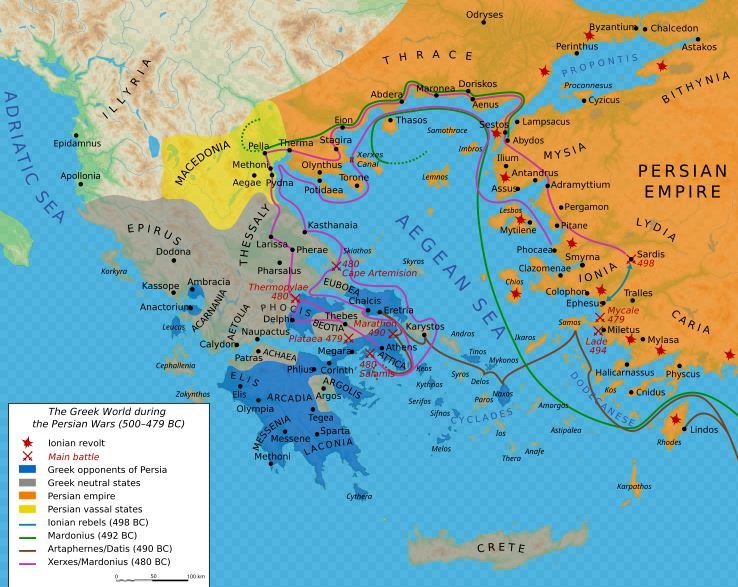
A map showing the Greek world at the time of the Persian Wars.
What is the primary source of information about the Second Persian War?
The primary source is Histories by Herodotus, which provides a detailed narrative of the war but includes some improbable elements that have raised questions about its accuracy.
What are the major weaknesses in Herodotus’ account?
Herodotus claims Athens evacuated 100,000 inhabitants within a week, which is logistically implausible. Also, the historian states the Peloponnesians built a 6-kilometer wall across the Isthmus of Corinth in one month, an unlikely accomplishment for the time. Finally, the deployment of 6,000 troops against a Persian army of 300,000 is inconsistent with the Spartans’ typically cautious military strategy.
Why has Herodotus’ account dominated historical understanding despite these weaknesses?
For centuries, there were no corroborative sources to challenge Herodotus, so his version of events remained widely accepted.
What is the “Decree of Themistocles,” and when was it discovered?
The Decree of Themistocles, also known as the “Decree of Troezen,” is a 3rd-century BCE inscription found in Troezen in 1959. It details the evacuation and military strategy of Athens during the Second Persian War.
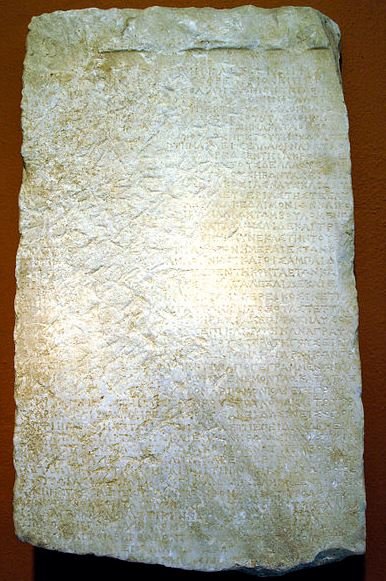
Decree of Themistocles.
What does the decree reveal about Athens’ evacuation plan?
- Women and children were relocated to Troezen.
- The elderly and movable property were secured on Salamis.
- Treasurers and priestesses remained on the Acropolis to guard sacred possessions.
What does the decree outline regarding naval strategy?
Athens deployed its entire male population to man 200 ships.
A two-fleet strategy was adopted: one fleet to assist at Artemision in northern Euboea; and another to defend Salamis and Attica.
What personnel requirements are specified in the decree?
Trierarchs (ship commanders) were chosen from property-owning Athenians with legitimate heirs to ensure accountability.
Marines and archers were selected from able-bodied men aged 20 to 30.
When does the decree suggest Athens was evacuated?
The decree indicates the evacuation occurred in spring 480 BCE, contradicting Herodotus’ claim that it happened hastily after Thermopylae.
How does the decree clarify inconsistencies in Herodotus’ account?
The decree resolves logistical issues by emphasizing early and detailed strategic planning, showing that Athens was evacuated and the naval fleet prepared well before the Persian advance.
What were the key elements of Themistocles’ strategy according to the decree?
- Naval Supremacy: Prioritizing naval defense to control key chokepoints.
- Proactive Preparation: Early planning and alliance-building gave the Greeks a strategic edge.
- Concentration of Forces: Choosing Salamis as the battleground utilized its favorable geography to counter Persian numerical superiority.
How does the decree enhance Herodotus’ narrative?
While it challenges some of Herodotus’ claims, the decree complements his account by providing additional details about Greek strategy, especially the significance of early preparations and naval coordination.
What role did the naval battle at Artemision play in the strategy?
The decree highlights Artemision as a critical engagement to delay the Persian advance and test their fleet, which Herodotus mentions but does not emphasize as strongly.





