Creation of the Delian League in 478 BC
The Delian League was a confederation of Greek city-states formed in 478 BC under the leadership of Athens. Its primary aim was to protect the Greek world from further aggression by the Persian Empire following the successful repulsion of the Second Persian invasion of Greece.
This league marked a major shift in Greek political and military alliances, transitioning from predominantly land-based coalitions to a more maritime-centered confederation.
Formation and Structure
The League derived its name from the island of Delos, where its official congresses and meetings were held. Delos was considered a sacred site, as it was home to the Temple of Apollo, making it a neutral and religiously significant location for the coalition’s assembly.
Members of the League included city-states from the Aegean islands, the Ionian coast of Asia Minor, and mainland Greece. At its height, the League had between 150 and 330 members.
The League operated under the premise of equality among its members. Each city-state was required to contribute either ships, manpower, or financial resources (called tribute) to the common cause.
However, Athens soon emerged as the dominant power in the coalition due to its significant naval strength and strategic position. Initially, this leadership was accepted because of Athens’ critical role in defeating Persia, particularly at the battles of Salamis and Mycale, but over time, Athens’ control became more imperialistic.
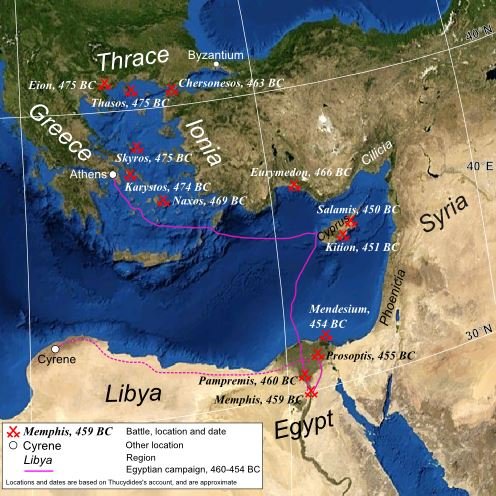
A map illustrating the sites of battles involving the Delian League from 477 to 449 BC.
Initial Purpose
The Delian League was originally established as a defensive and offensive alliance to protect Greek states against Persian retaliation. The primary goal was to safeguard the independence of Greek city-states, particularly those in Ionia, which were still vulnerable to Persian aggression.
The League also sought to secure control over the Aegean Sea, ensuring that trade routes were protected and that piracy was minimized.
Accomplishments of the Delian League
The Delian League achieved significant military, political, and economic successes during its existence. These accomplishments not only enhanced the League’s reputation but also solidified Athens’ position as a leading power in the Greek world.
Expulsion of Persian Forces
One of the League’s greatest achievements was the liberation of Greek cities in Asia Minor from Persian control. Through coordinated naval campaigns, the League expelled Persian garrisons from many key cities along the Ionian coast and the Aegean islands. This effort significantly weakened Persian influence in the region and ensured that Greece remained free from direct Persian interference for the next fifty years.
Securing the Aegean Sea
The Delian League established dominance over the Aegean Sea, eliminating Persian naval threats and securing vital maritime trade routes. This accomplishment not only provided economic stability but also allowed for the free movement of goods and ideas throughout the region.
Military Campaigns
The League conducted several successful military operations, including the decisive Battle of the Eurymedon around 466 BC. Led by the Athenian general Cimon, this battle resulted in a significant victory over Persian forces, both on land and at sea. It was a major blow to Persian ambitions in the Greek world.
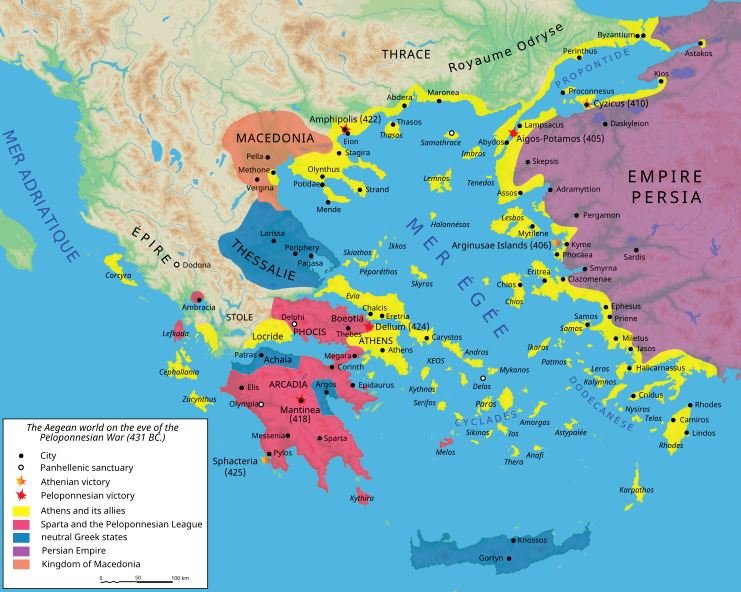
Image: A map highlighting Athens and the Delian League (in yellow) alongside the Peloponnesian League and the Persian Empire at the onset of the Peloponnesian War, circa 431 BC.
Economic Contributions
The League’s system of tribute payments generated significant wealth, much of which was managed by Athens. This wealth allowed Athens to fund massive public works projects, including the construction of the Parthenon and other iconic structures on the Acropolis. It also supported the development of Athens as a cultural and intellectual hub, fostering advancements in art, drama, and philosophy.
Establishment of Naval Supremacy
Under the Delian League, Athens built and maintained the largest and most powerful navy in the Greek world. This naval supremacy not only protected League members but also allowed Athens to project power far beyond the Aegean, influencing events throughout the eastern Mediterranean.
Major Facts about the Delian League
The Delian League’s history is marked by a series of key developments and turning points that reveal the complexities of its existence.
1. The Role of Athens
Athens was the leading city-state in the Delian League, providing much of the military strength and organizational leadership. While this was initially beneficial for the League’s objectives, Athens’ dominance gradually transformed the alliance into the Athenian Empire. Member states became increasingly subordinate, with Athens often enforcing compliance through military intervention.
2. Transformation into the Athenian Empire
By the mid-fifth century BC, the League’s original purpose of mutual defense and cooperation had shifted toward Athenian imperialism. Athens moved the League’s treasury from Delos to Athens in 454 BC, a symbolic act that signified the city’s control over the League’s resources. Athens began using League funds for its own purposes, including building projects and expanding its navy.
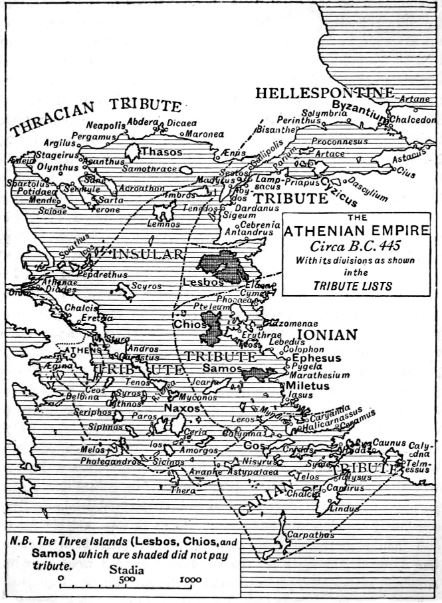
Image: The Athenian Empire circa 445 BC.
3. Rebellions and Suppression
Several member states resisted Athens’ growing authority. Notable rebellions included:
- Thasos (465 BC): Thasos revolted over disputes concerning trade and mining rights. Athens responded with force, besieging and subduing the island.
- Naxos: Naxos attempted to withdraw from the League but was forcibly brought back under Athenian control.
These rebellions highlighted the tensions between Athens and its allies, as the latter increasingly viewed Athens as an oppressor rather than a protector.
4. Tensions with Sparta
The Delian League’s growing power posed a direct challenge to Sparta’s hegemony and the Peloponnesian League. This rivalry contributed to the outbreak of the Peloponnesian War in 431 BC, a devastating conflict between Athens and Sparta that ultimately led to the League’s dissolution.
5. The Peloponnesian War and the League’s Dissolution
The Peloponnesian War marked the beginning of the end for the Delian League. Athens’ defeat in 404 BC by Sparta and its allies, including Persian support for the Spartan navy, resulted in the disbandment of the League. The Spartan commander Lysander dissolved the League, and Athens was stripped of its empire.
6. Legacy and Revival
Despite its dissolution, the Delian League left a lasting legacy. It demonstrated the potential of maritime alliances for collective defense and the projection of power. In the 4th century BC, Athens sought to revive a similar coalition with the establishment of the Second Athenian League. While this new alliance shared some features of the original League, it was less centralized and aimed to counter Spartan dominance rather than Persian threats.
Key Themes and Challenges
The Delian League’s history reveals several recurring themes and challenges faced by alliances in antiquity.
Balance of Power
The League began as a coalition of equals, but Athens’ overwhelming contribution of military resources and leadership led to an imbalance of power. This dynamic mirrors the broader struggles in alliances throughout history, where the dominant member often assumes disproportionate control.
Autonomy vs. Centralization
The League’s transformation into the Athenian Empire illustrates the tension between autonomy and centralization. While centralization allowed for more efficient decision-making and resource allocation, it also alienated member states and undermined the alliance’s original principles.
Maritime vs. Land-Based Power
The Delian League’s focus on naval power distinguished it from the land-based Peloponnesian League. This maritime strategy enabled the League to dominate the Aegean and project power across a wide area, but it also required significant financial and logistical resources.
Economic and Cultural Impact
The wealth generated by the League had profound economic and cultural effects, particularly for Athens. It funded public works, supported artistic and intellectual endeavors, and helped Athens become the cultural capital of the Greek world. However, this concentration of wealth also fostered resentment among other League members.
The Cost of Empire
The League’s evolution into the Athenian Empire highlights the challenges of sustaining an imperial system. While Athens benefited greatly, the coercive nature of its rule led to resistance and ultimately contributed to its downfall.
Conclusion
The Delian League stands as one of the most significant alliances in ancient Greek history. It was initially formed as a defensive coalition to protect against Persian threats but evolved into a powerful vehicle for Athenian imperialism. The League’s achievements, including the expulsion of Persian forces, the securing of the Aegean Sea, and the establishment of Greek naval dominance, were monumental. However, its transformation into an empire and the resulting tensions with both its allies and Sparta ultimately led to its downfall.
Frequently Asked Questions

What was the original structure and purpose of the Delian League?
The Delian League was initially a coalition of equal city-states forming a dual-purpose alliance (symmachia) for both offensive and defensive strategies. It aimed to provide protection, particularly to vulnerable Ionian colonies, and to resist Persian aggression.
Why is it called the Delian League?
The League derives its name from Delos, a sacred island that served as the site for its congresses. Meetings were held in the sanctuary of the Temple of Apollo on Delos, giving the alliance both a practical and religious significance.
How did Athens’ role in the League evolve over time?
Initially, Athens was a leading partner in the coalition, but over time, it became the dominant power. By the mid-fifth century BC, Athens had transformed the League into a naval empire, reducing the autonomy of other member states and centralizing control over League resources.
What strategic successes did the Delian League achieve?
The League expelled Persian forces from the Aegean, securing Greek dominance in the region and reducing Persia’s influence in the Greek world for fifty years.
How did Athens use the League’s resources, and what were the consequences?
Athens used the League’s resources to strengthen its navy, enhance its infrastructure, and fund projects such as the Parthenon. This led to resentment among other members and rebellions against Athens’ dominance, as seen in the revolt of Thasos in 465 BC.
What was the significance of moving the League’s treasury from Delos to Athens?
In 454 BC, under Pericles’ leadership, the League’s treasury was relocated to Athens, symbolizing the city’s control over the coalition. This move marked the transition from a mutual alliance to an Athenian-controlled empire.
What role did the Delian League play in the Peloponnesian War?
The League’s increasing centralization and Athens’ imperial ambitions threatened Spartan dominance, contributing to the outbreak of the Peloponnesian War. During the war, the League served as a symbol of Athenian power, but its dissolution followed Athens’ defeat in 404 BC.
What happened to the Delian League after the Peloponnesian War?
After Athens’ defeat, the Delian League was formally dissolved by the Spartan commander Lysander. However, Athens later attempted to re-establish its influence through the Second Athenian League in the 4th century BC.
How did the Delian League impact Greek culture and politics?
The League’s contributions funded Athens’ cultural and artistic advancements, making it a hub of art, architecture, and philosophy. Politically, it demonstrated the potential and challenges of collective alliances, particularly the difficulty of maintaining equality among members.
What was the legacy of the Delian League?
The Delian League highlighted both the strengths of unified defense and the risks of one state dominating an alliance. Its transformation into the Athenian Empire and subsequent dissolution underscored the challenges of balancing power in alliances. Despite its fall, the League profoundly influenced the governance and power dynamics of the ancient Mediterranean world.
What were some key rebellions against Athenian control within the League?
One notable rebellion was the revolt of Thasos in 465 BC. It exemplified growing dissatisfaction among member states with Athens’ heavy-handed control and misuse of League resources.
What was the role of Sparta in relation to the Delian League?
Sparta initially led the Greek resistance against Persia but later withdrew, allowing Athens to take over leadership. Sparta’s view of the Delian League as a threat to its hegemony eventually contributed to the Peloponnesian War.
How did Athens’ use of financial contributions from member states affect the League?
Many member states opted to pay financial dues instead of providing ships or manpower. Athens centralized and used these funds to expand its power, leading to resentment and decreased autonomy for other members.
What was the Second Athenian League, and how did it differ from the Delian League?
The Second Athenian League, established in the 4th century BC, was a less centralized alliance aimed at countering Sparta’s growing dominance. While it shared similarities with the Delian League, it reflected lessons learned from the earlier coalition’s shortcomings.