Tomb of the Unknown Soldier at the Arlington National Cemetery
The Tomb of the Unknown Soldier, located at Arlington National Cemetery in Arlington County, Virginia, serves as a burial site and monument dedicated to unidentified U.S. servicemen who lost their lives in service to the country. Established initially to honor an unidentified soldier from World War I, it has since expanded to include soldiers from World War II and the Korean War. These unidentified soldiers are symbolically representative of all unknown and unaccounted-for military personnel.
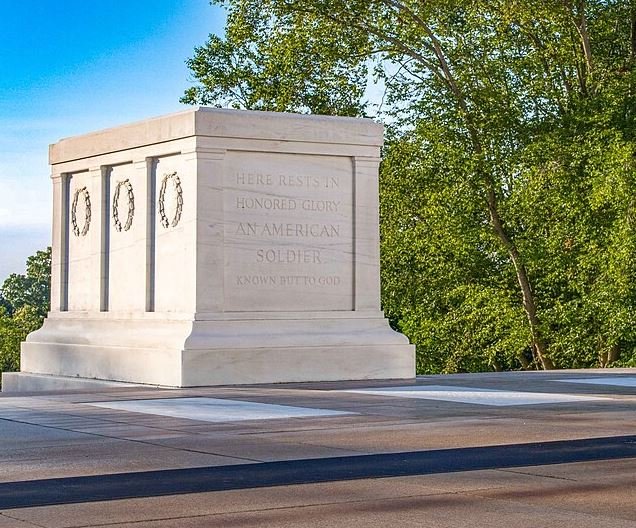
A close view of the Tomb of the Unknown Soldier.
The white marble sarcophagus that marks the tomb is one of America’s most revered symbols of military sacrifice. The tomb is guarded continuously by a soldier from the U.S. Army’s 3rd Infantry Regiment, “The Old Guard,” with the Changing of the Guard performed every hour (or half-hour during specific times of the year).
The Origins of the Tomb (1921)
On March 4, 1921, Congress approved the burial of an unidentified American soldier from World War I at the plaza of the newly constructed Memorial Amphitheater. This decision was made to pay tribute to the countless soldiers who gave their lives but whose identities were lost to history.
The World War I unknown soldier, whose remains were brought back from France, was interred on November 11, 1921. A temporary tomb was constructed at that time, comprising three tiers of marble and granite. At the heart of the tomb lay a rectangular opening where the unidentified remains were interred.
Development of the Permanent Tomb (1931)
Though the intent to build a permanent superstructure was clear from the start, it wasn’t until July 3, 1926, that Congress authorized funding to complete the tomb. The chosen design, by architect Lorimer Rich and sculptor Thomas Hudson Jones, featured a rectangular marble sarcophagus with neoclassical pilasters and symbolic carvings.
Quarrying the Yule marble required meticulous craftsmanship, involving a year-long effort in Colorado, Vermont, and Virginia. By September 1931, the marble blocks were assembled, and finishing touches were added under the direction of the Piccirilli Brothers, who had also worked on the Lincoln Memorial statue. The completed tomb was officially in place by April 9, 1932.
Symbolism and Inscription
The Tomb of the Unknown Soldier is adorned with carvings and symbols reflecting peace, victory, and valor. On the west panel, the words read:
HERE RESTS IN HONORED GLORY AN AMERICAN SOLDIER KNOWN BUT TO GOD.
The tomb features six carved wreaths symbolizing major World War I battles and three Greek figures representing Peace, Valor, and Victory. Its timeless symbolism extends to honor all U.S. soldiers who remain unidentified.
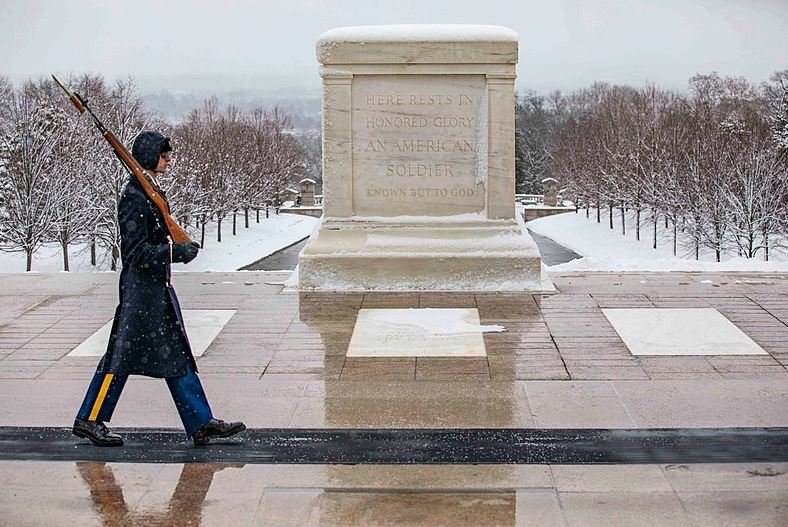
A 2021 photo of the Tomb.
Expansion to Honor World War II and Korean War Unknowns
In 1958, Congress approved the addition of unknown soldiers from World War II and the Korean War. The selection process involved painstaking efforts to ensure anonymity. Remains of unidentified servicemen from various theaters of World War II and Korea were brought to a central location.
Navy Hospital Corpsman William R. Charette, a Medal of Honor recipient, selected the World War II Unknown. Army Master Sergeant Ned Lyle performed a similar role for the Korean Unknown. On May 30, 1958, the remains of these two Unknowns were interred alongside their World War I predecessor. President Dwight D. Eisenhower presented each Unknown with the Medal of Honor during the ceremony.
The Vietnam Unknown and Its Identification
In 1984, the tomb expanded to include an Unknown from the Vietnam War. However, advances in DNA technology in the 1990s led to the positive identification of these remains as Air Force First Lieutenant Michael Blassie. Following this revelation, Blassie’s remains were returned to his family, and the Vietnam crypt was left empty. Today, its inscription reads:
Honoring and Keeping Faith with America’s Missing Servicemen 1958–1975.
The Role of the Tomb Guards
The Tomb of the Unknown Soldier has been guarded continuously since 1937 by the U.S. Army’s 3rd Infantry Regiment, “The Old Guard.” These Tomb Guards are meticulously trained and follow a strict regimen that involves memorizing cemetery details, mastering ceremonial drills, and maintaining impeccable uniforms. The guard’s routine involves:
- Marching 21 steps across the mat.
- Pausing for 21 seconds to face the tomb.
- Changing weapons to signify guarding the Unknown from potential threats.
The number 21 symbolizes the highest military honor: the 21-gun salute. Becoming a Tomb Guard is considered one of the Army’s most prestigious assignments.
Changing of the Guard Ceremony
The Changing of the Guard is a solemn ritual, performed hourly during winter and every half-hour during summer daylight hours. The Relief Commander oversees the transition, ensuring the new guard maintains the highest standard of discipline and respect. Visitors witnessing the ceremony are asked to remain silent and standing.
On notable occasions, such as the centennial of the Tomb in 2021, the public was allowed to lay flowers directly on the plaza—a rare privilege since 1925.
Maintenance and Preservation Efforts
The marble sarcophagus has endured wear and tear over the decades, with cracks and weathering becoming apparent as early as 1963. These imperfections prompted debates over whether the tomb should be repaired or replaced. Preservation efforts in 2009 successfully restored the structure, with further repairs completed in 2011. Despite minor flaws, the original marble remains, preserving the historical integrity of the monument.
International Recognition
The Tomb of the Unknown Soldier represents a global tradition of honoring unidentified war casualties. Similar monuments exist in England (Tomb of the Unknown Warrior), France, Canada, and other nations. In a gesture of solidarity, foreign nations have presented their highest awards to the Unknowns. For instance:
- The World War I Unknown was awarded the Victoria Cross by the United Kingdom.
- France honored the Unknown with the Legion of Honour and Croix de Guerre.
The reciprocity between nations underscores the shared sacrifices of soldiers across borders.
Significance of the Tomb
The Tomb of the Unknown Soldier is more than a burial site—it is a place of reverence, reflection, and national unity. It serves as a powerful reminder of the ultimate sacrifice made by countless soldiers whose names and stories remain unknown. Through ceremonies, guard rituals, and public observance, the tomb continues to inspire deep respect for the principles of service and duty.
Frequently Asked Questions
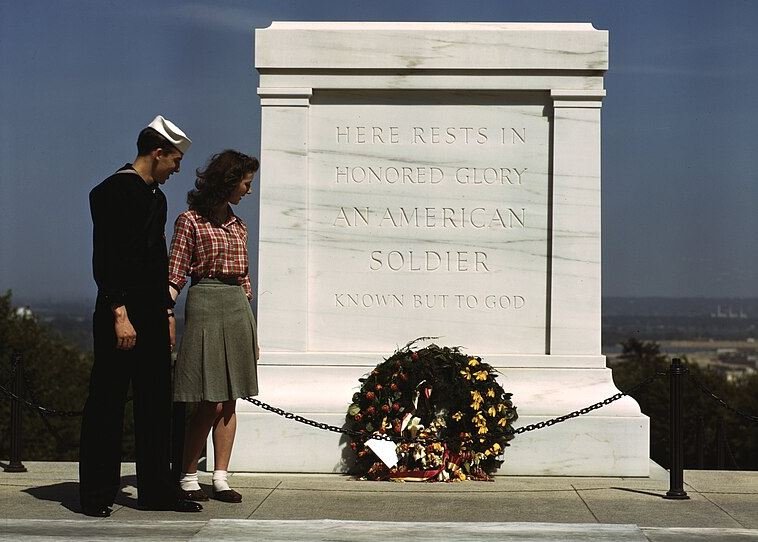
A 1943 photo of the Tomb.
Who designed and constructed the Tomb?
Architect Lorimer Rich and sculptor Thomas Hudson Jones designed the Tomb, completed in 1932 using marble from Colorado’s Yule Quarry.
What is the significance of the inscriptions and carvings?
The east panel depicts Peace, Victory, and Valor; the north and south panels include wreaths symbolizing major WWI battles; and the west panel reads, “Here rests in honored glory an American soldier known but to God.”
What is the Changing of the Guard?
A symbolic ceremony performed by the U.S. Army’s 3rd Infantry Regiment, it involves precise movements and occurs every 30 minutes to two hours, depending on the season and time of day.
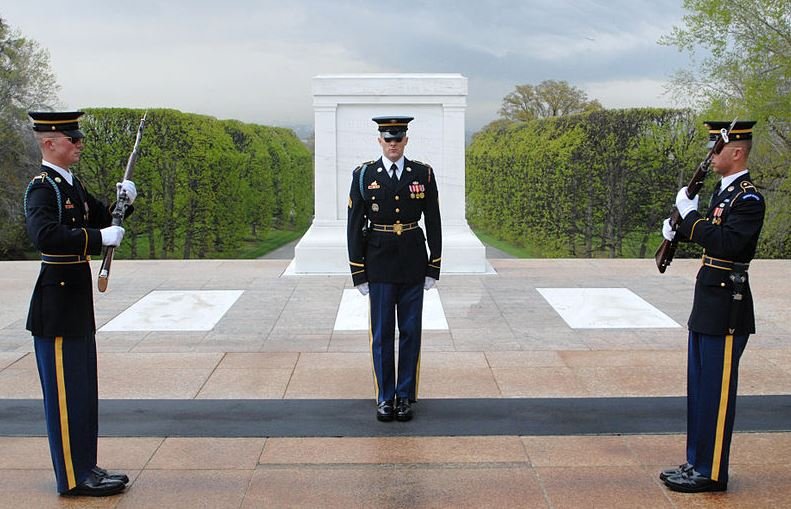
A photo of a “Changing of the Guard” event in 2005.
Who guards the Tomb?
The Tomb is guarded 24/7 by volunteer soldiers from the 3rd Infantry Regiment (“The Old Guard”). They undergo rigorous training to earn the prestigious Tomb Guard Identification Badge.