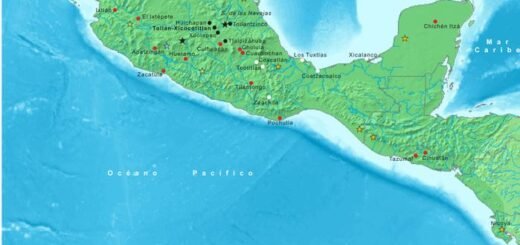
Tula: The Capital of the Toltec Empire
Tula, also known by its Otomi name Mämeni, is a Mesoamerican archaeological site of profound historical and cultural significance.
What was Tula’s significance in Mesoamerican history?
Serving as the capital of the Toltec Empire, Tula rose to prominence after the fall of Teotihuacan and before the rise of Tenochtitlan. Despite its importance, the site remains less studied than these other major centers, and debates persist regarding its political structure, influence, and interactions with other Mesoamerican cities like Chichen Itza. Situated in Tula de Allende, Hidalgo, northwest of Mexico City, the site features a museum, remains of earlier settlements, and a ceremonial center called Tula Grande.
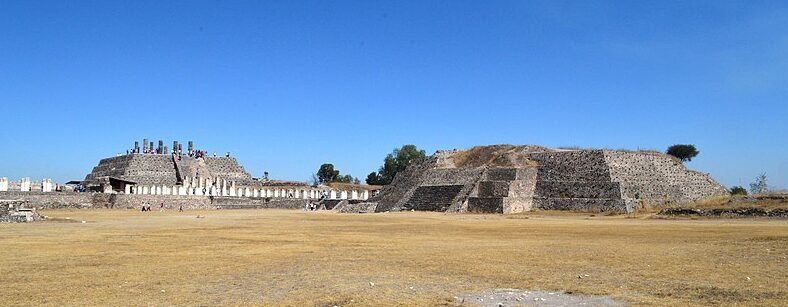
Tula archeological site.
Archaeological Features
Tula’s geography places it in the Tula River Valley at elevations between 2,000 and 2,200 meters above sea level. The site includes the ceremonial Tula Grande, the earlier Tula Chico, and orientation centers with artifacts and educational displays. The city’s ceremonial layout was strategically positioned on a limestone outcrop with steep natural defenses.
Key features of the site include:
- Pyramid B (Pyramid of Quetzalcoatl): A five-tiered structure capped by four 4-meter basalt warrior columns. These figures bear weapons, chest plates, and solar disks. The warrior statues on Tula’s temple pyramid are crowned by four 15-foot warrior statues, intricately adorned with Toltec-style ornaments, symbolizing their religious and militaristic culture.
- The Burnt Palace (Building C): Adjacent to Pyramid B, it contains evidence of fire damage and is surrounded by a serpent wall (Coatepantli), inspiring similar features in Aztec architecture.
- Ballcourts and Meeting Halls: Two Mesoamerican ballcourts and large halls with column-supported ceilings face a central plaza that could accommodate around 100,000 people.
These architectural advancements signal a shift in societal priorities, emphasizing public ceremonies and warrior dominance.
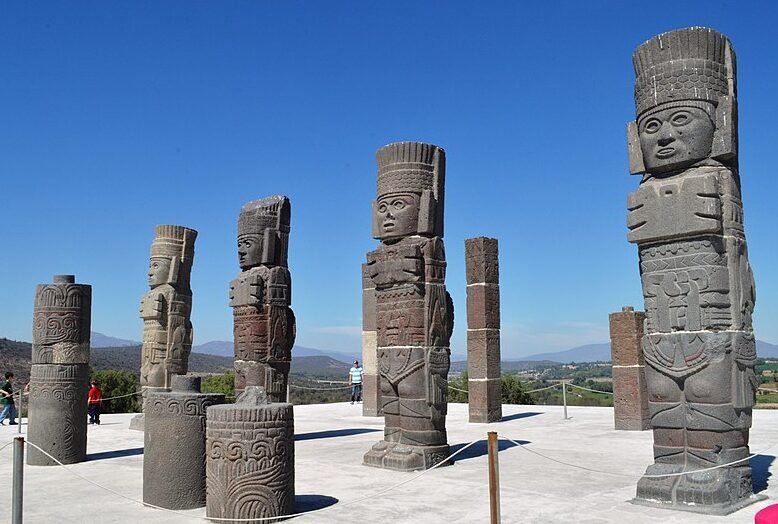
Tula’s art and carvings emphasize war and sacrifice. Common motifs include jaguars, coyotes, eagles consuming hearts, and serpents devouring skeletal figures. Image: Pyramid of Quetzalcoatl.
Historical Development
Tula’s earliest settlements date back to 400 BCE, likely influenced by Teotihuacan during the Epiclassic period. Tula Chico, smaller and less architecturally advanced, was the primary urban center from 650 to 900 CE. By 900, Tula Grande began to develop, marking the city’s peak.
Between 900 and 1150 CE, Tula flourished, covering more than 8 square kilometers (km²) with a population of about 55,000, plus an additional 20,000–25,000 in its hinterlands. Its economy relied on agriculture and obsidian mining. Long-distance trade networks brought ceramics from eastern Mesoamerica and Central America, indicating extensive cultural exchange.
Tula, the ancient Toltec capital, was a major cultural and religious center from around 900 to 1150 CE, influencing later Mesoamerican civilizations, particularly the Aztecs.
Tula’s decline began around 1000 CE, exacerbated by soil depletion, a drying climate, and incursions by the Chichimecas. By 1150, much of the city was abandoned. Its ceremonial center was burned, marking the city’s collapse by the 12th century. Despite its fall, Tula’s legacy influenced the Aztec Empire and other successor states.

Tula’s Influence and Mythology
Tula’s political sphere likely extended across modern Hidalgo, parts of the Valley of Mexico, and beyond. The site traded obsidian and other materials while influencing distant regions like the Yucatán, as evidenced by architectural similarities with Chichen Itza. The exact nature of this relationship—whether through trade or shared cultural ideologies—remains debated.
Today, Tula continues to attract visitors, offering insights into the Toltec civilization and its enduring legacy.
The feathered serpent deity Quetzalcoatl is closely linked to Tula. Mythological accounts describe the city’s downfall as tied to the betrayal of its ruler, Ce Acatl Topiltzin Quetzalcoatl, by the dark deity Tezcatlipoca. These stories, though heavily mythologized, reflect Tula’s cultural significance.
Did you know…?
In 1981, the Mexican government designated the archaeological site a national park, covering about 1 km².
Modern Significance
Despite its historical importance, Tula is less understood than sites like Teotihuacan or Tenochtitlan. Archaeological work from the 1950s to the 1970s confirmed its identity as Tollan, but many questions about its layout, political organization, and influence remain unanswered. A comprehensive map of the city has yet to be completed.
Frequently Asked Questions
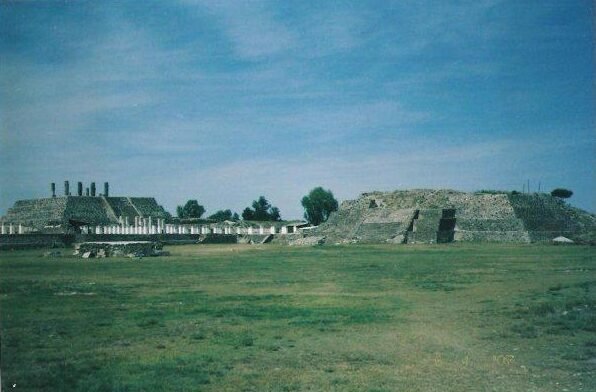
Tula served as the capital of the Toltec Empire between the fall of Teotihuacan and the rise of Tenochtitlan, exerting cultural and political influence over central Mexico and beyond. It played a pivotal role in the spread of the worship of Quetzalcoatl. Image: Remains of Tula de Allende.
What is the main architectural highlight of Tula?
The Pyramid of Quetzalcoatl (Pyramid B) is the primary attraction, featuring four 4-meter-tall basalt columns carved as Toltec warriors, which once supported the temple’s roof.
How does Tula compare to Teotihuacan and Tenochtitlan?
While smaller and less studied, Tula bridged the gap between these two iconic cities, influencing their successors, including the Aztec capital, in urban planning and cultural practices.
What themes dominate Tula’s art and architecture?
Tula’s main civic center includes a five-stepped temple pyramid dedicated to Quetzalcoatl, colonnaded halls, ball courts, and a palace complex. The pyramid is adorned with friezes depicting felines, birds of prey, and serpents.
What was the purpose of Tula’s palace complex?
The palace, separated from the main pyramid by a narrow alley, featured great halls with benches, thrones, and sunken light wells, likely serving as a residence and administrative center for Tula’s rulers.
What is the relationship between Tula and Chichén Itzá?
Though they could not have conquered each other, similarities in art and architecture suggest trade or cultural exchanges, linking central Mexico with the Yucatán Peninsula.
Why did Tula decline?
Around 1150 CE, environmental challenges, ethnic strife from Chichimeca migrations, and internal conflicts led to the city’s collapse, marked by the burning of its ceremonial center.
Religious Practices and Major Deities of Pre-Columbian Civilizations