What is the Eridu Genesis?
The Eridu Genesis, also known as the Sumerian Creation Myth, delves into humanity’s creation, the origins of kingship, the establishment of the first cities, and a global flood narrative. It is among the earliest recorded accounts of these foundational themes, influencing later Mesopotamian and biblical traditions. Related Sumerian texts, like the Debate Between Sheep and Grain and the Barton Cylinder, expand upon creation, while the myth connects to flood legends such as the Epic of Gilgamesh and Genesis.
Fragments and Discovery
The Eridu Genesis survives in three key fragments, each shedding light on the narrative. The primary tablet, discovered in 1893 at Nippur, dates to around 1600 BCE and was first identified by German Assyriologist Arno Poebel in 1912.
A second fragment, found in Ur, is from a similar period, while the third, a bilingual Sumerian-Akkadian version, hails from the Library of Ashurbanipal (circa 600 BCE). In 2018, a newly published fragment added further depth to the myth, although significant portions remain missing.
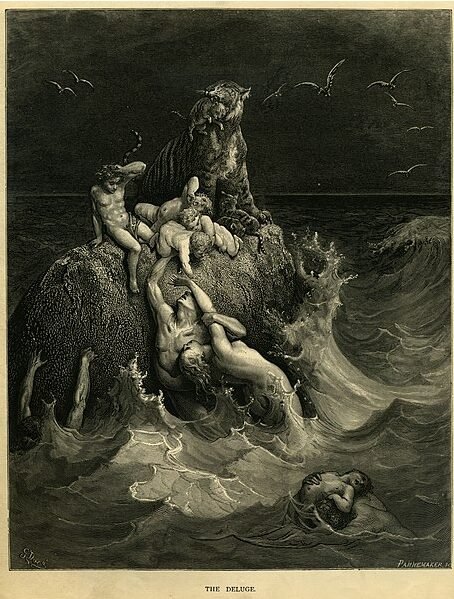
A depiction of flood myth from “The Deluge,” a frontispiece from Gustave Doré’s illustrated Bible edition.
Synopsis: Creation, Cities, and Flood
The surviving text begins after an initial section, likely detailing humanity’s creation and early nomadic existence, is lost. Nintur, the mother goddess, addresses humanity, urging them to establish cities and temples, signaling the transition to a sedentary, organized society. This moment heralds the naming of key early cities like Eridu, Badtibira, Larak, Sippar, and Shuruppak, each under divine patronage. These settlements operated on distributional economies rather than monetary systems. A subsequent lacuna suggests further cities and rulers were listed.
The narrative shifts to humanity’s disruption of the gods, particularly Enlil, who, unable to rest due to human noise, decrees their destruction via a flood. Enki, the god of wisdom and fresh waters, secretly warns Ziusudra, instructing him to construct a boat to save his family and representatives of all living creatures. Although details of the boat’s design are lost, the story resumes with the flood, a devastating seven-day storm. Afterward, Ziusudra offers sacrifices to the gods, who reward him with eternal life for preserving life on earth.
The Flood Myth: A Central Theme
The flood narrative in the Eridu Genesis mirrors other Mesopotamian myths, such as the Epic of Gilgamesh. Ziusudra’s survival and his act of sacrifice earn him immortality and a place in the divine realm. Interestingly, the Epic of Ziusudra introduces the idea of the hero dwelling in Dilmun (modern Bahrain), “the land where the sun rises,” differing from other accounts that describe his boat landing on mountains.
The flood’s depiction suggests localized events, such as severe river flooding in ancient Sumerian cities, including Shuruppak and Kish. Archaeological layers of riverine sediments, dated to around 2900 BCE, support the possibility of historical inspiration for this myth.

The Epic of Gilgamesh was narrated orally long before it was put in writing on clay tablets. | Image: Tablet V of the Epic of Gilgamesh
Cosmic and Civilizational Themes
The Eridu Genesis emphasizes the gods’ role in shaping human civilization. Kingship, framed as a divine institution, is central to organizing society and maintaining order. The myth aligns human progress—settlements, agriculture, and governance—with divine will, showcasing the intertwined nature of religion and daily life in Sumerian culture.
The flood, representing divine judgment, also reflects broader Mesopotamian themes of chaos and renewal. Humanity’s preservation through divine intervention highlights the precarious balance between mortal and divine realms.
Historical and Cultural Legacy
Modern interpretations of the Eridu Genesis suggest it encapsulates Sumerian views on societal origins, environmental catastrophes, and divine-human relationships. The flood story, in particular, resonates across cultures, from Mesopotamian epics to biblical narratives, underscoring its enduring influence. Scholars propose that the story might reflect historical memory of significant floods in the Euphrates-Tigris region, embedded within a framework of myth and religious symbolism.
Cylinder Seals in Ancient Mesopotamia: History and Significance
Questions and Answers
Where was the Eridu Genesis found?
The myth survives on three main fragments: one from Nippur, another from Ur, and a bilingual Sumerian-Akkadian fragment from Ashurbanipal’s Library in Nineveh.
What is the role of Nintur in the story?
Nintur, the mother goddess, calls upon humanity to abandon a nomadic lifestyle, build cities, and establish civilization under divine guidance.
Which cities are mentioned in the Eridu Genesis?
The text names Eridu, Badtibira, Larak, Sippar, and Shuruppak as some of the earliest cities created under divine patronage.

Remains of a ziggurat at Eridu
Why did the gods decide to send a flood?
The gods, particularly Enlil, were disturbed by the noise and activity of humans, prompting the decision to destroy humanity with a flood.
How does Enki assist humanity?
Enki, the god of wisdom, warns Ziusudra of the impending flood and instructs him to build a boat to save himself, his family, and animals.
What happens after the flood?
After the flood subsides, Ziusudra offers sacrifices to the gods, who grant him eternal life as a reward for preserving life.





