Who was the Arab-Roman Deity Elagabalus?
Elagabalus, also known as Aelagabalus or Heliogabalus, was an Arab-Roman deity whose worship originated in Emesa (modern Homs, Syria). The name derives from the Aramaic “ʾĕlāhgabāl” or Arabic “Ilah al-Jabal,” both meaning “God of the Mountain.” The deity was initially revered by the Emesan dynasty, a priestly family that served as its custodians. Roman coins and inscriptions consistently referred to this god as Elagabalus from AD 218 onward, coinciding with the rise of the Roman emperor who shared its name.
The Cult of Elagabalus in Emesa
The cult of Elagabalus was central to the religious identity of Emesa. A black conical meteorite, considered sacred, was housed in the temple at Emesa and symbolized the god. Elagabalus was seen as a “Ba’al,” or lord, preserving distinct Arab characteristics in its worship and representation. These included rituals that underscored the god’s connection to nature and the mountains.
The sun deity Elagabalus retained Arab characteristics in name and representation and was known as Ba’al (lord) in Emesa.
By the second century, the cult expanded beyond Syria. Dedications to Elagabalus were found as far afield as Woerden in the Netherlands, illustrating its reach within the Roman Empire. Despite the geographic spread, the deity retained its regional essence, appealing to both Roman and Greek adherents under the names Sol Invictus and Elagábalos, respectively.

A Roman aureus from Antioch (218–219 AD) depicts Emperor Elagabalus. The reverse honors the Sun God Elagabal with a golden chariot carrying Emesa’s sacred stone.
The Transition to Rome
Elagabalus gained prominence in Rome due to the young Emperor Elagabalus, originally a hereditary high priest of the deity at Emesa. Upon his ascension in 218 AD, he transported the sacred stone to Rome, integrating the god into Roman religious life. He merged Elagabalus with the Roman sun god Sol, creating the syncretic Sol Invictus, or “Unconquered Sun.”
The emperor erected the Elagabalium, a temple on the Palatine Hill, to enshrine the sacred stone. Herodian, a contemporary historian, described the meteorite as revered by the masses, with natural markings believed to represent the sun. This connection reinforced the god’s solar attributes, aligning it with existing Roman traditions.
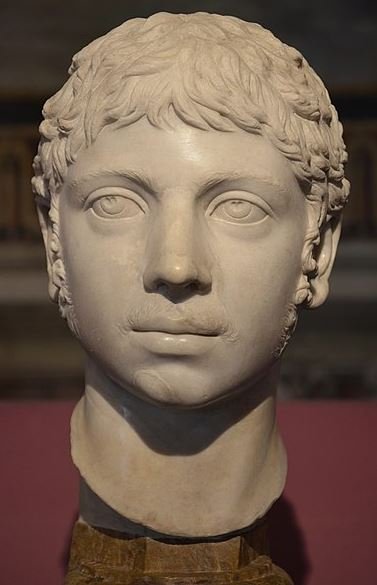
Marble bust of Roman Emperor Elagabalus at the Capitoline Museums in Rome.
Rituals and Celebrations
The religious practices associated with Elagabalus were elaborate and theatrical. Herodian recounted how the emperor himself performed rituals, including dancing around the altar to the beat of drums and cymbals. One of the most notable celebrations occurred during the summer solstice. This festival featured grand processions, public feasts, and the display of the sacred stone.
During the procession, the stone was carried in a chariot adorned with gold and jewels. The emperor ran backward before the chariot, symbolically guiding the deity through the streets. This act echoed elements of Babylonian Akitu festivals, suggesting cross-cultural influences in the Emesan cult.
Religious Reform and Controversy
As emperor, Elagabalus sought to elevate his deity above all others in the Roman pantheon. According to Cassius Dio, he attempted to unite Roman and Syrian religions under the supremacy of Elagabalus. This initiative included transferring sacred Roman relics, such as the Palladium and the fire of Vesta, to the Elagabalium.
The emperor also proposed marriages for his deity, selecting goddesses like Astarte, Minerva, or Urania as consorts. These actions alienated many Romans, as they disrupted traditional religious hierarchies. Furthermore, Elagabalus reportedly demanded that Jews, Samaritans, and Christians integrate their rites into his temple, aiming to make it a universal religious center.

Decline and Legacy
The emperor’s religious policies and personal conduct led to widespread dissatisfaction. After his assassination in 222 AD, his successor, Alexander Severus, reversed these changes. The cult of Elagabalus retreated to Emesa, where it resumed its localized significance.
Despite its decline, the cult’s brief prominence in Rome highlights the fluidity of religious practices within the empire. The syncretism exemplified by Elagabalus reflects broader trends of cultural exchange and adaptation in the Roman world.
Questions and Answers
What was the significance of Elagabalus in the Roman Empire?
The cult of Elagabalus spread across the Roman Empire in the 2nd century. The emperor Elagabalus, who was a hereditary high priest of the deity, introduced its worship to Rome. The god was assimilated with Sol, the Roman sun god, becoming known as Sol Invictus (“Unconquered Sun”).
What was the Elagabalium
The Elagabalium was a temple on the Palatine Hill in Rome, built to house the holy stone (a black conical meteorite) from the temple of Emesa. The meteorite was considered sacred and believed to bear markings resembling the sun.
What rituals were associated with the cult of Elagabalus in Rome?
The emperor held elaborate ceremonies, including a summer solstice festival with food distributions. The holy stone was paraded through Rome in a gold-adorned chariot drawn by white horses, with the emperor running backward before it. These practices resembled the Babylonian Akitu festival.

How did the emperor Elagabalus attempt to integrate religions?
Elagabalus tried to unite Roman and Syrian religions under his god, elevating Elagabalus above chief Roman god Jupiter (equivalent of Zeus in Greek mythology). He transferred sacred Roman relics to the Elagabalium and demanded Jews, Samaritans, and Christians incorporate their rites into his temple’s worship.
FACT CHECK: At World History Edu, we strive for utmost accuracy and objectivity. But if you come across something that doesn’t look right, don’t hesitate to leave a comment below.





