Who were the Bolsheviks? – Origin Story, Notable Leaders, & Dissolution
The Bolsheviks were a revolutionary political faction that emerged within the broader Russian socialist movement in the early 20th century. They became one of the most influential and transformative political forces in modern history, spearheading a revolution that dismantled the centuries-old Russian monarchy, fundamentally reshaped Russian society, and influenced socialist and communist movements across the globe.
Although they ultimately evolved into the ruling party of the Soviet Union and then dissolved in the late 20th century, the Bolsheviks’ legacy remains significant. Understanding who they were requires examining their origins, ideological distinctions, prominent leaders, key policies, and the circumstances that led to their rise and eventual transformation.

The Bolsheviks’ rise from a faction within the RSDLP to the ruling party of a global superpower was marked by ideological rigor, strategic adaptability, and a willingness to embrace controversial methods. Image: A 1920 meeting of the Bolshevik Party members.
Origin Story
The Bolsheviks originated as a faction of the Russian Social Democratic Labour Party (RSDLP), a Marxist political organization founded in the late 19th century. At that time, Russia was undergoing profound social and economic changes. Although it remained a largely agrarian and autocratic empire under the rule of the Romanov Tsars, industrialization had begun to change its social fabric.
The emergence of an urban working class, the growth of factories, and the spread of Marxist ideas created an environment fertile for political dissent and revolutionary thought. The RSDLP aimed to unite workers and intellectuals around the principles of Marxism, believing that a proletarian revolution could abolish class distinctions and usher in a socialist state. However, from the beginning, internal debates plagued the party, reflecting deeper theoretical and strategic disagreements about how best to achieve revolutionary change in a sprawling, economically diverse empire.
Factions: Lenin versus Martov
The split that gave birth to the Bolsheviks occurred at the RSDLP’s Second Party Congress in 1903. Here, Vladimir Ilyich Lenin, a dedicated revolutionary theorist and organizer, clashed with Julius Martov, another prominent Marxist intellectual, over the question of party membership.
Lenin insisted on creating a party composed of disciplined, professional revolutionaries fully committed to the cause. He argued that a tightly organized vanguard party—uncompromising and ideologically unified—was essential to guide the working class toward revolution.
Martov, in contrast, preferred a more inclusive model, one that would allow a broader base of sympathizers, activists, and supporters to participate with fewer restrictions. These seemingly procedural differences reflected deep ideological rifts.
Lenin believed an elite revolutionary core was needed to overcome both state repression and the disorganization that would inevitably result from a loose membership structure. Martov’s vision risked diluting the party’s revolutionary character, in Lenin’s view, by allowing elements insufficiently dedicated to the class struggle to steer it off course.
The faction led by Lenin came to be known as the Bolsheviks, derived from the Russian word bolshinstvo, meaning “majority,” because at one point in the congress they won a crucial vote. Conversely, Martov’s faction became known as the Mensheviks (from menshinstvo, “minority”).
Although these names were initially somewhat misleading—control and influence often shifted between the two factions—the labels stuck. The Bolsheviks soon distinguished themselves through their uncompromising tactics and their commitment to a disciplined, centralized party structure. They stood apart from the Mensheviks, who generally advocated a more gradual approach to revolution, closer cooperation with liberal opposition forces, and a less centralized organization.

Image: Vladimir Lenin.
Underground Newspapers and Other Works
In the years following the split, the Bolsheviks worked clandestinely within Russia and in exile. Under the harsh conditions of Tsarist repression, they produced underground newspapers, pamphlets, and revolutionary literature. They reached out to workers in the rapidly growing industrial centers, forging strong ties with the proletariat.
By 1905, a wave of revolutionary unrest, triggered by the catastrophic Russo-Japanese War and culminating in mass strikes and the creation of workers’ councils (soviets), gave both Bolsheviks and Mensheviks an opportunity to test their strategies. Although the 1905 Revolution ultimately failed to topple the monarchy, it showed the potential power of the working class and the viability of the soviet as a grassroots organ of self-government and revolutionary action. The Bolsheviks drew important lessons from this experience, refining their revolutionary tactics and deepening their conviction that a disciplined vanguard party could seize power under the right historical conditions.
Between 1905 and the outbreak of World War I in 1914, the Bolsheviks and Mensheviks continued to diverge, with various attempts at reconciliation ultimately failing. The outbreak of war created new fault lines: while many socialists across Europe supported their national governments in the conflict, Lenin and the Bolsheviks viewed the imperialist war as an opportunity to turn the conflict between rival capitalist nations into a class war against the ruling elites. They argued that workers should not kill each other on behalf of their oppressors but should instead unite to overthrow the exploitative systems at home. This stance set them further apart from moderate socialists and strengthened their reputation as uncompromising revolutionaries.
Notable Leaders
The Bolshevik movement was shaped by several key figures, each contributing unique skills and perspectives. Among them, Vladimir Lenin stands as the central architect of Bolshevik ideology. Lenin’s writings, strategic thinking, and leadership style were instrumental in defining the party’s direction. He combined a deep understanding of Marxist theory with a canny sense of political opportunity, flexibility, and pragmatism. Without Lenin’s intellectual rigor and unwavering commitment, the Bolsheviks might never have coalesced into a cohesive, formidable force.
Another critical figure was Leon Trotsky, who initially sided with the Mensheviks but moved closer to Lenin’s viewpoint over time. By the tumultuous year of 1917, Trotsky had joined the Bolsheviks and played a decisive role in planning and executing the October Revolution. A gifted orator, strategist, and organizer, Trotsky helped transform the Red Guards—armed Bolshevik militias—into the Red Army, ensuring the survival of the fledgling Soviet state during the brutal Civil War (1917–1922). His intellectual contributions and talents as a military leader made him second only to Lenin in the early Soviet hierarchy.
Joseph Stalin emerged as a central figure in the Bolshevik party later, especially after Lenin’s death in 1924. Initially serving in less glamorous roles—such as party secretary, a position he took in 1922—Stalin’s skill at managing party bureaucracy, building networks of loyal supporters, and controlling the internal apparatus allowed him to outmaneuver rivals for leadership. Though not as notable a theoretician as Lenin or Trotsky, Stalin’s influence grew as he consolidated power, particularly in the late 1920s. Under Stalin, the Bolshevik party evolved into the Communist Party of the Soviet Union, developing a political system characterized by centralized control, forced collectivization, rapid industrialization, and the ruthless suppression of dissent.

Image: Joseph Stalin
Other Bolshevik leaders also played significant roles. Figures like Grigory Zinoviev, Lev Kamenev, and Nikolai Bukharin were instrumental in party debates and policymaking. Zinoviev and Kamenev, close collaborators of Lenin, initially doubted the timing of the October uprising but later served key functions in the early Soviet regime. Bukharin, often regarded as one of the party’s leading theorists after Lenin, contributed to debates on the transition from capitalism to socialism, peasant policy, and the interpretation of Marxist doctrine in a largely agrarian country. The interplay of these leaders’ ideas, personalities, and alliances shaped the evolving character of the Bolshevik regime and the policies it pursued.
The Path to Power
The Bolsheviks remained a determined minority until the dramatic events of 1917. Two revolutions rocked Russia that year. The first, in February (March in the Gregorian calendar), toppled the Tsar and established a Provisional Government composed of liberals and moderate socialists.
Rather than satisfy the revolutionary aspirations of the masses, this government faltered under the pressures of continuing World War I, economic disarray, and demands for land redistribution. It promised elections for a Constituent Assembly and some liberal reforms, but it failed to address the most pressing desires of workers, soldiers, and peasants. Into this political vacuum stepped Lenin, who returned from exile in April 1917 with his “April Theses,” calling for “all power to the soviets” and an end to the Provisional Government’s half measures.
As the months passed, the Bolsheviks won increasing support among workers and soldiers frustrated by ongoing hardships. By October (November in the Gregorian calendar), the Bolsheviks had a majority in key soviets, notably in the capital, Petrograd (formerly St. Petersburg).
With Trotsky organizing the Red Guards, the Bolsheviks launched a nearly bloodless coup on October 25–26, seizing government buildings and arresting members of the Provisional Government. This event, often known as the October Revolution, placed the Bolsheviks at the helm of state power, creating the world’s first socialist government.
Early Policies and Civil War
Once in power, the Bolsheviks immediately issued decrees that resonated with the masses: they withdrew Russia from World War I through the Treaty of Brest-Litovsk in early 1918, nationalized key industries, and began redistributing land to peasants. They also asserted the principle of workers’ control in factories and moved toward establishing a planned economy. Yet their vision of a classless society did not materialize overnight, as the new state faced a bitter and protracted civil war against anti-Bolshevik (White) forces, foreign interventionists, and rival socialist groups.
During the Russian Civil War, the Bolsheviks implemented “War Communism,” a policy of centralizing economic control and requisitioning grain from peasants to feed cities and the Red Army. Although these measures helped them win the war, they also caused resentment and economic hardship, setting the stage for internal conflicts. By 1921, with victory secured, Lenin introduced the New Economic Policy (NEP), which temporarily rolled back some centralization and allowed limited private enterprise, hoping to revive an economy battered by years of war.
Throughout the 1920s, internal debates raged within the party over the pace of industrialization, the relationship with peasants, and the long-term strategy for building socialism in a predominantly agrarian country. Lenin’s death in 1924 left a leadership vacuum that Stalin adeptly filled, sidelining Trotsky and other rivals.
READ MORE: How Did Stalin Rise to Power?
Transformation Under Stalin and Beyond
Under Stalin, the Bolshevik legacy took on a drastically different character. Stalin rejected the more pluralistic and tolerant aspects of the early Soviet period, purging former allies, crushing dissent, and enforcing strict ideological conformity. The party engineered massive state-led industrialization programs that transformed the Soviet Union into a major industrial power within a decade. Simultaneously, the forced collectivization of agriculture and the Great Purges inflicted heavy human costs, causing famine, terror, and the elimination of large segments of the intelligentsia and old Bolshevik guard.
By the 1930s, the Bolshevik party, now the All-Union Communist Party (Bolsheviks), had consolidated a totalitarian regime that would play a decisive role in world affairs. The Soviet Union’s victory over Nazi Germany in World War II and its emergence as a global superpower during the Cold War era underscored the historical significance of the revolution the Bolsheviks had initiated in 1917.
However, this transformation came at the expense of the original Bolshevik ideals of workers’ self-emancipation and democratic participation. The democracy envisioned in soviets had largely vanished, replaced by a bureaucratic state apparatus. Lenin’s notion that the state would eventually “wither away” as socialism matured never materialized. Instead, under successive leaders, the Communist Party maintained a monopoly on power, with little room for genuine worker control or political pluralism.

The Long Decline and Dissolution
Over time, the achievements of the Soviet system—rapid industrialization, advances in education and science, improved literacy rates, and significant social welfare programs—were overshadowed by systemic inefficiencies, bureaucratic stagnation, corruption, and political repression. The Soviet leadership struggled to keep pace with the economic and technological advances of capitalist countries in the West. Attempts at reform, such as Nikita Khrushchev’s limited de-Stalinization or Mikhail Gorbachev’s policies of glasnost (openness) and perestroika (restructuring), revealed deep structural problems that could not be remedied without eroding the very foundations of the party’s centralized authority.
By the late 1980s, Gorbachev’s reforms unleashed forces the rigid system could not contain. Greater freedom of speech allowed the airing of long-suppressed grievances, and national tensions in the non-Russian republics threatened the Soviet Union’s integrity. As various republics declared independence, the power of the Communist Party—and by extension, the legacy of the Bolsheviks—rapidly waned.
In August 1991, a hardline coup attempt by Communist officials failed, further discrediting the party and accelerating the Soviet Union’s collapse. By the end of 1991, the USSR was formally dissolved, and the Communist Party that traced its lineage to the Bolsheviks was banned (at least temporarily) in Russia. The Bolshevik experiment, which had begun as a radical bid to overthrow autocracy and build a socialist utopia, ended in the dissolution of the Soviet state and the discrediting of its political model.
Legacy and Historical Significance
The Bolsheviks’ legacy is hotly debated. Their success in overthrowing the Romanov dynasty and withdrawing Russia from World War I reshaped global politics. The Soviet model they created inspired revolutionary movements worldwide, fueling anti-colonial struggles, the rise of communist parties in Asia and Europe, and the ideological battles of the Cold War.
On the other hand, critics argue that the authoritarian turn and the horrors of Stalinism betrayed the original revolutionary promise and sullied the ideals of socialism and communism. The brutality, famines, purges, and strict censorship that characterized much of the Soviet era remain a dark stain on the Bolshevik legacy.
In scholarly analysis, the Bolsheviks are recognized as a product of their time: a group of revolutionaries operating under the conditions of repression, war, and rapid social change. Their insistence on centralized leadership reflected both the political realities they faced—intense state suppression and the complexity of governing a vast, diverse empire—and their ideological conviction that a small, dedicated core of revolutionaries could serve as the engine of history.
The party’s evolution from a clandestine faction to the ruling force of a superpower highlights the fluid relationship between ideology and power. As they gained authority, new contradictions emerged between their stated goals of worker emancipation and their methods of top-down control.
The final dissolution of the Soviet Union in 1991 closed the Bolshevik chapter. Yet their story continues to inform debates on revolution, social change, and the viability of socialist alternatives. Historians, political scientists, and activists still wrestle with the questions that animated the Bolsheviks: Can a party speak for the working class? Is it possible to achieve true equality without centralized control? How can a revolutionary movement maintain both discipline and democracy? These and other inquiries ensure that the Bolsheviks’ legacy remains a reference point for anyone contemplating the meaning and potential of radical political transformations.
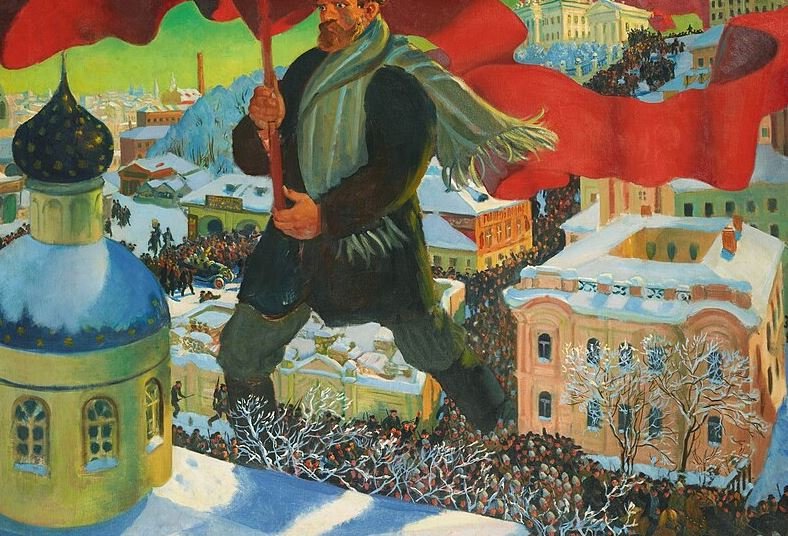
Image: A painting entitled “Bolshevik” by Russian artist Boris Kustodiev.
Frequently Asked Questions

What caused the split between the Bolsheviks and Mensheviks?
The split arose over disagreements about party membership and organization. Lenin wanted a disciplined core of activists, while Martov, leader of the Mensheviks, favored a broader membership base.

Image: Julius Martov
How did Lenin’s ideology shape the Bolsheviks?
Lenin’s belief in vanguardism and democratic centralism emphasized centralized leadership and strict adherence to Marxist principles. He argued for a professional revolutionary elite to guide the working class toward revolution.
What was the role of the Bolsheviks in the 1917 Russian Revolution?
The Bolsheviks led the October Revolution, overthrowing the Provisional Government. They gained support from workers, soldiers, and peasants by advocating for “all power to the soviets” and promising land redistribution and peace.
How did the Bolsheviks consolidate power after the October Revolution?
The Bolsheviks initially ruled with the Left Socialist-Revolutionaries but later centralized power, outlawing opposition parties. During the Civil War, they used policies like War Communism to maintain control and supply the Red Army.
What was the significance of the Russian Civil War for the Bolsheviks?
The Civil War (1917–1922) solidified Bolshevik power as they defeated anti-revolutionary forces and foreign interventionists. The victory allowed them to establish the Russian Soviet Federative Socialist Republic, later forming the USSR.
How did the Bolsheviks’ policies change under Lenin and Stalin?
Under Lenin, the New Economic Policy (NEP) allowed limited private enterprise to stabilize the economy. Under Stalin, the party shifted to rapid industrialization, collectivized agriculture, and centralized authoritarian rule.
What is the global legacy of the Bolsheviks?
The Bolsheviks inspired communist movements worldwide, providing a model for revolutionary action and governance. However, their authoritarian methods also became a symbol of repression in non-communist societies.





