Yungang Grottoes
The Yungang Grottoes are among the most significant Buddhist temple grottoes in China, located near Datong in Shanxi Province.
These caves, carved during the Northern Wei dynasty, represent a remarkable fusion of Buddhist art from Central Asia with traditional Chinese cultural elements.
Recognized as a UNESCO World Heritage Site, the Yungang Grottoes stand as an enduring testament to the spread of Buddhism into China and the artistic innovations of the period.

An aerial view of the Yungang Grottoes.
READ MORE: Most Famous UNESCO World Heritage Sites
Historical Background
Following the decline of the Western Jin dynasty, northern China fell under the rule of the Tuoba clan of the Northern Wei dynasty. The dynasty’s rulers embraced Buddhism, which had entered China via the Silk Road. The capital at the time, Pingcheng (modern-day Datong), became a major center for Buddhist art and culture. The grottoes were commissioned in the 5th century CE as part of an imperial initiative to promote Buddhism.
The first phase of construction began around 461 CE and continued until 465 CE, primarily focusing on caves 16 to 20. These initial carvings were executed under direct imperial patronage.
The second phase, from 471 CE to 494 CE, saw the creation of several twin caves (e.g., caves 5/6 and 7/8) and was characterized by increased intricacy in design. However, after the Northern Wei moved their capital to Luoyang in 494 CE, state support for the grottoes ended, leading to a final phase where private donors financed additional carvings until around 525 CE. The unrest in the region eventually brought the carving activities to a halt.
Architectural and Artistic Features
The Yungang Grottoes are an exceptional example of rock-cut architecture. They stretch across approximately 2,600 feet of sandstone cliffs, with the caves ranging between 30 and 60 feet in height. The site consists of 53 major caves, 1,100 minor caves, and around 51,000 Buddhist statues.
Each cave exhibits a unique combination of artistic styles. The earlier caves, such as caves 16 to 20, display strong influences from Indian Gandhara and Central Asian styles, with robust, full-bodied Buddha figures and elaborate drapery folds. As the artistic tradition evolved, later carvings incorporated distinctly Chinese elements, featuring serene facial expressions and more refined detailing.
A notable highlight is Cave 6, constructed between 465 and 494 CE under the patronage of Emperor Xiao Wen. This cave features a central stupa pillar extending from floor to ceiling, surrounded by elaborate carvings of standing Buddhas, Bodhisattvas, monks, and celestial figures. The upper walls are adorned with intricately painted and sculpted panels that depict Buddhist teachings and narratives.
READ MORE: 10 Greatest Emperors of China
Conservation Efforts and Challenges
The sandstone composition of the Yungang Grottoes makes them highly susceptible to natural weathering and environmental damage. Over the centuries, exposure to wind, rain, and temperature fluctuations has led to significant erosion. The proximity of Datong, an industrial city, has also introduced pollution-related degradation. Dust from nearby mines and highways further accelerates the decay of the sculptures.
Efforts to conserve the grottoes date back to the Liao dynasty, during which some restoration work was undertaken. Between 1049 and 1060, the “Ten Temples of Yungang” were built to shield the caves, but these structures were later destroyed by fire. During the Qing dynasty, wooden protective buildings were erected in front of caves 5 and 6, which still stand today.
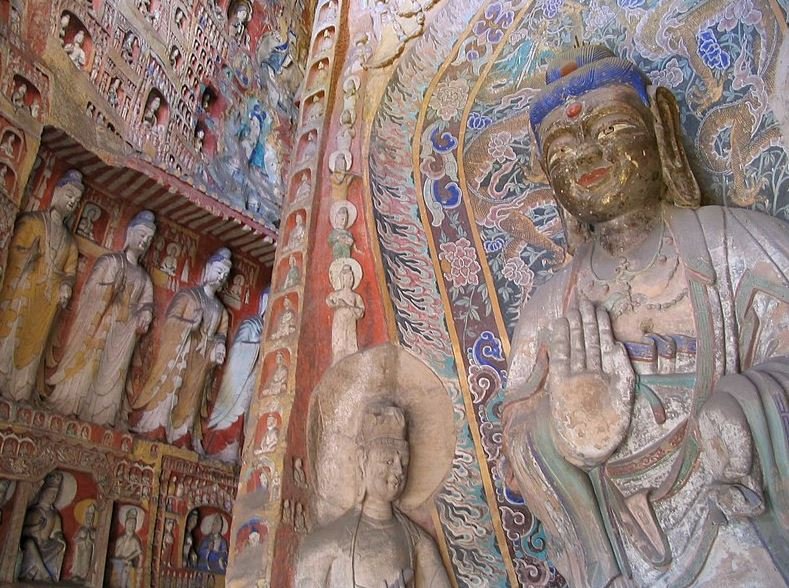
Side wall statue in Cave 11 of the Yungang Grottoes.
The Yungang Grottoes remain a monumental achievement in Buddhist art, showcasing the intricate blend of Indian, Central Asian, and Chinese artistic traditions.
Modern conservation initiatives began in the 1950s, including sealing cracks in the sandstone and afforestation projects aimed at reducing damage from sandstorms. In 1991, scientists conducted air quality studies at the site to assess pollution levels and implement protective measures. However, damage inflicted during China’s Cultural Revolution, including bullet marks and defacement by Red Guards, remains visible in certain sections of the grottoes.
What does the Yungang Grottoes have in common with the popular video game Black Myth: Wukong?
In recent years, the Yungang Grottoes have gained widespread recognition in modern media.
The site’s breathtaking carvings were prominently featured in the video game Black Myth: Wukong, which drew global attention to the region. Following the game’s release, tourism at Yungang surged dramatically, surpassing the visitor numbers of the Longmen and Mogao Grottoes within a few weeks.
Capitalizing on this newfound popularity, Shanxi’s tourism board incorporated stunning visuals of the grottoes in its 2024 promotional campaigns, leading to a significant boost in travel interest.
Cave Highlights
Cave 6: A Centerpiece of Yungang Artistry
Cave 6 is among the most elaborate grottoes, spanning approximately 1,000 square meters. It features a stupa-pillar design, a hallmark of early Buddhist cave architecture. The interior is entirely covered with carvings and painted murals. The walls are divided into two tiers, with the upper section showcasing standing Buddhas, Bodhisattvas, and monks. Though the cave has undergone multiple repainting efforts—some sources suggest up to twelve times—the original color schemes remain difficult to determine.
Cave 12: A Riot of Decoration
Cave 12 is renowned for its intricate carvings and lively depictions of musicians, celestial beings, and Buddhist deities. Created in the second phase of construction (after 465 CE), the cave illustrates the artistic transition from Central Asian influences to a more Chinese aesthetic. The presence of musicians playing traditional instruments such as the pipa and sheng reflects the cultural synthesis that defined the Northern Wei period.
Cave 20: The Iconic Buddha Statue
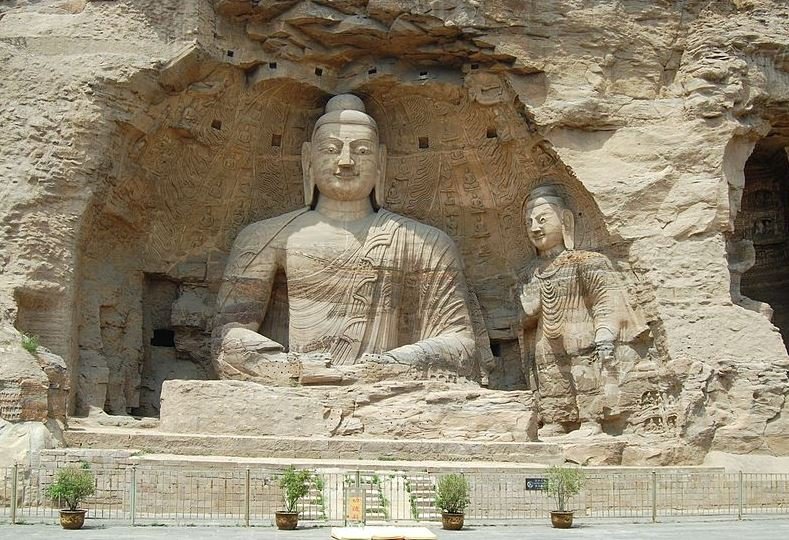
A close view of Cave 20 of the Yungang Grottoes.
One of the most famous sculptures at Yungang is housed in Cave 20—a colossal seated Buddha with a height of approximately 13.7 meters (45 feet). This statue, often regarded as the symbol of Yungang, represents Shakyamuni Buddha. Its facial features, calm demeanor, and slight smile embody the evolving Chinese interpretation of Buddhist imagery.
Frequently Asked Questions
When were the Yungang Grottoes constructed?
The grottoes were carved between 461 and 525 AD in three distinct phases, with early caves built under imperial patronage before the Northern Wei court moved to Luoyang in 494 AD.

A view of Caves 7 to 20 of the Yungang Grottoes.
How many caves and statues are in the Yungang Grottoes?
The site contains 53 major caves, approximately 1,100 minor caves, and around 51,000 niches housing Buddha statues.
What cultural influences shaped the Grottoes?
The grottoes reflect a fusion of Buddhist art from Central and South Asia with Chinese traditions, a result of Buddhism’s spread via the Silk Road.
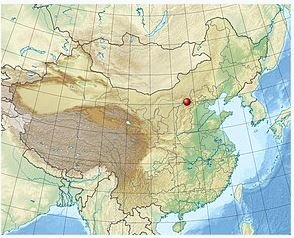
A map of China showing the location of Yungang Grottoes (in red)
What challenges threaten the preservation of the Yungang Grottoes?
The grottoes face deterioration from weathering, air pollution, mining activity, and sandstorms from the nearby Gobi Desert.
How has conservation been carried out at the Grottoes?
Restoration efforts have included sealing sandstone cracks, reforestation to reduce sandstorms, and pollutant monitoring. Some caves also underwent reconstruction in the Qing dynasty.
What is significant about Cave 6?
Cave 6, built between 465 and 494 AD, features intricate carvings and paintings, a central stupa pillar, and a two-story layout with depictions of Buddhas, Bodhisattvas, and celestial beings.