Alexander the Great’s Indian Campaign
Spanning between 327 and 325 BCE, the Indian campaign of Alexander the Great was a remarkable chapter in ancient history. It was marked by the Macedonian king’s audacious march into the Indian subcontinent.
After defeating the Achaemenid Persian Empire, Alexander extended his conquests to the northwestern regions of India, incorporating territories such as Gandhara and the Indus Valley (modern-day Punjab and Sindh in Pakistan) into his empire.
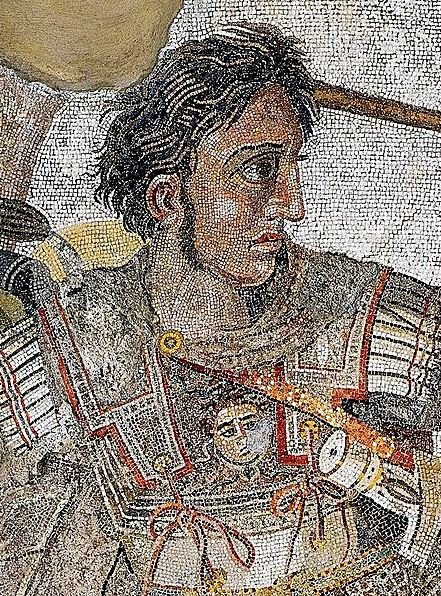
Mosaic of Alexander the Great.
This expedition not only pushed the boundaries of his dominion further than any preceding Western conqueror but also brought the Hellenistic and Indian worlds into contact, leaving a legacy of cultural exchange and conflict.
Conquest of the Indus Valley and Taxila
Alexander’s campaign began with the absorption of Gandhara, a region that had previously been a Persian satrapy. Among the prominent cities in this area was Taxila, an important center of learning and trade. Taxila’s ruler, Ambhi (known in Greek sources as Omphis), chose to submit peacefully to Alexander, providing his army with resources and logistical support. This alliance was strategic, as it allowed Alexander to establish a base for his operations and avoid resistance in a region known for its fortified cities and organized defenses.
The Battle of the Hydaspes (326 BCE)

“Battle of the Hydaspes” by French artist Charles Le Brun.
In Punjab, Alexander encountered one of his most formidable adversaries: King Porus (or Puru), ruler of the Paurava kingdom.
The two armies clashed near the Hydaspes River (modern Jhelum), a battle that tested the mettle of Alexander’s forces.
Porus’s army included war elephants, which posed a new challenge for the Macedonians. Despite this, Alexander’s superior tactics and use of cavalry secured his victory.
Impressed by Porus’s valor and leadership, Alexander reinstated him as a satrap, marking one of the rare instances where the Macedonian conqueror sought to integrate local rulers into his administration.
The Battle of the Hydaspes was costly for both sides and revealed the limits of Alexander’s campaign. Although victorious, his army suffered heavy losses, and the effort required to defeat Porus highlighted the growing exhaustion of his troops.
The Halt at the Hyphasis (Beas) River
After his victory over Porus, Alexander set his sights on the Nanda Empire in the Indo-Gangetic Plain. However, the vast Nanda army, reportedly several times larger than Alexander’s, loomed as a daunting challenge.
Furthermore, the Macedonian soldiers, weary from years of campaigning and wary of the immense scale of Indian warfare, mutinied at the Hyphasis River. They refused to march further east, compelling Alexander to abandon his plans for further conquest. Recognizing the need to preserve his army’s morale and strength, he reluctantly turned back, marking the easternmost point of his campaign.
Southern Punjab and Sindh Campaigns
As Alexander retreated, he directed his forces southward, traversing the regions of southern Punjab and Sindh along the Indus River. Along this route, he encountered several tribes and kingdoms, including the Malloi and the Oxydracae. The Mallian campaign was particularly grueling; during the siege of one of their fortresses, Alexander was severely wounded. Despite this, his army prevailed, demonstrating the resilience and determination of the Macedonian forces even in retreat.
Cultural and Socio-Political Observations
The Greek accounts of Alexander’s campaign provide a window into the socio-political and cultural conditions of the Indian subcontinent during the late 4th century BCE. The Indus Valley was a patchwork of small states and tribal societies, some of which were ruled by kings while others were organized around tribal affiliations. The Greek writers observed a vibrant urban economy based on agriculture and trade, with cities like Taxila serving as hubs of commerce and intellectual activity.
The Greeks also documented aspects of Indian society, such as the caste system and the role of the Brahmanas (priestly class), whom they referred to as “Brachmanes.” Naked ascetics, likely Jain or Ajivika monks, caught the attention of Alexander’s chroniclers, as did Indian philosophical traditions and medical practices. However, the Greeks made little mention of temples or religious idols, a contrast to their observations in other parts of Alexander’s empire.
Legacy of the Indian Campaign
Although Alexander did not conquer the entire subcontinent, his campaign had significant consequences for both the Hellenistic and Indian worlds. The Greek presence in India facilitated cultural exchanges, particularly in art, philosophy, and science. The establishment of cities like Alexandria Bucephalus (in honor of Alexander’s beloved horse) and the administrative framework left behind by Alexander’s satraps laid the groundwork for future interactions between the two regions.
The political vacuum left by Alexander’s departure and the subsequent death of his satraps in India paved the way for the rise of the Maurya Empire. Chandragupta Maurya, the founder of the Mauryan dynasty, would later unify much of the Indian subcontinent, capitalizing on the destabilization caused by Alexander’s campaign and the decline of his successors.
Challenges and Achievements
Alexander’s Indian campaign showcased both his military genius and the limitations of imperial ambition. His ability to adapt to new environments, such as the use of war elephants by Indian forces, underscored his tactical flexibility.
However, the campaign also revealed the logistical and psychological challenges of maintaining a prolonged military expedition far from home. The mutiny at the Hyphasis River highlighted the breaking point of even the most seasoned and loyal troops, underscoring the human cost of Alexander’s relentless drive for conquest.

The Return Journey
Alexander’s return to the west was marked by further hardship. He divided his forces, sending part of his army with Admiral Nearchus to explore the Persian Gulf while he led the rest through the Gedrosian Desert. This grueling journey tested the resilience of his troops, who endured extreme heat, thirst, and hunger. Despite these challenges, Alexander’s charisma and leadership helped maintain cohesion within his army.
Frequently Asked Questions

Why did Alexander invade India?
Alexander sought to extend his empire after conquering Persia, viewing the Indus Valley as a rightful extension of his Achaemenid conquests.
What was the significance of the Battle of Hydaspes?
The battle against King Porus in 326 BC was Alexander’s last major victory, showcasing his strategic brilliance but also highlighting the cost of his campaigns.
Why did Alexander’s army refuse to advance beyond the Hyphasis River?
Exhaustion, homesickness, and fear of facing the larger Nanda and Gangaridai armies led to the mutiny, forcing Alexander to turn back.
What role did local Indian rulers play during Alexander’s campaign?
Some, like Taxiles, allied with Alexander, while others, such as Porus and the Assakenoi, resisted fiercely.
How did the Greek accounts describe Indian society?
They noted the Brahmanas as philosophical teachers, described urban economies based on agriculture and trade, and highlighted practices like Sati and slavery.
What was the Siege of Aornos?
Aornos, a mountain fortress, was Alexander’s final major siege, marked by his strategic ingenuity and driven by his desire to outdo the mythical exploits of Heracles.
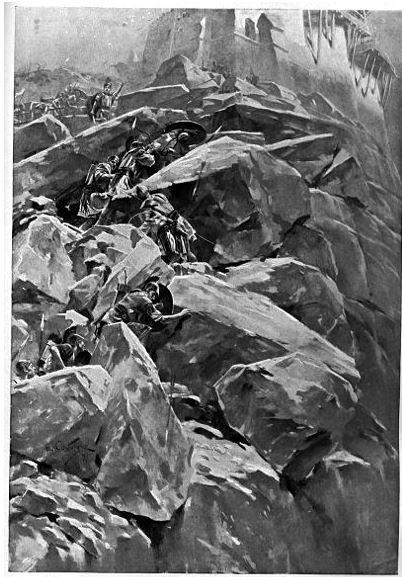
A 19th-century painting depicting the Siege of the Aornos.
What were the outcomes of Alexander’s Indian campaign?
He expanded his empire to include parts of the Indus Valley, but his failure to advance further east marked the limits of his conquests.
What happened to Alexander’s territories in India after his death?
They fell to the Maurya Empire under Chandragupta Maurya following the Seleucid–Mauryan War, marking the end of Macedonian influence in the region.





