Battle of Salamis (480 BCE)
The Battle of Salamis, fought in 480 BCE, stands as one of the most pivotal naval engagements in ancient history. Occurring during the second Persian invasion of Greece, this confrontation pitted a coalition of Greek city-states against the powerful Achaemenid Persian Empire. The result was a remarkable Greek victory that shifted the course of the Greco-Persian Wars and set the stage for the eventual ascendancy of classical Greek culture.
Despite being heavily outnumbered by the Persian fleet, the Greek allies managed to transform their perceived weaknesses into strategic advantages. By choosing where and when to fight, they exploited the terrain, outsmarted their opponent, and showcased tactical ingenuity. The outcome of Salamis highlighted the importance of leadership, cunning, and morale in determining the fate of entire civilizations.
READ MORE: Rulers of the Achaemenid Empire: From Cyrus the Great to Artaxerxes V
Historical Background
The origins of the conflict lay in Persian attempts to subjugate the fractious Greek world, partly in retaliation for prior Greek involvement in the Ionian Revolt and the surprising defeat of Persian forces at Marathon in 490 BCE. King Xerxes I (also known as Xerxes the Great), succeeding his father Darius I (also known as Darius the Great), sought to avenge these setbacks and bring all Greece under Persian control. To achieve this, Xerxes marshaled an immense force of infantry, cavalry, and warships.
After successfully bridging the Hellespont and advancing through Thrace and Macedon, Xerxes’s army encountered Greek resistance at Thermopylae in 480 BCE. While the Spartan-led defenders fought heroically, Persia eventually overcame their position. Concurrently, at the sea battle of Artemisium, the Greek fleet struggled to hold off the Persian navy. With Thermopylae lost and the enemy now advancing into mainland Greece, the Greeks regrouped for what would become a decisive turning point: the Battle of Salamis.

Image: A map showing key locations of the battle.
Strategic Context
The crucial question facing the Greeks was where and how to confront the Persian fleet. Many Greek allies urged withdrawal to the Isthmus of Corinth, hoping to defend the Peloponnese on land. Yet this would leave their fleet exposed in open seas, where the numerically superior Persians could encircle and overwhelm them. Moreover, allowing the Persians free rein at sea could enable amphibious landings behind Greek lines, crushing all resistance.
Themistocles, an Athenian general of considerable foresight, argued for a different strategy. He insisted on using the narrow straits of Salamis, a cramped waterway near Athens, to negate Persian numerical superiority. By forcing the battle into this confined channel, the Greeks aimed to limit the room for Persian maneuvers and concentrate on tight, disciplined engagements. This gamble would require convincing allies to stand their ground and also luring Xerxes into committing his massive fleet where its numbers would become a hindrance rather than an asset.
Allied Greek Forces and Themistocles
The Greek coalition at Salamis consisted of city-states that were often rivals in peace but had united against a common foe. Sparta, renowned for its land-based military strength, reluctantly accepted a subordinate role in naval matters. Athens, thanks to Themistocles’s vision, had built a large fleet of triremes in the years before the invasion. These ships were fast, agile, and capable of ramming enemy vessels, manned by crews who had grown increasingly confident.
Themistocles had played a leading role in convincing Athens to expand its navy after the discovery of silver mines at Laurion. Rather than distribute the newfound wealth, he persuaded the Athenians to invest in the construction of triremes. Without this naval buildup, Salamis would never have been possible. At Salamis itself, Themistocles’s cunning was on full display. He sent a deceptive message to Xerxes, claiming the Greeks were divided and planning to flee. Believing victory near, Xerxes hastened into the straits, falling into Themistocles’s carefully laid trap.
Persian Forces and Xerxes
The Persian Empire boasted an enormous fleet assembled from a variety of subject peoples: Phoenicians, Egyptians, Cilicians, Ionians, and others. While this diversity allowed the Persians to amass formidable numbers, it also created challenges in cohesion and unified command. Xerxes, eager for a swift and crushing victory, relied on these naval forces to support his land operations.
Xerxes’s confidence stemmed partly from his overwhelming numerical superiority. He had seen how Persian ground forces brushed aside Greek resistance at Thermopylae. With Athens evacuated and subsequently burned, he assumed the Greeks would soon submit. Yet Xerxes underestimated the resilience and cunning of his adversaries. The tight constraints of Salamis would undermine Persian advantages and reveal the vulnerability of a large, heterogeneous force in confined waters.

Image: Relief of Xerxes
The Battle Unfolds
On the morning of the battle, the Persian navy sailed into the Salamis straits, expecting to catch the Greeks retreating or in disarray. Instead, they found a well-ordered battle line waiting in the cramped passages. The Greeks initially backed their ships, feigning hesitation and drawing the Persians deeper into the channel. Suddenly, the Allied fleet surged forward, launching an aggressive counterattack.
Confined and struggling to maneuver effectively, the Persian warships collided with one another, hindering their ability to respond. Greek triremes, designed for ramming, slammed into Persian hulls, sending enemy vessels to the bottom. Marines on deck boarded crippled ships, turning portions of the battle into brutal close-combat fights. Amid the chaos, Persian leaders fell, morale crumbled, and the fleet broke apart. Xerxes, watching from a vantage point on shore, saw his once-mighty navy disintegrate into panic and confusion.
Aftermath and Consequences
In the immediate aftermath, Xerxes realized the situation had changed. His navy, vital for resupply and flanking operations, was now crippled. He worried that the Greeks might destroy the pontoon bridges over the Hellespont, trapping his army in Europe. Thus, he withdrew the bulk of his forces back to Asia, leaving behind a contingent under Mardonius to continue the campaign on land.
The following year, 479 BCE, the Allies achieved further victories. At Plataea, a Greek army led by the Spartans decisively defeated Mardonius, ending the Persian threat on land. Around the same time, at Mycale, an Allied fleet routed what remained of the Persian naval contingents. These twin triumphs ended the second Persian invasion and secured Greece’s freedom from foreign domination. Without the naval victory at Salamis, these later successes might have been unattainable.
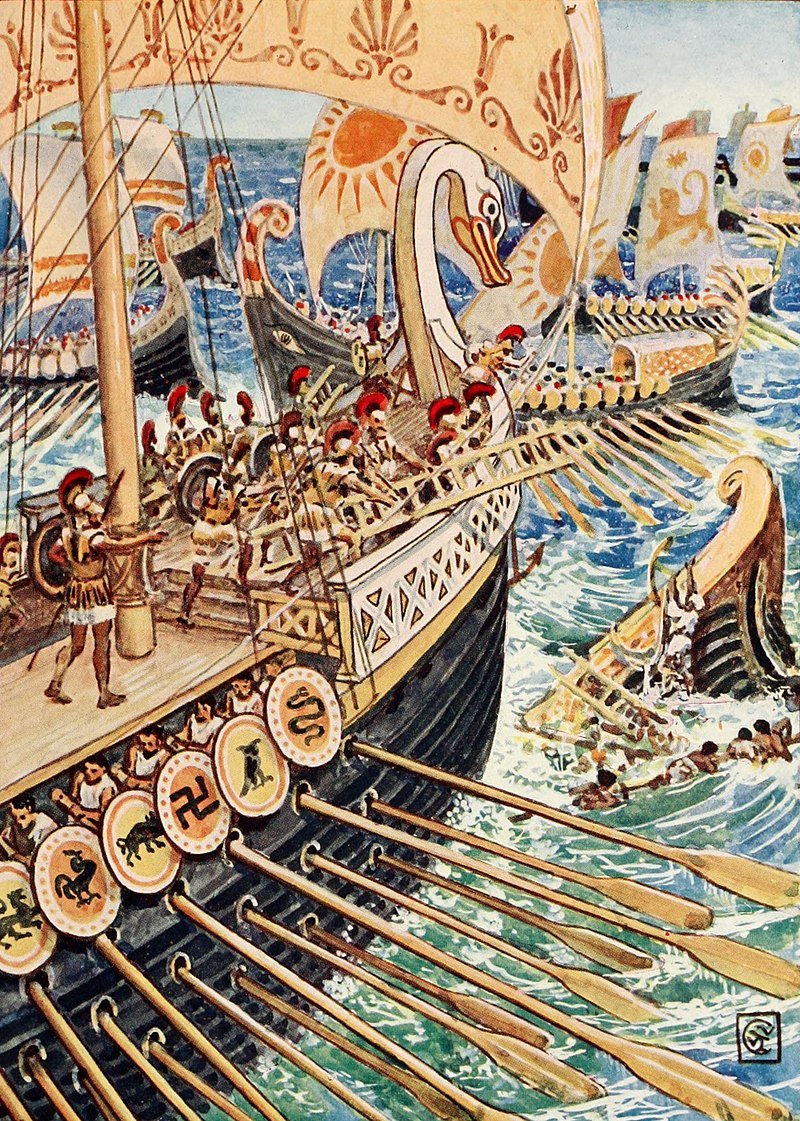
Image: A 19th-century illustration depicting the Battle of Salamis.
Significance and Legacy
The Battle of Salamis changed the trajectory of the Greco-Persian Wars. Had Persia triumphed, it is conceivable that Greek independence would have evaporated, radically altering the cultural and political development of the region. Instead, victory at Salamis safeguarded the nascent institutions of Athenian democracy, the freedoms of the Greek poleis, and the intellectual ferment that would characterize the classical era.
From a strategic perspective, Salamis demonstrates how terrain and tactical cunning can overcome raw numerical superiority. Themistocles’s insight—fighting in narrow waters—rendered the Persian advantage moot. Greek seamanship, combined with their willingness to hold a united front under extreme pressure, proved decisive. In military history, Salamis remains a prime example of the value of careful planning, intelligence, and the element of surprise.
Culturally, Salamis allowed Greece to preserve and foster a remarkable legacy. The ensuing period of relative stability enabled Athens to emerge as a cultural powerhouse. The city’s Golden Age saw the flourishing of drama, philosophy, architecture, and art. Figures like Aeschylus, Sophocles, and Euripides would produce plays still studied millennia later. Philosophers like Socrates, Plato, and Aristotle laid the intellectual foundations of Western thought. Much of this cultural richness hinged on the fact that the Greek world was never fully subjugated by Persia.
History and Major Facts about the Three Most Acclaimed Greek Tragedians
Politically, Salamis reinforced the value of cooperation among independent city-states when faced with existential threats. While internal rivalry would later resurface, the alliance forged against Persia set a powerful precedent. The message was that unity could safeguard autonomy and freedom, allowing a diverse and vibrant tapestry of polities to flourish rather than be subsumed into a vast empire.
The battle also highlighted the significance of naval power. At Salamis, sea control proved as crucial as success on land. Mastery of the waters around Greece would remain an enduring concern in the region’s geopolitics. Over the centuries, other powers would learn from these lessons, recognizing that naval strategy could shape the fate of entire nations. In the immediate wake of Salamis, the Greeks would push further offensively, eventually driving Persian influence out of the Aegean and securing their maritime frontier.
In terms of collective memory, Salamis became symbolic of Greek resilience and ingenuity. By overcoming overwhelming odds, the Allies forged a narrative of heroic struggle that inspired future generations. Commemorations of the victory at Salamis reinforced Greek identity, reminding people that valor, cleverness, and unity could triumph against seemingly unstoppable forces.
For modern historians, Salamis offers insight into the complexities of ancient warfare and diplomacy. The engagement underscores the interplay of leadership, intelligence, morale, and environment in shaping outcomes. Military might alone did not guarantee success: Xerxes had the numbers, but lacked the effective strategy to wield them in restricted waters. Themistocles’s resourcefulness and ability to anticipate Persian reactions proved decisive, showing how a single commander’s vision could tip the scales of history.

Frequently Asked Questions about the Battle of Salamis (480 BCE)
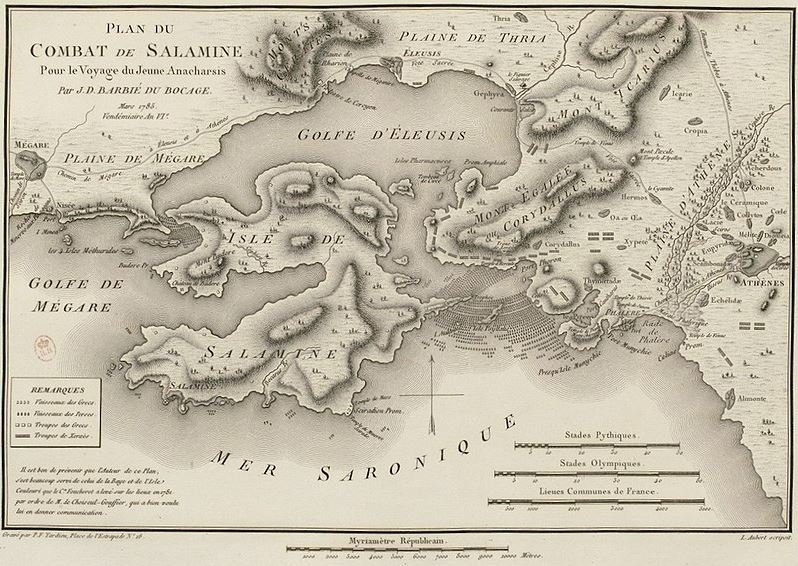
Image: An engraving depicting key regions during the Battle of Salamis.
When and where did the Battle of Salamis take place?
It was fought in 480 BCE in the narrow straits between the Greek mainland and the island of Salamis near Athens.
Who led the Greek coalition at Salamis?
Themistocles, an Athenian general, guided the Greek fleet, while Sparta and other city-states formed the alliance.
Which empire attempted to conquer Greece during this invasion?
The Achaemenid Persian Empire under King Xerxes I tried to subjugate the Greek city-states.
Why did the Greeks decide to fight in the confined waters of Salamis?
Themistocles believed that the narrow straits would neutralize Persia’s numerical advantage and prevent outflanking maneuvers.
How did Themistocles lure Xerxes into battle at Salamis?
He sent a deceptive message suggesting that the Greeks were in disarray and about to flee, tempting the Persians to rush into the straits.
What was the outcome of the battle for the Persian fleet?
The Persian fleet became disorganized in the cramped space, suffered heavy losses, and was forced to retreat.
How did the victory at Salamis affect the Persian invasion?
It halted the Persian advance, undermined Xerxes’s confidence, and eventually led to the Persian withdrawal and the failure of their invasion.
What larger impact did the Greek win at Salamis have on the war?
It was a turning point that set the stage for Greek victories at Plataea and Mycale, ending the immediate Persian threat.
How did the Greek success at Salamis influence their civilization afterward?
Freed from Persian domination, Greek culture, democracy, philosophy, and the arts flourished, shaping Western civilization’s future.





