The Death of Achilles
Achilles, the legendary Greek hero of the Trojan War, stands as one of the most enduring figures in Greek mythology. Renowned for his unmatched prowess in battle and his near invincibility, his death is a subject steeped in rich narratives and varying accounts across ancient sources. These stories not only highlight the complexities of Achilles’ character but also delve into themes of fate, mortality, heroism, and the interplay between humans and the divine.

Image: A polychromatic pottery painting from ancient Greece, dating to approximately 300 BC, depicting Achilles in the midst of the Trojan War.
Prophecy and Foreshadowing in the Iliad
From the outset, Achilles’ destiny is intertwined with prophecy. It was foretold that he would either live a long, uneventful life or die young with eternal glory. Choosing the path of glory, Achilles becomes the central figure in Homer‘s Iliad.
In Book 22, as Hector faces death at Achilles’ hands, he prophesies that Achilles will soon meet his own end. Hector declares that Paris and Apollo will slay Achilles at the Scaean Gates of Troy, foreshadowing the hero’s impending fate.
In Book 23, the theme of mortality is further emphasized when the spirit of Patroclus, Achilles’ closest companion, visits him in a dream. Patroclus implores Achilles to ensure that their bones are placed together after his own death, symbolizing their unbreakable bond. This poignant request not only underscores the depth of their friendship but also serves as an ominous reminder of Achilles’ own mortality. The golden vase mentioned—a cherished gift from his mother, Thetis—embodies both their camaraderie and the influence of the divine in mortal affairs.
Encounters with the Afterlife in the Odyssey
Homer’s Odyssey continues to explore Achilles’ fate beyond his death. In Book 11, Odysseus ventures into the underworld and encounters the shade of Achilles. When Odysseus greets him as “blessed in life, blessed in death,” Achilles responds with a haunting lament, expressing that he would rather be a servant to the lowest of men than rule over the dead. This exchange sheds light on Achilles’ reflections on glory and the afterlife, revealing a profound disillusionment with the heroic ideals he once embodied. However, his spirits lift when Odysseus recounts the heroic deeds of his son, Neoptolemus, during the Trojan War, providing Achilles with a sense of enduring legacy and pride.
In Book 24, King Agamemnon’s ghost offers a detailed account of Achilles’ death and the honors that followed. According to Agamemnon, Achilles’ bones were intermingled with those of Patroclus and placed in the golden vase, fulfilling Patroclus’ earlier request.
In contrast, the bones of Antilochus—another close companion who grew dear to Achilles after Patroclus’ death—were enclosed separately. The Greeks honored Achilles with traditional funeral games and erected a massive tomb on the Hellespont. This monument not only served as a tribute to the fallen hero but also acted as a navigational landmark for seafarers, ensuring that Achilles’ memory would endure through the ages.
Alternative Accounts: The Aethiopis and Beyond
Beyond Homer’s epics, other ancient sources offer differing perspectives on Achilles’ death. The Aethiopis, an epic poem attributed to Arctinus of Miletus (now lost but known through summaries), presents another version. In this account, Achilles continues his exploits until he is killed by Paris, assisted by Apollo. This narrative introduces the notion of Achilles being shot in his vulnerable heel—a detail that gained prominence in later retellings by Roman poets like Statius.
Furthermore, the Aethiopis depicts Achilles as living on after death on the island of Leuke at the mouth of the Danube River. This portrayal suggests a form of deification or eternal heroism, a common motif for illustrious figures in Greek mythology. On Leuke, Achilles is said to reside with other heroes, enjoying an immortal existence that transcends human limitations.
The Tragic Tale of Polyxena
An alternative narrative involves Achilles’ profound love for Polyxena, a Trojan princess. In this story, Achilles seeks to end the war through marriage and approaches King Priam to request her hand. Priam consents, seeing the potential for peace.
However, during a secret meeting at the temple of Apollo, Paris—Polyxena’s brother and the very catalyst of the war due to his abduction of Helen—ambushes Achilles. Paris shoots him with a divine arrow, often described as guided by Apollo, leading to Achilles’ demise. This account adds layers of personal betrayal and tragedy, highlighting the destructive consequences of love entangled with the horrors of war.
The Dispute Over Achilles’ Armor
Following his death, Achilles’ magnificent armor becomes the centerpiece of a bitter dispute between Odysseus and Ajax the Greater. Crafted by Hephaestus, the god of fire and metalworking, the armor is unparalleled in its beauty and strength. Both warriors believe themselves deserving of this legacy, each citing their own bravery and contributions to the Greek cause.
To settle the matter, the Greeks decide that the two should present their cases before a panel, often depicted as consisting of Trojan prisoners or Greek leaders. Odysseus, renowned for his eloquence and cunning, sways the judges in his favor and is awarded the armor. Ajax, feeling dishonored and betrayed, succumbs to intense rage and humiliation.
Athena, who favors Odysseus, inflicts madness upon Ajax. In his delusional state, he slaughters livestock, mistaking them for his fellow Greeks. Upon regaining his sanity and realizing his actions, Ajax is overcome with shame and ultimately takes his own life. This tragic outcome underscores the devastating effects of pride and the profound impact of Achilles’ legacy on his peers.

Achilles met his end when Paris of Troy shot an arrow that struck his heel, his sole vulnerable spot. The statue Dying Achilles (Achilleas Thniskon) stands in the gardens of the Achilleion, commemorating this moment.
Odysseus and Ajax in the Underworld
In the Odyssey, Odysseus later encounters the shade of Ajax in the underworld. Despite Odysseus’ attempts to reconcile, Ajax’s spirit remains silent and resentful, refusing any form of communication. This enduring grudge emphasizes the deep-seated notions of honor and pride among Greek heroes, persisting even beyond death. It reflects on the irreversible consequences of actions taken in life and the heavy weight of unresolved conflicts.
Symbolism in Achilles’ Weaponry
Achilles’ weapons are laden with symbolic significance. His shield, also forged by Hephaestus, is famed for its intricate designs depicting the cosmos and human civilization. Described in vivid detail in the Iliad, the shield represents a microcosm of the world, blending scenes of war and peace, agriculture and festivity. It serves as a testament to the interconnectedness of human experiences and the broader themes of existence.
His spear, known as the Pelian Spear, holds a special place in his legend. Gifted by his mentor Chiron—the wise centaur who tutored many Greek heroes—the spear was crafted from ash wood taken from Mount Pelion. It was said that no other warrior could wield it, highlighting Achilles’ unique status and unparalleled martial ability. The exclusivity of the spear symbolizes his destined role and the exceptional nature of his heroism.
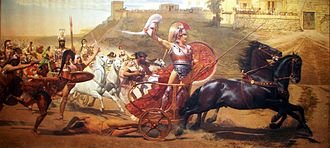
A fresco in the Achilleion, Corfu, depicts a victorious Achilles dragging Hector’s lifeless body through Troy.
Relics and Cultural Impact
Artifacts attributed to Achilles continued to fascinate the ancient world. A spear believed to be his was preserved in the temple of Athena on the acropolis of Phaselis in Lycia, a coastal region along the Pamphylian Gulf.
In 333 BC, Alexander the Great visited Phaselis during his campaign against the Persian Empire. Deeply inspired by Achilles, whom he regarded as a personal hero, Alexander carried a copy of the Iliad with him. While his biographers do not explicitly mention the spear at Phaselis, the existence of such relics underscores the enduring influence of Achilles’ story.
Centuries later, the geographer Pausanias noted the spear’s presence, indicating that these symbols of heroism remained significant in cultural memory.
Themes of Heroism, Mortality, and Legacy
The varied narratives of Achilles’ death encapsulate fundamental themes prevalent in Greek mythology. His stories explore the tension between fate and free will, the pursuit of glory versus the value of life, and the inevitable nature of mortality. Achilles embodies the archetype of the tragic hero—extraordinarily gifted yet bound by destiny, whose choices lead to both greatness and downfall.
The accounts of his death, whether through the treachery of Paris and Apollo or the tragic love story with Polyxena, highlight the vulnerability inherent even in the mightiest of heroes. They reflect on the idea that no one, regardless of strength or valor, can escape their destined end. Moreover, the repercussions of his death on characters like Ajax and Odysseus emphasize the interconnectedness of human actions and the lasting impact one individual’s fate can have on others.
Universal Themes in the Story
Achilles’ legacy extends beyond his martial achievements. His story resonates with universal human experiences—love, friendship, honor, pride, and the quest for meaning. The profound bond between Achilles and Patroclus illustrates the depths of companionship and loyalty. The tragic consequences stemming from disputes over his armor reveal the destructive potential of envy and rivalry.
His reflections in the underworld offer a sobering perspective on the pursuit of glory, suggesting that the accolades of heroism may pale in comparison to the simple joys of life. This sentiment adds a layer of philosophical contemplation to his character, inviting audiences to ponder the true value of fame and the costs associated with it.
Influence on Later Generations
Achilles’ influence permeated not only Greek culture but also left an indelible mark on subsequent generations. Figures like Alexander the Great drew inspiration from his legend, seeking to emulate his heroism and achieve comparable greatness. The continued reverence for Achilles in art, literature, and historical accounts underscores the timeless appeal of his narrative.
Artifacts like Achilles’ spear captivated the ancient world. Alexander the Great, identifying with Achilles, visited the temple of Athena in Phaselis where the spear was kept.
His story has been revisited and reinterpreted through the ages, from classical tragedies to modern adaptations. The themes encapsulated in his life and death remain relevant, speaking to the enduring human fascination with heroism, the complexities of the human condition, and the desire for one’s deeds to outlive oneself.
Conclusion
The death of Achilles in Greek mythology is a multifaceted tale that weaves together threads of prophecy, heroism, betrayal, and the inexorable nature of fate. Through various accounts, ancient storytellers explored the dimensions of his character, the consequences of his actions, and the profound impact he had on both his contemporaries and those who came after.
Achilles embodies the paradox of the hero who is both invincible and vulnerable, exalted yet ultimately mortal. His narratives invite reflection on the essence of glory, the value of life, and the legacies we leave behind. By examining the diverse stories surrounding his death, we gain insights into the cultural values of ancient Greece and the universal themes that continue to resonate in human consciousness.
Frequently Asked Questions

Image: Achilles caring for the injured Patroclus.
According to Homer’s Iliad, how is Achilles’ death foretold by Hector?
In Book 22 of the Iliad, as Hector lies dying at the hands of Achilles, he prophesies that Paris and Apollo will slay Achilles at the Scaean Gates of Troy.
How does the Roman poet Statius’s interpretation specify the manner of Achilles’ death?
Statius specifies that Achilles’ death comes from an arrow to his heel—the only vulnerable part of his otherwise invincible body.
What request does the spirit of Patroclus make to Achilles in Book 23 of the Iliad?
In Book 23, Patroclus’ spirit visits Achilles in a dream, imploring him to ensure that their bones are placed together in Achilles’ golden vase, a treasured gift from his mother, Thetis.
The golden vase symbolizes the profound bond between Achilles and Patroclus, as well as the intersection of mortal heroism and divine intervention.
In Homer’s Odyssey, how does Achilles’ shade respond to Odysseus when greeted as “blessed in life, blessed in death”?
Achilles responds poignantly that he would rather be a slave to the lowest of men than rule over the dead, highlighting his perspective on glory and mortality.
Achilles’ spirits lift when Odysseus recounts the heroic exploits of his son, Neoptolemus, during the Trojan War, providing him with a legacy that transcends his own life.
According to Book 24 of the Odyssey, how were Achilles’ and Patroclus’ remains handled after their deaths?
King Agamemnon recounts that Achilles’ bones were mixed with those of Patroclus and placed in the golden vase, while the bones of Antilochus were enclosed separately.
What purpose did the massive tomb on the Hellespont serve?
The tomb served as a tribute to Achilles and as a navigational landmark for seafarers, ensuring that his memory would endure.
How does the Aethiopis portray Achilles after his death?
The Aethiopis depicts Achilles as living on after death on the island of Leuke at the mouth of the Danube River, suggesting a form of deification or eternal heroism.
What causes the dispute over Achilles’ armor after his death?
Achilles’ magnificent armor becomes the center of a fierce dispute between Odysseus and Ajax the Greater, both claiming to be the bravest after Achilles and deserving of the armor.
How is the dispute over the armor resolved, and what are the consequences for Ajax?
Trojan prisoners judge Odysseus to be more deserving, awarding him the armor. Enraged and humiliated, Ajax is driven temporarily mad by a curse from Athena. In his delusion, he slaughters livestock, mistaking them for his comrades, and upon realizing his actions, he commits suicide out of shame.
Despite Odysseus’ attempts at reconciliation, Ajax’s spirit remains resentful and refuses to speak, highlighting the enduring weight of honor and pride among heroes.
What is significant about Achilles’ shield and spear?
Achilles’ shield, forged by Hephaestus, is renowned for its intricate designs depicting various aspects of the world and human life. His spear, the Pelian Spear, was a gift from his mentor Chiron and was said to be wielded by no other man, emphasizing his unique prowess and destiny.
What role does divine intervention play in the accounts of Achilles’ death?
Divine intervention is significant; Apollo guides Paris’ arrow in some accounts, and Hephaestus crafts Achilles’ armor and shield, symbolizing the gods’ direct influence on mortal affairs.
How does the story of Achilles’ death impact the characters who survive him?
His death leads to further tragedy, such as Ajax’s suicide, fuels disputes over his armor, and leaves a lasting legacy that shapes the actions and emotions of other heroes like Odysseus.





