The Uffizi Gallery in Florence, Italy
The Uffizi Gallery, or Galleria degli Uffizi, is one of the most prestigious and visited art museums in the world. Located in Florence, Italy, it is an architectural and artistic treasure trove that houses an extensive collection of Renaissance masterpieces. Established in the 16th century under the patronage of the Medici family, the gallery has grown to become a cornerstone of global art history. Today, it attracts millions of visitors annually who come to witness some of the most renowned works of Western civilization.
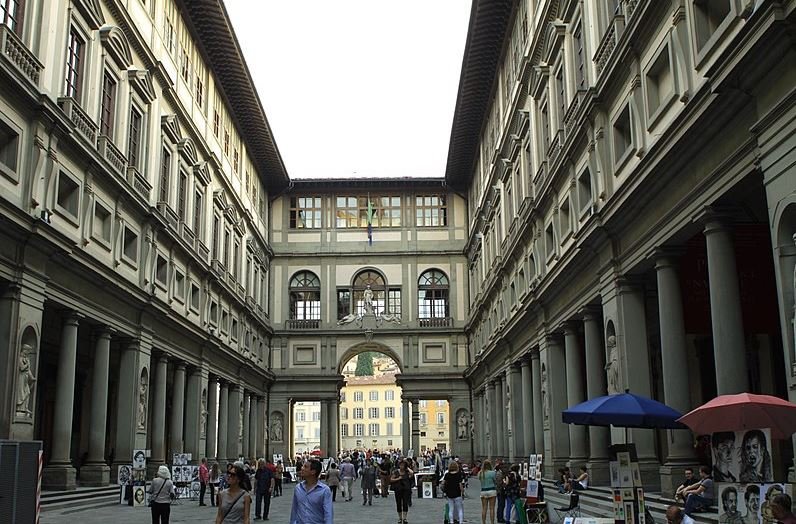
The narrow courtyard of the The Uffizi Gallery.
READ MORE: Top 10 Renaissance Artists and their Most Famous Masterpieces
Origins and Construction
The Uffizi Gallery’s origins trace back to the powerful Medici dynasty, which played a pivotal role in the cultural and economic development of Florence. Cosimo I de’ Medici, the first Grand Duke of Tuscany, commissioned Giorgio Vasari in 1560 to design a building that would house the administrative offices (uffizi) of Florence’s government. The structure was envisioned as a central hub for governance, consolidating various agencies and guilds under one roof.
The architectural design of the Uffizi was revolutionary. Vasari incorporated a long, narrow courtyard leading to the Arno River, creating a visually striking and organized streetscape. The project continued under architects Alfonso Parigi and Bernardo Buontalenti after Vasari’s death, with construction completed in 1581. The top floor was soon converted into a gallery, allowing members of the Medici family to display their extensive art collection in a private setting.
The Role of the Medici Family
The Medici family were not only political rulers but also some of the most significant patrons of the arts in Renaissance Italy. Grand Duke Francesco I de’ Medici expanded the function of the Uffizi by commissioning Buontalenti to design the Tribuna degli Uffizi in 1584. This octagonal room became an exclusive space to showcase the Medici’s most prized artistic treasures, including paintings, sculptures, and rare artifacts.
The Medici were crucial in assembling the Uffizi’s vast art collection. Anna Maria Luisa de’ Medici ensured its preservation in Florence through the Patto di Famiglia, preventing its removal from the city.
When the Medici lineage ended in the 18th century, Anna Maria Luisa de’ Medici ensured that the family’s extensive art collection remained in Florence. She negotiated the Patto di Famiglia (Family Pact), a legal agreement that prevented the artworks from being removed from the city. This decision solidified the Uffizi’s place as one of the earliest modern museums, ensuring that its masterpieces remained accessible to the public.
Expansion and Public Access
Although the Uffizi was open to visitors by special request as early as the 16th century, it officially became a public museum in 1769. The gallery was formally established in 1865, reinforcing its role as a national artistic institution. Over time, more rooms were dedicated to showcasing Renaissance masterpieces, expanding the museum’s influence and reputation.
Due to its growing collection and popularity, several artworks were transferred to other Florentine museums, such as the Bargello. However, the Uffizi remained the primary institution for Renaissance art, preserving key pieces by Botticelli, Michelangelo, Leonardo da Vinci, Raphael, and Caravaggio.
Architectural Significance
One of the defining features of the Uffizi is its cortile (internal courtyard), a long and narrow space open to the Arno River at one end. Vasari’s architectural innovation emphasized perspective, creating a seamless visual extension toward the river. The uniform facades, adorned with decorative cornices and classical elements, contribute to the building’s harmonious design.
During the 19th century, statues of famous artists were placed in niches along the courtyard’s colonnades, further enhancing the museum’s artistic ambiance. These statues pay tribute to Italy’s great masters, linking the physical structure of the Uffizi to the artistic heritage it preserves.

Renaissance Masterpieces
The Uffizi Gallery is home to an extraordinary collection of paintings and sculptures from the 13th to the 18th centuries. Some of its most iconic works include:
Early Renaissance Works
- Cimabue – Santa Trinita Maestà
- Duccio – Rucellai Madonna
- Giotto – Ognissanti Madonna
- Gentile da Fabriano – Adoration of the Magi
High Renaissance and Mannerist Paintings
- Sandro Botticelli – Primavera, The Birth of Venus, Adoration of the Magi (1475)
- Leonardo da Vinci – The Annunciation, Adoration of the Magi
- Michelangelo – The Holy Family (Doni Tondo)
- Raphael – Madonna of the Goldfinch, Portrait of Pope Leo X
- Titian – Flora, Venus of Urbino
- Parmigianino – Madonna with the Long Neck
- Caravaggio – Bacchus, Medusa, Sacrifice of Isaac
- Artemisia Gentileschi – Judith and Holofernes

Leonardo da Vinci’s “Annunciation”
In addition to paintings, the museum houses important classical sculptures, such as the Venus de’ Medici and The Wrestlers. These works demonstrate the Medici’s fascination with both ancient and contemporary artistry.
Modern Developments and Renovations
To accommodate its ever-growing collection and visitor numbers, the Uffizi has undergone several expansions and renovations. In 2006, the exhibition space was significantly enlarged, increasing from 6,000 to nearly 13,000 square meters. This expansion allowed many previously stored artworks to be put on display.
The Nuovi Uffizi (New Uffizi) project, launched in 1989, sought to modernize the museum’s infrastructure while preserving its historic integrity. Between 2015 and 2017, several galleries were renovated, incorporating updated lighting, climate control, and security measures. In 2018, a revised ticketing system was introduced to reduce the notoriously long waiting times for entry.
During the COVID-19 pandemic, the museum faced unprecedented closures, remaining shut for six months in 2020. Attendance dropped by about 70%, though the institution adapted by increasing its digital presence. Many works from the Uffizi’s collection became available online through platforms like Google Arts and Culture, allowing global audiences to engage with the museum virtually. The gallery reopened in May 2021 with additional exhibition rooms and a focus on diversifying its representation of artists.
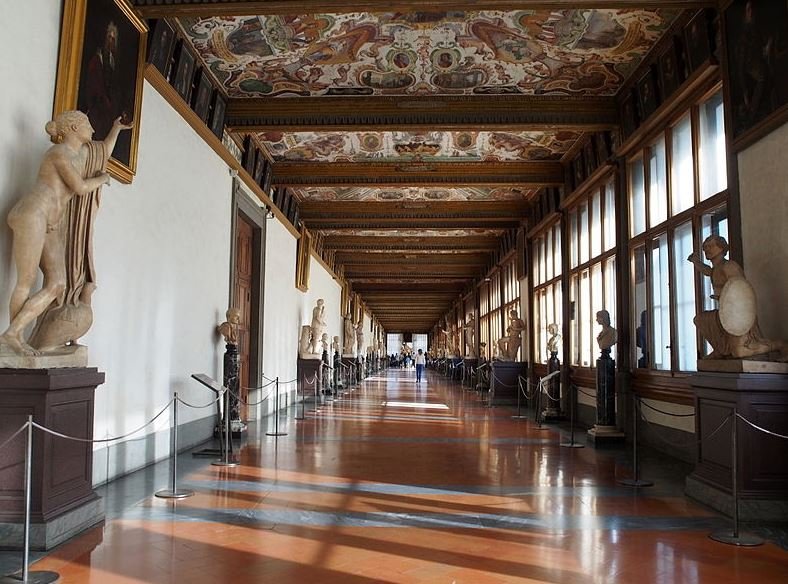
A 2014 photo of the museum’s hallway.
Notable Incidents
The Uffizi has faced challenges throughout its history, including acts of violence and protest.
1993 Car Bomb Attack
On May 27, 1993, a car bomb explosion near the museum, orchestrated by the Sicilian Mafia, caused extensive damage to parts of the building. Five people lost their lives, and several artworks were either destroyed or severely impacted. The Niobe Room, home to classical sculptures, was among the most affected areas. Despite this tragedy, extensive restoration efforts have preserved much of the Uffizi’s collection.
Climate Activist Protests
In recent years, climate activists have targeted the Uffizi to draw attention to environmental issues. On July 22, 2022, members of the group Ultima Generazione glued themselves to the protective glass covering Botticelli’s Primavera as part of a protest against fossil fuel consumption. Again, on February 13, 2024, activists attached images of flooding in Tuscany to the glass protecting Botticelli’s Birth of Venus in protest of climate change inaction. Thankfully, no damage was done to the artworks.
Cultural and Cinematic Influence
The Uffizi Gallery’s immense cultural impact extends beyond its physical location. It has been featured in numerous documentaries and films, including the 2021 production Inside the Uffizi, which explores the museum’s history and artistic legacy. Scholars, art historians, and tourists alike continue to regard the Uffizi as a fundamental institution in the study of Renaissance art.
10 Most Renowned Italian Renaissance Painters and their Masterpieces
Frequently Asked Questions
Who founded the Uffizi Gallery and for what purpose?
Cosimo I de’ Medici commissioned Giorgio Vasari in 1560 to design the Uffizi as government offices. Over time, it became a private gallery for the Medici art collection and was later opened to the public.
Which are the most famous artworks housed in the Uffizi?
Some of its most iconic pieces include Botticelli’s The Birth of Venus and Primavera, Leonardo da Vinci’s Annunciation, Michelangelo’s Doni Tondo, and Caravaggio’s Medusa.

A close view of the “Primavera”
How has the Uffizi evolved over time?
Initially a private collection, it officially opened to the public in 1769. The museum has undergone several expansions, with major renovations in recent years to modernize its facilities and increase exhibition space.
What challenges has the Uffizi faced?
The museum has endured threats such as the 1993 Mafia bombing, which damaged artworks, and climate protests targeting Botticelli’s paintings. However, restoration efforts have preserved its collection.





