How did Christianity become the dominant religion of the Roman Empire?
The reign of Emperor Constantine the Great (306–337 AD) was a transformative period in Roman history, marking the transition of Christianity from a persecuted faith to a dominant force within the empire. Scholars continue to debate the motivations behind Constantine’s support for Christianity and the nature of his own beliefs. His policies, including the Edict of Milan and support for the Church, laid the foundation for the Christianization of the Roman state.
Below, World History Edu explores the background, policies, and impact of Constantine’s religious transformation.
Christianity Before Constantine
Christianity faced intermittent persecution before Constantine’s reign. The first recorded state-sponsored persecution occurred in AD 64 under Emperor Nero, who blamed Christians for the Great Fire of Rome. Later emperors, such as Domitian and Trajan, also issued measures against Christians.
However, it was the Great Persecution under Diocletian (303–311) that was the most systematic and severe. Christians were arrested, executed, and subjected to forced apostasy. Despite this, Christianity continued to grow, particularly among the lower classes and in urban centers.
The persecution ended in 311 with an edict of toleration issued by Galerius. This decree permitted Christians to practice their faith but did not restore their confiscated properties. Constantine, then a caesar in the Western Roman Empire, played a role in this edict’s issuance. However, it was his subsequent policies that fundamentally altered Christianity’s status in the empire.
Constantine’s Conversion
Constantine’s personal conversion to Christianity remains a subject of debate. Some historians suggest that his mother, Helena, influenced his Christian leanings, while others argue that his conversion was a strategic move to unify the empire. Regardless, his decision to publicly embrace Christianity was a turning point in religious history.
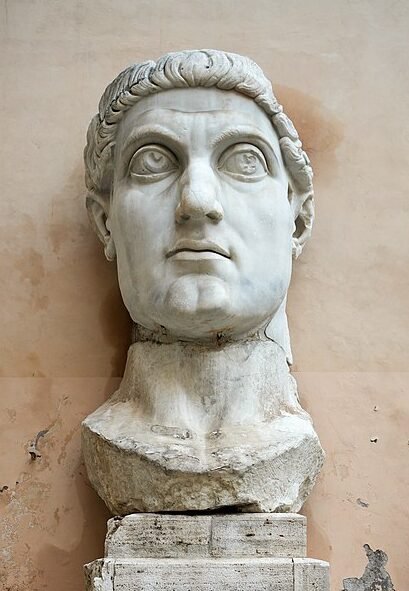
Head of the Colossus of Constantine at the Capitoline Museums in Rome, Italy.
Vision of Apollo
In 310, before his definitive conversion to Christianity, Constantine reportedly had a vision of Apollo promising him victory. This vision, described in a panegyric, may indicate that Constantine initially sought divine favor from multiple religious traditions before fully committing to Christianity.
The Battle of the Milvian Bridge
A crucial moment in Constantine’s transformation occurred in 312 during his campaign against Maxentius. According to Eusebius of Caesarea, Constantine saw a cross of light in the sky bearing the Greek inscription τούτῳ νίκα (“In this sign, conquer”). That night, he reportedly had a dream in which Christ instructed him to use the sign as a protective emblem in battle. The next day, Constantine’s forces, bearing the Chi-Rho symbol on their shields, triumphed over Maxentius. This victory reinforced his belief that the Christian God had granted him divine favor.

An illustration portraying the Battle of the Milvian Bridge.
The Edict of Milan (313 AD)
Following his victory, Constantine and his Eastern co-emperor Licinius issued the Edict of Milan in 313. This proclamation granted religious tolerance to Christians and restored confiscated church properties. Unlike previous toleration edicts, it marked a shift from merely allowing Christian worship to actively endorsing and protecting it. The edict also reaffirmed the importance of religious worship for the state’s well-being, reflecting Constantine’s broader religious policy.
Patronage of the Church
After 313, Constantine took on the role of protector and patron of Christianity. His support manifested in several ways:
Financial Support and Construction
Constantine granted funds for the construction of Christian churches, including the first St. Peter’s Basilica in Rome and the Church of the Holy Sepulchre in Jerusalem. He also provided financial incentives for clergy, including tax exemptions.

St. Peter’s Basilica, located in Vatican City, stands as the world’s largest Catholic church.
Favoritism Toward Christians
Christianity gradually became privileged under Constantine’s rule. Although he did not outlaw pagan practices, he promoted Christian officials within his administration. His policies favored Christian morality, such as restricting gladiatorial games and outlawing crucifixion. He also encouraged Sunday observance, aligning Christian worship with state regulations.
The Council of Nicaea (325 AD)
One of Constantine’s most significant religious interventions was convening the First Council of Nicaea in 325. The council aimed to resolve the Arian controversy, which questioned Christ’s divine nature. The Nicene Creed, formulated at the council, became a foundational statement of Christian orthodoxy. Constantine’s involvement demonstrated his commitment to Christian unity as a means of maintaining imperial stability.

An icon shows Emperor Constantine and First Council of Nicaea bishops (325) holding the 381 Creed.
The Establishment of Constantinople
Between 324 and 330, Constantine founded the city of Constantinople as the new imperial capital. Unlike Rome, which was deeply tied to traditional paganism, Constantinople was designed as a Christian city. The construction of churches within its walls reinforced its Christian character. The city soon became a stronghold of Christian political and theological influence.
Constantine’s Baptism and Death
Despite his lifelong support for Christianity, Constantine delayed his baptism until his final days in 337. This delay was common among converts who wished to minimize post-baptismal sins. He was baptized by Eusebius of Nicomedia, an Arian bishop, which has led some historians to question his theological leanings. Nonetheless, he was buried in the Church of the Holy Apostles in Constantinople, solidifying his legacy as a Christian emperor.
Without a shred of doubt, the Constantinian shift reshaped the religious landscape of Europe, influencing centuries of theological, political, and cultural developments.
Impact on the Roman Empire
Constantine’s policies had profound long-term effects on the Roman Empire and Christianity:
The State Church of the Roman Empire
Although Christianity was not yet the official state religion, Constantine’s policies set the stage for its dominance. In 380, Emperor Theodosius I issued the Edict of Thessalonica, making Nicene Christianity the empire’s official faith. This transformation began under Constantine, whose support allowed the church to grow in wealth, influence, and organization.
Though Constantine’s personal beliefs remain debated, his impact on Christian history is undeniable.
Suppression of Pagan Practices
While Constantine tolerated pagan practices, he gradually restricted them. He halted state funding for pagan temples and encouraged the conversion of temple sites into churches. Over time, this contributed to the decline of traditional Greco-Roman religious practices.
Theological and Political Precedents
Constantine established a model of imperial involvement in church affairs. Future Christian emperors followed his precedent by convening councils, enforcing doctrine, and using Christianity as a unifying state ideology. This integration of church and state had lasting consequences for both religious and secular governance in Europe.

Questions and Answers
What was the significance of Constantine’s reign for Christianity?
Constantine’s reign marked the transition of Christianity from a persecuted faith to a dominant religion in the Roman Empire. His policies, including the Edict of Milan and support for the Church, laid the foundation for Christianity’s expansion and influence.
How did Constantine convert to Christianity?
Constantine’s conversion is attributed to a vision before the Battle of the Milvian Bridge in 312, where he saw a cross in the sky with the message “In this sign, conquer.” He later adopted Christianity and promoted it throughout the empire.
What was the Edict of Milan, and why was it important?
The Edict of Milan, issued in 313 by Constantine and Licinius, granted religious tolerance to Christians and restored confiscated church property. It marked a shift from persecution to official support for Christianity.
How did Constantine support the Christian Church?
Constantine provided financial aid for church construction, granted privileges to Christian clergy, and promoted Christian officials in his administration. His patronage helped Christianity gain institutional strength.
What role did Constantine play in the Council of Nicaea?
In 325, Constantine convened the First Council of Nicaea to address the Arian controversy. The council established the Nicene Creed, which defined orthodox Christian beliefs and reinforced church unity.
Why did Constantine establish Constantinople?
Constantinople, founded between 324 and 330, served as a Christian imperial capital, free from Rome’s pagan traditions. The city became a major center of Christian political and religious influence.
Was Constantine baptized as a Christian?
Constantine delayed his baptism until his final days in 337, possibly to avoid post-baptismal sins. He was baptized by Eusebius of Nicomedia, an Arian bishop, raising questions about his theological stance.
How did Constantine’s policies impact the Roman Empire?
His policies set the stage for Christianity’s dominance, weakened pagan institutions, and established the precedent for imperial involvement in church affairs, shaping both religious and political history.





