Kamose: Ruler of the Theban Seventeenth Dynasty
Kamose was the final ruler of the Theban Seventeenth Dynasty at the end of the Second Intermediate Period. His reign, often estimated at three years but sometimes extended to five by modern scholars, was significant for his military campaigns against the Hyksos, the foreign rulers of Lower Egypt. He was likely the son of Seqenenre Tao and Ahhotep I and the brother of Ahmose I, the founder of the Eighteenth Dynasty. Kamose sought to expel the Hyksos and reclaim full Egyptian sovereignty, continuing the struggle initiated by his father. His efforts laid the groundwork for the ultimate victory achieved by his brother, Ahmose I, who established the New Kingdom.

Kamose
Kamose is best known as the last pharaoh of the Seventeenth Dynasty.
The Political Landscape
Before Kamose’s reign, the Theban rulers had maintained a fragile peace with the Hyksos, who controlled Lower Egypt. The Seventeenth Dynasty held authority over Upper Egypt as far north as Cusae, but this was not a complete rule over the country. The Hyksos presence was well established in Avaris, and they had influence over the Nile Delta. Despite occasional conflicts, Thebes had reached an accommodation with them, which included economic agreements such as transit and pasturage rights.
The Catalyst for War
Kamose rejected this status quo and sought to unify Egypt under native rule. The Theban elite, however, were cautious, fearing that war would disrupt stability.
According to the Carnarvon Tablet, Kamose’s council advised against engaging the Hyksos, arguing that Thebes was secure and benefiting from existing arrangements.
However, Kamose dismissed these concerns, declaring that Egypt should not be divided among foreigners. He framed his campaign as a mission to restore Egyptian pride and eliminate foreign rule.

The Northern Campaign
In his third year, Kamose launched his offensive against the Hyksos. He sailed north along the Nile, engaging enemy strongholds. His forces first attacked Nefrusy, a key town just north of Cusae, which was controlled by an Egyptian garrison loyal to the Hyksos. Kamose’s Medjay troops swiftly overran the defenses, securing the region.
His strategy involved isolating major Hyksos-controlled cities by capturing surrounding settlements. This tactic allowed him to advance rapidly without facing overwhelming resistance. While the historical records break off at this point, it is likely that he continued his campaign toward Avaris, the Hyksos capital. However, it remains uncertain whether he directly attacked Avaris or simply weakened its influence by capturing nearby territories.

The Tomb of Kamose, Housed in the Egyptian Museum, Cairo.
The Capture of the Hyksos Messenger
During the campaign, Kamose’s troops intercepted a Hyksos courier carrying a message from King Apophis of Avaris to the ruler of Kush. The letter requested military support against Kamose, highlighting the impact his offensive had on the Hyksos. Recognizing the threat posed by an alliance between the Hyksos and the Kushites, Kamose swiftly acted to neutralize this danger. He ordered an attack on the Bahariya Oasis to disrupt the overland trade routes and prevent reinforcements from reaching Avaris.
Extent of Kamose’s Conquests
Although Kamose claimed to have reached Avaris, scholars debate the extent of his advance. His second stela, found in Thebes, does not explicitly state that he attacked Avaris itself but rather that he targeted “anything belonging to Avaris.” Some historians, such as Kim Ryholt, argue that Kamose’s campaign likely halted near the Cynopolite Nome (modern Faiyum), rather than reaching Lower Egypt. The intercepted letter, which Kamose later returned to Apophis in Atfih (south of Avaris), suggests that the Hyksos had been pushed back significantly but still retained their stronghold in the Delta.
The Nubian Campaign
Kamose also fought against the Kushites, who were traditional allies of the Hyksos. The intercepted letter indicated that he had previously launched an attack on Nubian territory, prompting Apophis to seek their aid. This campaign likely took place before his third regnal year, implying that Kamose was engaged in simultaneous conflicts on multiple fronts. His southern offensive sought to weaken Kushite influence and prevent a two-front war against Thebes.
Kamose’s campaigns in both the north and south helped consolidate Theban power, leading to the establishment of the New Kingdom.
The Duration of Kamose’s Reign
Although only his third regnal year is securely attested, evidence suggests Kamose ruled longer. Two inscriptions from Arminna and Toshka, located in Nubia, bear the names of Kamose and Ahmose I side by side. These inscriptions indicate that they were co-rulers for a period. Since Ahmose was not mentioned in Kamose’s Year 3 stelae, this coregency likely began afterward, implying that Kamose ruled for at least four or five years.
Kamose’s campaigns extended beyond his third year, particularly against the Kushites. Some scholars believe his second Nubian campaign targeted Buhen, a major fortress, which showed signs of destruction and deliberate erasure of Kamose’s inscriptions. This suggests that his forces had to retake lost territory before Ahmose could fully secure the south.
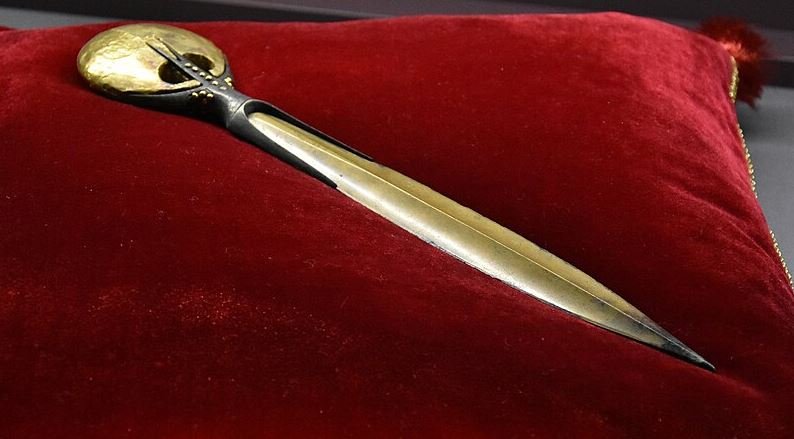
Dagger of Kamose at the Royal Library of Brussels in Belgium.
Kamose’s Burial and Legacy
Kamose’s sudden death remains a mystery. Unlike later pharaohs, he was buried modestly in a simple wooden coffin lacking the traditional royal uraeus. This suggests he may have died unexpectedly, possibly in battle. His tomb was located at Dra’ Abu el-Naga’ but was looted in antiquity. Artifacts from his burial, including a gold and silver dagger and a pectoral inscribed with Ahmose’s name, were found scattered in various locations, indicating that his grave was disturbed long after his reign.
His efforts against the Hyksos and Kushites paved the way for his brother, Ahmose I, to complete the expulsion of the Hyksos and reunify Egypt. Ahmose’s conquests marked the beginning of the Eighteenth Dynasty and the New Kingdom, ushering in Egypt’s golden age of imperial expansion and prosperity.
Kamose’s Stelae and Records
Kamose erected two stelae in Thebes that detail his military exploits. These inscriptions were later copied into the Carnarvon Tablet, a key source for understanding his reign. The first stela describes his rejection of the Theban council’s advice against war and his attack on Nefrusy. The second stela narrates his capture of the Hyksos messenger and his victories in Middle Egypt.
Despite limited records, his legacy as a warrior-pharaoh who fought to restore Egyptian sovereignty remains undeniable.
In addition to these, other inscriptions bearing Kamose’s name have been found in Karnak and Armant, reinforcing his military achievements. A recently discovered inscription from 2008 provides further details about his campaigns, adding to the growing body of evidence about his reign.
Frequently Asked Questions
What was Kamose’s main military goal?
He sought to reclaim Lower Egypt from the Hyksos and unify Egypt, continuing the conflict initiated by his father, Seqenenre Tao.
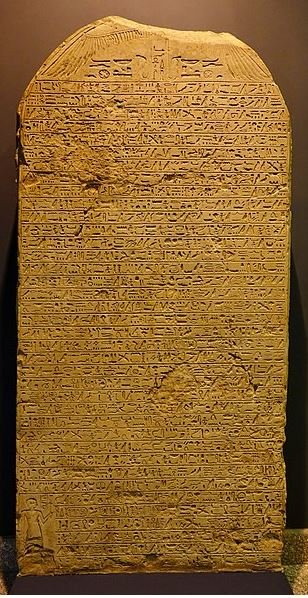
Kamose’s second stela which records his victory against the Hyksos.
Why did Kamose’s courtiers oppose war with the Hyksos?
They had established peaceful coexistence with the Hyksos, allowing trade and pasturage rights in Lower Egypt, making war seem unnecessary.
What evidence exists of Kamose’s campaigns?
His victory stelae and the Carnarvon Tablet describe his northern campaign, including the capture of a Hyksos messenger seeking Kushite aid.

Did Kamose attack Avaris?
There is no direct evidence he reached Avaris; his campaign likely stopped at the Cynopolite nome, limiting Hyksos influence.
Did Kamose fight the Kushites?
Yes, he waged campaigns against Nubia, which the Hyksos had allied with, possibly capturing the fortress at Buhen.
How long did Kamose reign?
His reign was traditionally thought to be three years, but evidence suggests he ruled for around five years, possibly with a brief coregency with Ahmose I.
What happened to Kamose’s mummy?
It was discovered at Dra’ Abu el-Naga’ but was poorly preserved; his burial items, including a dagger and mirror, are now in European museums.





