Second Intermediate Period of Ancient Egypt
The Second Intermediate Period (c. 1700-1555 BC) was a time of fragmentation and political instability in ancient Egypt, occurring between the end of the Middle Kingdom and the emergence of the New Kingdom. This period saw the division of Egypt into smaller competing dynasties, particularly the 13th through the 17th Dynasties. It is most notably recognized for the Hyksos’ rule over Lower Egypt, with their capital established at Avaris.
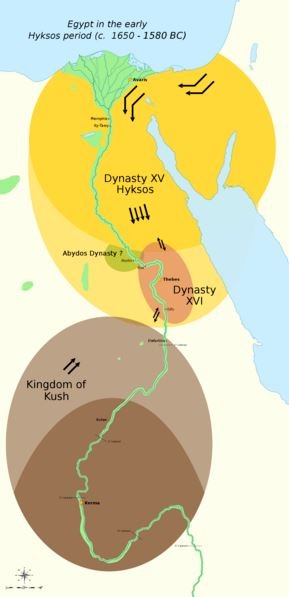
In the early years of Hyksos rule (c. 1650–1590 BC), Egypt was in a state of political fragmentation, characteristic of the broader instability of the Second Intermediate Period (c. 1800–1550 BC).
READ ALSO: 9 Famous Middle Kingdom Pharaohs
Collapse of the Middle Kingdom
The decline of the Middle Kingdom was marked by the end of the 12th Dynasty following the death of Queen Sobekneferu. Her lack of an heir resulted in the weakening of centralized power, leading to the establishment of the 13th Dynasty. Despite initially ruling from Itjtawy, this dynasty faced increasing difficulties in maintaining control over Egypt. The Byzantine chronicler George Syncellus noted that the 13th Dynasty had sixty rulers, governing for approximately 453 years. However, rapid successions and internal instability gradually diminished their influence.
Migration to Thebes and the Rise of the 14th Dynasty
A significant shift occurred when the 13th Dynasty relocated to Thebes, potentially under Merneferre Ay. This move may have been influenced by the invasion of the eastern Delta and the Memphite region by Canaanite groups, whose culture was closely linked to the Middle Bronze Age Levant.
While some scholars argue this marked the onset of the Second Intermediate Period, others, such as Ryholt and Baker, reject this notion, citing evidence that suggests the 13th Dynasty continued to govern Memphis. Concurrently, the 14th Dynasty emerged in the Nile Delta, with its capital at Xois. This dynasty consisted of rulers of Canaanite descent and lasted for varying lengths of time, according to different ancient sources.
READ ALSO: How did the Nile make Egypt a great ancient civilization?
The Hyksos and the 15th Dynasty
The most defining aspect of the Second Intermediate Period was the rise of the Hyksos, who established the 15th Dynasty. Initially settling in the Nile Delta, the Hyksos were either migrants or invaders from West Asia. Manetho’s Aegyptiaca describes them as conquerors, yet modern research suggests their presence may have resulted from a gradual migration rather than an outright military invasion.
The Hyksos rulers, particularly Salitis, ruled from Avaris and exerted control over Lower Egypt. The Turin King List records six Hyksos kings, with Khamudi being the last. They maintained distinct cultural elements, such as Canaanite religious practices and military technology, including the horse-drawn chariot, which would later influence native Egyptian warfare.

A cylindrical seal featuring a cartouche that bears the inscription “Khamudi.”
The Second Intermediate Period was a time of significant transition in ancient Egypt, marked by political fragmentation, foreign rule, and eventual reunification.
The Abydos and 16th Dynasties
While the Hyksos controlled the north, the 16th Dynasty emerged in Thebes, ruling Upper Egypt. Sources like Manetho provide conflicting descriptions, sometimes portraying the 16th Dynasty as Theban and at other times as Hyksos-controlled.
Thebes faced constant pressure from the Hyksos and was eventually conquered. Famine and economic hardships further weakened the 16th Dynasty, contributing to its eventual collapse.
Additionally, the Abydos Dynasty, a smaller ruling faction, controlled a portion of Upper Egypt around Abydos but was short-lived and ultimately absorbed into the Theban sphere.
The 17th Dynasty and the War of Liberation
Following the fall of the 16th Dynasty, the 17th Dynasty emerged in Thebes. This period saw efforts to resist Hyksos rule and reclaim Egyptian independence.
Early rulers of the 17th Dynasty maintained a tenuous peace with the Hyksos but ultimately engaged in open conflict. Seqenenre Tao II initiated hostilities against the Hyksos, an effort continued by his successor, Kamose.
The final expulsion of the Hyksos was achieved under Ahmose I, who successfully besieged and conquered Avaris. This victory marked the end of the Second Intermediate Period and the beginning of the New Kingdom.
READ ALSO: 12 Major Achievements of Pharaoh Ahmose I
The expulsion of the Hyksos and the rise of the 18th Dynasty signified the beginning of Egypt’s resurgence as a dominant power in the ancient world.
Reunification and the Dawn of the New Kingdom
With the defeat of the Hyksos, Ahmose I established the 18th Dynasty, reuniting Egypt under a centralized monarchy. He implemented military reforms and expanded Egyptian influence beyond its traditional borders. The consolidation of power under Ahmose ushered in a new era of prosperity, military expansion, and architectural achievements, setting the stage for the height of ancient Egyptian civilization during the New Kingdom.
Ancient Egyptian Kings of the New Kingdom and their Accomplishments
Timeline of the Second Intermediate Period
- c. 1700 BC – Start of the Second Intermediate Period; Egypt fragmented into multiple dynasties.
- c. 1773–1650 BC – The 13th Dynasty rules from Itjtawy but gradually weakens, leading to instability.
- c. 1700 BC – The 14th Dynasty emerges in the Nile Delta, breaking away from central authority.
- c. 1650 BC – The Hyksos establish the 15th Dynasty, ruling Lower Egypt from Avaris.
- c. 1650 BC – The Abydos Dynasty rules a small portion of Upper Egypt.
- c. 1650–1580 BC – The 16th Dynasty governs Thebes but faces military pressure from the Hyksos.
- c. 1580 BC – The 16th Dynasty collapses under Hyksos expansion.
- c. 1571–1540 BC – The 17th Dynasty rises in Thebes and begins resistance against Hyksos rule.
- c. 1549–1545 BC – Seqenenre Tao starts military campaigns against the Hyksos.
- c. 1545–1540 BC – Kamose continues the war against the Hyksos.
- c. 1540–1530 BC – Ahmose I expels the Hyksos and reunifies Egypt.
- c. 1555 BC – The Second Intermediate Period ends; the New Kingdom begins.

A relief depicting Pharaoh Ahmose I striking down what is believed to be a Hyksos adversary.
Frequently Asked Questions
Who were the Hyksos?
A West Asian people who established the 15th Dynasty in Avaris, possibly arriving peacefully but later portrayed as invaders.
What source provides key chronology for this period?
The Turin King List from Ramesses II’s reign, along with scarab typology.
How did the Middle Kingdom collapse?
Queen Sobekneferu’s death without an heir ended the 12th Dynasty, leading to the weaker 13th Dynasty.

A bust of Sobekneferu.
Why did the 13th Dynasty relocate to Thebes?
Likely due to Canaanite rulers taking control of the eastern Delta and Memphis.
What was the role of the 14th Dynasty?
A breakaway dynasty in the Delta, possibly of Canaanite origin, that coexisted with the 13th Dynasty before the Hyksos takeover.
How did the Hyksos establish the 15th Dynasty?
They settled in the Delta and gradually took control, with their first ruler, Salitis, founding Avaris.
Did the Hyksos rule all of Egypt?
No, they mainly controlled Lower Egypt, while the Thebans and other local dynasties ruled Upper Egypt.
What was the Abydos Dynasty?
A short-lived local dynasty ruling Abydos and possibly Thinis during the 15th and 16th Dynasties.
What caused the downfall of the 16th Dynasty?
Continuous Hyksos military pressure and internal struggles led to its collapse.
How did the 17th Dynasty resist the Hyksos?
Theban rulers like Seqenenre and Kamose waged war against the Hyksos, paving the way for Ahmose I’s final victory.
What ended the Second Intermediate Period?
Ahmose I expelled the Hyksos, unified Egypt, and established the 18th Dynasty, beginning the New Kingdom.





