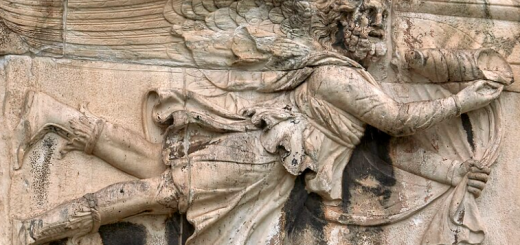
Nessus in Greek Mythology
Nessus is a notable centaur in Greek mythology, renowned for his tragic role in the story involving Heracles (Hercules in Roman Mythology) and Deianeira. The tale of Nessus not only highlights themes of betrayal and vengeance but also underscores the consequences of deception. His story is intertwined with other legendary elements of Greek mythology, shedding light on the deeper symbolic meanings that have endured over centuries.
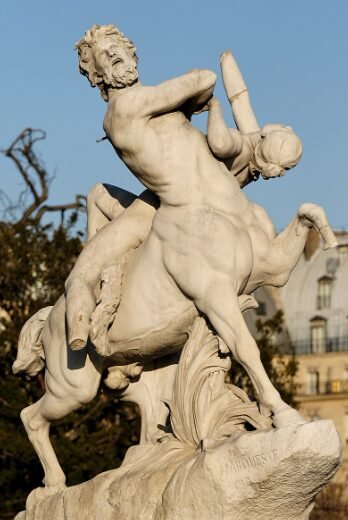
In Greek mythology, Nessus was a notable centaur and son of Centauros. Image: 2006 photo of Laurent Marqueste’s statue depicting Nessus struck by an arrow with Deianeira.
Origins and Background
Nessus was one of the centaurs, creatures depicted as half-human and half-horse, symbolizing a duality of civilization and untamed nature.
According to mythology, centaurs were descendants of Ixion, a mortal king, and Nephele, a cloud nymph created in the likeness of Hera, Queen of the gods.
Nessus’s father was Centauros, who fathered many of the centaurs, and they were often portrayed as unruly and violent beings. However, Nessus played a unique role that set him apart from the typical depiction of centaurs.
After participating in the battle with the Lapiths, Nessus became a ferryman on the Euenos River.
Centaurs were known for their association with wild behavior and impulsivity, often clashing with humans due to their savage nature. They famously battled the Lapiths during the wedding feast of Pirithous, where they tried to abduct the bride and other female guests, leading to a violent conflict. Nessus, like his kin, participated in these events and survived the battle with the Lapiths. His later role as a ferryman on the river Euenos, however, is where his story intersects with that of Heracles.
The Encounter with Heracles and Deianeira
Nessus’s most famous story begins when he encounters Heracles, one of Greece’s greatest heroes, and Heracles’ wife, Deianeira. As the couple traveled, they came to the river Euenos. Nessus, offering his services as a ferryman, proposed to carry Deianeira across the river while Heracles swam across himself. Heracles agreed, but the encounter soon turned dark.
Midway through the crossing, Nessus attempted to assault Deianeira, seeking to take advantage of the situation. From the riverbank, Heracles saw what was happening and acted swiftly. He used his bow and shot Nessus with an arrow dipped in the lethal blood of the Hydra, a monster he had previously slain during one of his Twelve Labors. This arrow carried a potent poison that ensured a quick and painful death.
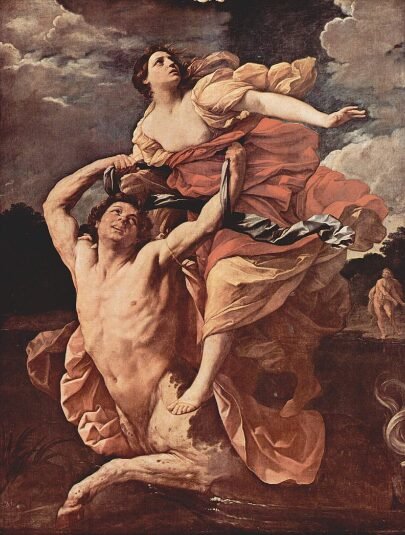
Italian Baroque painter Guido Reni, Abduction of Deianira, 1620–21, Louvre Museum, Paris.
Nessus’s Deceptive Revenge
While dying, Nessus crafted a scheme born of malice and cunning. He called out to Deianeira and told her that if she ever doubted Heracles’s fidelity, she should take some of his blood and use it as a love charm. Nessus knew that his blood, tainted with the Hydra’s poison, would instead bring destruction.
Deianeira, unaware of the true nature of the blood, believed Nessus’s dying words. She kept a portion of the blood, thinking it would secure Heracles’s love should she need it in the future. This act of trust, rooted in deceit, would later become the catalyst for a tragic chain of events.
The Tragic Outcome
Heracles’s feats as a hero were legendary, but his life was marked by challenges and rivalries. Over time, Deianeira began to fear losing Heracles’s affection, especially when he showed interest in Iole, a beautiful princess. Seeking to rekindle his love and loyalty, Deianeira decided to use the blood-soaked robe prepared with Nessus’s blood.
Heracles wore the robe to a gathering, but soon the poison began to take effect. The robe clung to his skin, searing it with an unbearable burning sensation. Heracles tried to tear it off, but it only worsened his suffering, as pieces of his flesh came away with the fabric. The pain was so intense that Heracles ultimately chose to end his torment by constructing a funeral pyre on Mount Oeta, where he lay down and accepted his fate.

Death of Hercules, Scorched by the Centaur Nessus Tunic – Francisco de Zurbarán (1598-1664) – PD-art-100
In a final act of divine intervention, Zeus took pity on Heracles, who had been a faithful and valorous hero throughout his life. Zeus brought Heracles to Mount Olympus, granting him immortality and a place among the gods. Deianeira, upon learning the catastrophic results of her actions, was stricken with guilt and ended her own life.

Nessus was killed by Heracles, but his poisoned blood later caused Heracles’ death, making him a pivotal figure in the hero’s tragic end. Image: Heracles, Deianira and Nessus, black-figure hydria, 575-550 BCE Louvre (E 803)
Symbolic Themes and Interpretations
The story of Nessus, Heracles, and Deianeira is rich with symbolism. Nessus represents betrayal and the destructive power of deception. His cunning act serves as a reminder of how trust can be manipulated, leading to unforeseen and tragic consequences. The tale also highlights themes of jealousy, loyalty, and the unintended consequences of well-meaning actions.
The myth of Nessus has parallels in other Greek stories, such as those involving Medea and her vengeful actions driven by love and betrayal. The poisoned gift trope, embodied by Nessus’s blood-soaked robe, is a recurring motif in literature and mythology, symbolizing something that appears beneficial but conceals a hidden danger.
Cultural and Literary Legacy
Nessus’s story has transcended its mythological origins to become a part of broader cultural and literary references. The concept of the “Nessus Shirt” or “Shirt of Nessus” has entered the lexicon as a metaphor for a gift that causes harm to the recipient. This idea has been used to describe historical events and figures of speech, such as maliciously giving blankets infected with disease to adversaries.
The enduring appeal of Nessus’s tale lies in its powerful lessons about trust, betrayal, and the consequences of seemingly small actions.
In classical literature, Sophocles’ Trachiniae (Women of Trachis) retells the story, focusing on the emotional turmoil and tragic outcomes of trust and betrayal. This play underscores the human elements of doubt, love, and the devastating effects of deception.
Disney’s Hercules and Other depictions in popular culture
Beyond ancient texts, Nessus appears in various forms in modern literature and media. He is featured in Dante Alighieri’s Inferno, where he serves as one of the centaurs patrolling the Phlegethon, a river of boiling blood in the Seventh Circle of Hell. Nessus guides Dante and Virgil through the landscape, illustrating his role as both a figure of punishment and a guide through peril.
In popular culture, Nessus has been depicted in adaptations such as Disney’s Hercules, where he is shown as a brutish river guardian defeated by the hero. The story has also inspired elements in video games and literature, such as Larry Niven’s Ringworld series and Gene Wolfe’s The Book of the New Sun.
Frequently Asked Questions

Nessus was a centaur known for his role in the tragic story involving Heracles and the Tunic of Nessus. He attempted to assault Deianeira, Heracles’ wife, leading to a chain of events that ultimately resulted in Heracles’ death.
What did Nessus do to seek revenge against Heracles?
As Nessus lay dying from a Hydra-poisoned arrow shot by Heracles, he told Deianeira that his blood would ensure Heracles’ loyalty, knowing it was actually poisonous.

Deianira by English artist Evelyn De Morgan
How did Deianeira use the blood of Nessus, and what were the consequences?
Deianeira spread the centaur’s blood on a robe and gave it to Heracles to regain his affection. The poisoned blood caused Heracles immense pain when he wore the robe, ultimately leading to his death.

Deianira and the dying centaur Nessus as he reveals the “love potion” (poisonous blood). Image: “Deianira and the dying centaur Nessus” by American artist Howard Pyle
What themes does the myth of Nessus and Heracles explore?
The myth emphasizes themes of trust, betrayal, and unintended consequences. It also serves as an example of how deceit can have fatal outcomes.
Which literary work retells the myth of Nessus and highlights these themes?
Sophocles’ play Trachiniae (Women of Trachis) retells this myth, focusing on trust and betrayal.
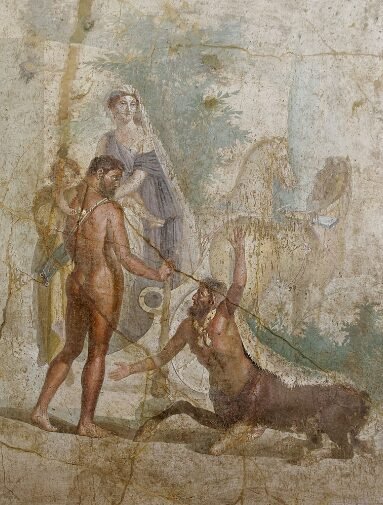
Heracles carrying his son Hyllus as the centaur Nessus prepares to ferry Deianira across the river. Pompeii fresco.
How does the origin of centaurs relate to Nessus’s story?
Before the Greeks developed centaur mythology, similar figures appeared in Kassite culture as guiding spirits. The word “centaur” may come from terms meaning “water-whipper” or “water spirit,” connecting Nessus’s story with ancient symbolic meanings.
How is Nessus depicted in Dante Alighieri’s Inferno?
In Inferno, Nessus is one of the centaurs who patrols the Phlegethon, a river of boiling blood in the Circle of Violence, ensuring sinners stay submerged. He guides Dante and Virgil under Chiron’s orders.
In what modern adaptations does Nessus appear?
Nessus is featured as a river guardian in Disney’s Hercules and appears in video games and series like Titan Quest, Destiny 2, and the animated adaptation of Dante’s Inferno.
What is the metaphorical significance of the “Nessus Shirt”?
The term “Nessus Shirt” refers to something seemingly beneficial that is actually harmful. It has been used to describe historical events where items, such as infected blankets, were given with malicious intent.

Lichas delivers Nessus’s garment to Hercules, woodcut by German artist Hans Sebald Beham, circa 1542-1548.
What impact has the story of Nessus had on modern literature and culture?
Nessus’s story has influenced works like Larry Niven’s Ringworld series and Gene Wolfe’s The Book of the New Sun. The myth symbolizes deceit and the far-reaching effects of actions, continuing to be a powerful narrative in storytelling.