Origin story of the Antikythera Mechanism and what it predicted
The story of the Antikythera Mechanism begins in 1900, when a group of sponge divers stumbled upon a shipwreck off the coast of the Greek island of Antikythera. The divers were initially searching for natural sponges in the Aegean Sea but discovered something far more significant. The shipwreck they found, believed to date back to around 70-60 BC, contained a treasure trove of artifacts, including marble statues, elegant vases, glistening jewelry, and ancient coins.
Among these treasures was a lump of corroded bronze and wood, initially dismissed as unremarkable. However, in 1902, Greek archaeologist Valerios Stais noticed that the lump contained gear wheels, which led to a more detailed investigation. This discovery marked the beginning of the journey to understand the Antikythera Mechanism, an object that would revolutionize our understanding of ancient technology.

Initial Reactions and Investigations
At first, the significance of the mechanism was not fully recognized. It was simply seen as a corroded lump, roughly the size of a large dictionary. However, when the presence of gear wheels inside the lump was confirmed, excitement grew among scholars and scientists. The realization that these gears were precision-made, with teeth about a millimeter long, was particularly shocking. Such intricate craftsmanship from ancient Greece was completely unexpected.
Over the next few decades, researchers began to piece together the fragments of the mechanism, trying to understand its purpose and construction. Early studies revealed that it was a complex device, far ahead of its time, capable of performing sophisticated astronomical calculations.
Technological Advances in Understanding
The true complexity of the Antikythera Mechanism was not fully appreciated until the latter half of the 20th century, when advances in technology allowed for more detailed investigations. In the 1970s, a team led by Derek J. de Solla Price used X-ray imaging to examine the interior of the device. This revealed dozens of hidden cogs and gears, providing a glimpse into the intricate machinery within.
The breakthrough came with the advent of 3D X-ray technology. An eight-ton X-ray machine was transported to Athens, where it was used to scan all 82 surviving fragments of the mechanism. These scans provided detailed three-dimensional images of the gears and other internal components, allowing researchers to separate and study them in unprecedented detail.
Revelations from Modern Technology
The 3D X-ray images revealed a wealth of new information about the Antikythera Mechanism. Among the discoveries were inscriptions previously hidden within the corroded bronze. These inscriptions included a user guide, written in ancient Greek, which explained how the device worked. This was a significant revelation, as it provided critical insights into the operation and purpose of the mechanism.
The new data enabled researchers to reconstruct the mechanism more accurately. They discovered that it was a sophisticated astronomical calculator, capable of predicting the positions of the sun, moon, and planets, as well as the timing of solar and lunar eclipses. The device could also track the cycles of the ancient Greek calendar, including the Olympiad cycle, which was used to time the Olympic Games.
Reasons why these countries and individuals boycotted the 1936 Berlin Olympics
What the Antikythera Mechanism Predicted
The Antikythera Mechanism is often described as the world’s first analog computer due to its ability to perform complex calculations and predict astronomical events.
Here is a detailed look at what it could predict:
Solar and Lunar Cycles
One of the primary functions of the Antikythera Mechanism was to track the cycles of the sun and moon. It could predict the phases of the moon, showing whether it would be full, new, or in one of the intermediate phases. This was achieved through a complex system of gears that modeled the moon’s elliptical orbit and its varying speed as it moved across the sky.
The mechanism also predicted solar and lunar eclipses. The ancient Greeks had developed sophisticated theories about the motions of celestial bodies, and the mechanism could mechanize these theories to predict when and where eclipses would occur. It included a dial that could be set to display upcoming eclipses, providing information about their timing and characteristics.
Planetary Positions
The Antikythera Mechanism also tracked the positions of the five known planets: Mercury, Venus, Mars, Jupiter, and Saturn. By turning a handle, the user could move the gears to see where these planets would be in the sky at any given time. This was a remarkable feature, as it required a detailed understanding of the complex motions of the planets, including their retrograde movements, where they appear to move backward in the sky due to the relative positions of the Earth and the planets in their orbits.
Calendrical Functions
In addition to its astronomical predictions, the Antikythera Mechanism had several calendrical functions. It could track the cycles of the ancient Greek calendar, including the Metonic cycle, which is a period of 19 years after which the phases of the moon repeat on the same days of the year. This cycle was crucial for aligning lunar and solar calendars.
The mechanism also included the Callippic cycle, a more refined version of the Metonic cycle spanning 76 years, and the Saros cycle, which is an 18-year period used to predict eclipses. These cycles were displayed on various dials and were critical for timing religious festivals and agricultural activities.
Major Calendars in Human History: Origins, Structures, & Impacts on Societies
The Olympiad Cycle
One of the unique features of the Antikythera Mechanism was its ability to track the Olympiad cycle. This four-year period was used to time the Olympic Games, one of the most important events in ancient Greece. By turning the handle, users could determine when the next Olympic Games would take place, ensuring that the event was held at the correct time.
Rethinking Ancient Technology
The discovery of the Antikythera Mechanism has had a profound impact on our understanding of ancient technology. Before its discovery, the common view was that ancient civilizations, including the Greeks, had limited technological capabilities. They were known for their achievements in philosophy, mathematics, and the arts, but their technological prowess was thought to be relatively rudimentary.
The Antikythera Mechanism challenged this perception. It demonstrated that the ancient Greeks had developed highly sophisticated technology that rivaled, and in some cases surpassed, the capabilities of later historical periods. The precision and complexity of the gears, the ability to predict astronomical events, and the integration of multiple cycles into a single device were all remarkable achievements.
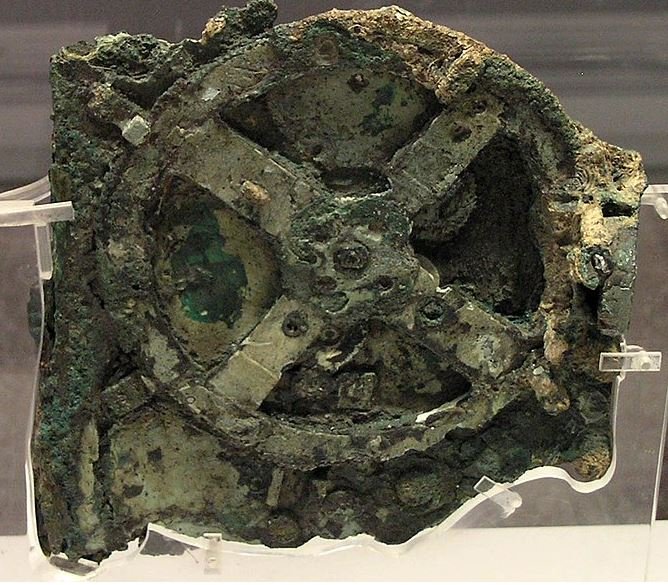
The Antikythera Mechanism highlights the nonlinear nature of technological progress, which sometimes includes periods of significant advancement followed by regression. Image: Front view of the Antikythera Mechanism.
The Significance of Precision Engineering
The precision engineering required to build the Antikythera Mechanism is particularly noteworthy. The gears were cut with such precision that it indicates a high level of craftsmanship and understanding of mechanical engineering. This suggests that the Greeks not only had the theoretical knowledge to design such a device but also the practical skills to manufacture it.
The mechanism’s construction required a detailed understanding of gear ratios, materials science, and mechanical principles. This level of sophistication implies that the Greeks had a well-developed tradition of mechanical engineering, which may have included other devices that have not yet been discovered.
Insights into Ancient Greek Astronomy
The Antikythera Mechanism also provides valuable insights into ancient Greek astronomy. The ability to predict solar and lunar eclipses, track planetary positions, and model the complex motions of celestial bodies demonstrates a sophisticated grasp of celestial mechanics. The mechanism’s design reflects a heliocentric model of the solar system, which was a revolutionary idea at the time.
This suggests that the Greeks were exploring concepts that would not be widely accepted until the Renaissance, nearly 1500 years later. The mechanism serves as a bridge between ancient and modern scientific thought, highlighting the continuity of human inquiry into the workings of the cosmos.

English science fiction writer and futurist Arthur C. Clarke suggested that if the ancient Greeks had fully understood the capabilities of the technology they created, they might have reached the moon within 300 years. This underscores the advanced nature of the mechanism and its potential impact on technological progress. Image: A 2005 picture of Arthur Clarke.
Modern Implications and Future Discoveries
The discovery of the Antikythera Mechanism has highlighted the importance of underwater archaeology and the potential for shipwrecks to yield significant historical artifacts. The ongoing advancements in diving technology and underwater exploration are likely to lead to more discoveries that could further reshape our understanding of ancient history.
There are thousands of shipwrecks in the Mediterranean, many of which remain unexplored. As diving technology improves, it becomes possible to explore deeper wrecks and recover artifacts that have been hidden for centuries. These discoveries could provide new insights into ancient technology, trade, and cultural exchange.
Building a Physical Model
Today, researchers continue to study the Antikythera Mechanism, and efforts are underway to build a physical model using ancient Greek techniques. This project aims to understand how the device was constructed and operated, providing a tangible link to the technological achievements of the past.
By recreating the mechanism using period-accurate materials and methods, researchers hope to gain deeper insights into the craftsmanship and engineering skills of the ancient Greeks. This hands-on approach can also help to verify the theoretical models and interpretations developed through modern technology.
A Legacy of Technological Innovation
The Antikythera Mechanism serves as a reminder of the nonlinear nature of technological progress. Throughout history, technological advancements have often occurred in fits and starts, with periods of significant innovation followed by regression and loss of knowledge. The mechanism is a testament to the ingenuity and creativity of our ancestors, highlighting the potential for significant advancements to be lost and rediscovered over time.
Understanding the history of technology helps us appreciate the achievements of past civilizations and recognize the importance of preserving and studying ancient artifacts. The Antikythera Mechanism continues to inspire scientists, historians, and engineers, reminding us of the enduring quest to understand and predict the workings of the natural world.
Conclusion
The Antikythera Mechanism is a remarkable testament to the ingenuity and technological prowess of the ancient Greeks. Its discovery has forced historians and scientists to reconsider the timeline of technological development and acknowledge that ancient civilizations were capable of creating highly sophisticated devices.

Questions and Answers on the Antikythera Mechanism
The Antikythera Mechanism is a remarkable testament to the ingenuity and technological prowess of the ancient Greeks. Its discovery has forced historians and scientists to reconsider the timeline of technological development and acknowledge that ancient civilizations were capable of creating highly sophisticated devices.
Below are some FAQs about the Antikythera mechanism, a device sometimes proclaimed as the world’s first analog computer:
Why was the discovery of the Antikythera Mechanism considered astonishing?
The discovery was astonishing because it revealed a level of technological sophistication in ancient Greece that was previously unknown. The mechanism contained precision gears with teeth about a millimeter long, which was completely unexpected for that time period.
When and how was the Antikythera Mechanism discovered?
The mechanism was discovered 120 years ago by sponge divers who found a shipwreck off the tiny island of Antikythera in Greece. Among the treasure trove of items retrieved were marble statues, elegant vases, jewelry, ancient coins, and a corroded lump of metal that turned out to be the Antikythera Mechanism.
What was the initial reaction to the corroded metal lump found among the treasures?
Initially, the lump of corroded metal was not recognized as anything significant. It was just a corroded lump about the size of a large dictionary. However, when gear wheels were discovered inside it in 1902, it garnered significant attention.

What is the Antikythera Mechanism and what does it do?
The Antikythera Mechanism is a dedicated calculating machine that uses bronze gear wheels to calculate the cycles of the cosmos, including the sun, the moon, and the planets against the stars. It could predict astronomical positions and eclipses.
How did the ancient Greeks use the Antikythera Mechanism?
The ancient Greeks used the Antikythera Mechanism as a calculating machine to apply their astronomical theories. By turning a handle, users could calculate the positions of celestial bodies years into the future. It mechanized scientific predictions, which was a revolutionary step in technology at that time.
What significant revelations were discovered through modern X-ray technology?
Modern X-ray technology revealed not only the gear wheels in three dimensions but also new inscriptions that had been hidden within the corroded bronze. These inscriptions included a user guide that provided crucial information on how the device worked.
The new inscriptions and X-ray data have led to significant breakthroughs in understanding the mechanism. They revealed that it could predict eclipses and track the variable motion of the moon. These insights have allowed experts to model the front of the device and understand its full capabilities.
What does the Antikythera Mechanism tell us about ancient Greek technology?
The Antikythera Mechanism shows that the ancient Greeks had a sophisticated understanding of astronomy and mechanical engineering. It demonstrates that they were capable of creating highly advanced technology, challenging previous assumptions about their capabilities.

How has the discovery of the Antikythera Mechanism challenged previous assumptions about ancient civilizations?
The mechanism challenges previous assumptions by revealing that ancient civilizations, particularly the Greeks, had developed highly advanced technology. It opens up new questions about what other technologies might have been developed and subsequently lost.
What is the significance of the precision and complexity of the Antikythera Mechanism’s gears?
The precision and complexity of the gears indicate a high level of craftsmanship and mechanical engineering. This suggests that the Greeks not only had the theoretical knowledge to design such a device but also the practical skills to manufacture it.
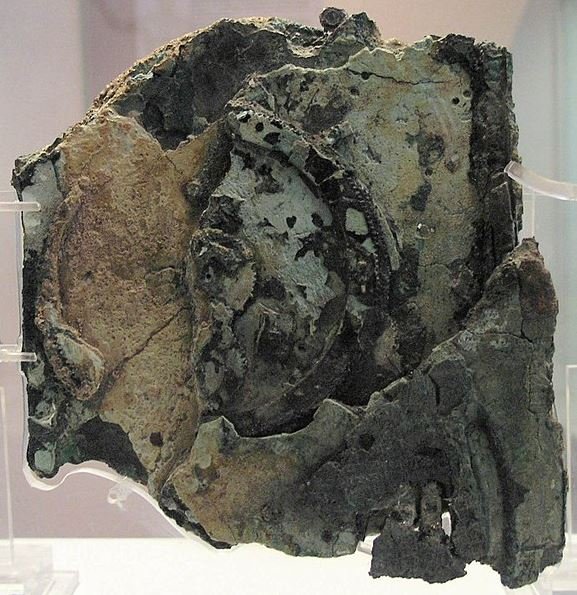
In so many ways, the Antikythera Mechanism illustrates that technological progress does not always follow a straight line. It develops in fits and starts, with periods of significant advancement sometimes followed by regression and loss of knowledge. Image: A rear view of the Antikythera Mechanism.





