Paper-Making in Ancient China
Among the many profound contributions of ancient China to world civilization, the invention of paper stands as one of the most transformative. It not only revolutionized communication and bureaucracy within China but also had global repercussions that changed the course of human history. Before the invention of paper, writing surfaces included bamboo slips, wooden tablets, silk, and other less efficient materials. These earlier media were either too bulky, expensive, or fragile to allow widespread use.

Dating back to around 256 CE, the “Pi Yu Jing” is the oldest known paper book, crafted from six distinct materials.
The invention of paper provided a cheap, light, and durable alternative that democratized knowledge, enabled the expansion of education, and facilitated the growth of the Chinese empire’s bureaucratic state.
The Historical Context Before Paper
In the centuries leading up to the invention of paper, the Chinese employed a variety of writing materials depending on the social class, purpose, and availability of resources.
The earliest Chinese script was inscribed on oracle bones during the Shang Dynasty (c. 1600–1046 BCE), which were typically ox scapulae or turtle plastrons used in divination rituals. While these served a ceremonial function, they were clearly impractical for regular writing.
During the later Zhou Dynasty, bamboo slips and wooden tablets became widespread. These strips were strung together to create books, known as “jiance.” The major drawback of bamboo was its weight and bulkiness, making storage and transportation difficult, especially as administrative record-keeping grew more complex.
Silk was also used for writing, particularly during the Warring States period and the Han Dynasty, due to its smooth texture and portability. However, silk was expensive and considered too luxurious for everyday administrative tasks or mass education. The high cost of silk limited its use to the elite. Thus, the need for a more affordable and practical writing medium became increasingly evident as China’s population and bureaucracy expanded.
The Invention of Paper: Cai Lun and the Han Dynasty
The conventional narrative attributes the formal invention of paper to Cai Lun, a court eunuch and official during the Eastern Han Dynasty in 105 CE. Although earlier forms of paper-like material have been discovered in China dating as far back as the 2nd century BCE, Cai Lun is credited with standardizing the paper-making process and presenting it to the imperial court. His innovations significantly improved the quality, durability, and affordability of paper, making it more viable for widespread use.
According to historical records in the “Hou Hanshu” (Book of the Later Han), Cai Lun created paper from a blend of bark, hemp, rags, and fishing nets, mashed and pulped into a slurry and spread on a flat surface. The pulp was drained and dried into thin sheets. This mixture and method produced a writing material that was not only smooth and suitable for brush strokes but also light, foldable, and easy to store. The new medium was praised by the emperor, and Cai Lun received imperial recognition. This endorsement accelerated the adoption of paper across the empire.
Technological Evolution and the Papermaking Process
The early papermaking technique developed under Cai Lun was simple yet remarkably efficient. It involved several steps: collecting raw materials such as tree bark, hemp, and old rags; soaking and boiling them to create a pulp; pounding and straining the mixture; and then spreading the pulp evenly onto a woven screen or mold. The water would drain, and the remaining mat of fibers was pressed and dried into sheets.
Over time, artisans improved the technique. The Tang Dynasty (618–907 CE) witnessed refinements in pulp processing and drying methods, which produced stronger, more consistent paper. The use of materials such as mulberry bark and bamboo fibers gained prominence, especially in southern China where bamboo was abundant. Screens used for drying were increasingly made of fine silk or brass wire mesh, allowing for finer and thinner sheets. This technological evolution enhanced paper’s quality and broadened its applications beyond mere record-keeping.
Different grades of paper were developed for different purposes. Coarser types were used in everyday documentation, while fine white papers became preferred for calligraphy, religious texts, and artistic expression. Some papers were even treated with starch or other substances to make them more resistant to insects or suitable for painting and dyeing.

Cultural Significance and Intellectual Impact
The rise of paper had immense implications for Chinese culture and intellectual life. With an affordable and efficient medium, the production of books, records, and letters increased exponentially. Paper facilitated the dissemination of Confucian teachings, particularly during the Han Dynasty, when Confucianism was promoted as state ideology. The reproduction and spread of classical texts became significantly easier, aiding in the standardization of education across the empire.
The civil service examination system, which required candidates to memorize and interpret Confucian classics, greatly benefited from the availability of paper. Candidates could access study materials more readily, and exam papers could be produced, stored, and reviewed with greater ease. This helped create a meritocratic administrative elite and laid the groundwork for one of the world’s longest-lasting bureaucracies.
Paper also played a critical role in the rise of literature and the arts. Poets such as Li Bai and Du Fu composed verses that were widely circulated thanks to the availability of paper. In the realm of visual art, Chinese ink painting flourished as paper provided a smooth and absorbent surface that perfectly suited brushwork. Buddhist scriptures and Daoist texts were copied and transmitted with increasing efficiency, aiding the spread of religious beliefs throughout the population.
Economic and Administrative Expansion
From an administrative perspective, paper became indispensable. The Han bureaucracy maintained detailed records, censuses, tax data, edicts, and military reports. Previously reliant on cumbersome bamboo slips, administrators quickly adopted paper for its superior portability and usability. Archives could be stored more compactly, and orders could be communicated more efficiently across vast distances. This contributed to the consolidation of imperial control over China’s sprawling territories.
The paper industry itself became an important sector of the economy. Centers of papermaking emerged in regions such as Sichuan, Anhui, and Zhejiang. By the Tang Dynasty, paper had become a commercial product, traded along with other goods. Different varieties were crafted for various purposes—some for official use, others for the public market. Specialized artisans and workshops developed around this craft, creating jobs and fostering technological competition.
With the growth of urban centers and the rise of merchant classes, paper also found applications in commerce. Contracts, receipts, shipping logs, and business correspondence increasingly relied on paper. By enabling economic transactions to be recorded and verified, paper helped integrate regional markets and contributed to the sophistication of the Chinese economy.
Religious and Philosophical Dissemination
Religious traditions in China were transformed by the rise of paper. Buddhism, which entered China during the Han Dynasty and flourished during the Tang, used paper to propagate its teachings. Sutras and commentaries were transcribed and distributed to monasteries, scholars, and lay believers. The Diamond Sutra, printed in 868 CE, is the world’s oldest surviving printed book, exemplifying the marriage of papermaking and early printing technology in China.
The Daoist tradition also made extensive use of paper for recording esoteric knowledge, producing talismans, and maintaining liturgical texts. Religious practices became increasingly text-based, and access to sacred writings expanded beyond the priesthood.
Paper enabled not just the recording of belief, but its public performance. Street preachers, storytellers, and entertainers could use written scripts and songbooks to standardize their performances. Wall posters, edicts, and flyers spread messages rapidly in urban centers, foreshadowing mass communication.
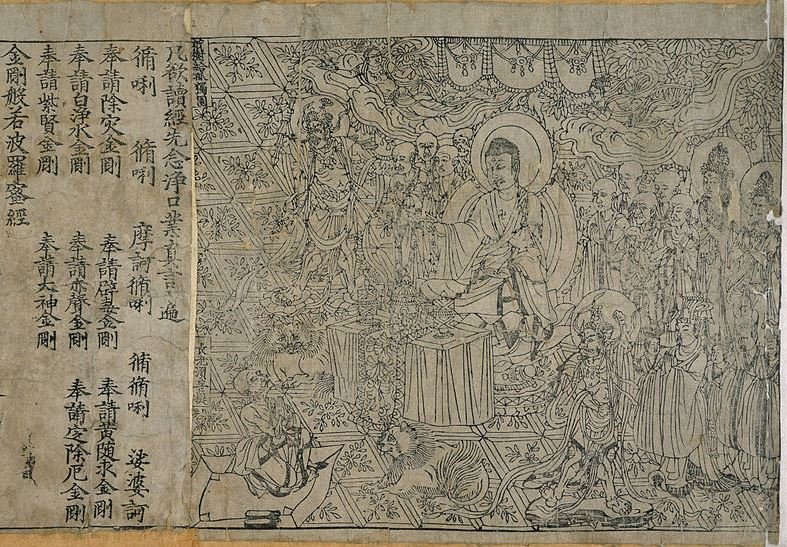
Frontispiece of the Diamond Sutra. Its housed at the British Library in London.
The Invention of Printing and Synergy with Paper
One of the most profound outcomes of paper’s invention was its synergy with another Chinese innovation: printing. Initially, texts were copied by hand, a labor-intensive process even on paper. However, during the Tang and Song Dynasties, the technique of woodblock printing emerged. This involved carving entire pages of text onto wooden blocks, inking them, and pressing them onto paper sheets. This method allowed the mass production of books, calendars, almanacs, and religious tracts.
The spread of woodblock printing, later followed by the invention of movable type during the Song Dynasty (credited to Bi Sheng around 1040 CE), created a printing revolution centuries before Gutenberg’s press in Europe. The printing of encyclopedias, dictionaries, and scientific manuals accelerated the spread of knowledge. Paper made this revolution feasible by offering a medium that could receive ink uniformly and was flexible enough for printing.
Paper and printing together created a cultural ecosystem where literacy expanded, public discourse flourished, and cultural continuity was maintained through tumultuous dynastic changes.
Paper empowered administrators, scholars, artists, merchants, and monks alike. It laid the foundation for a literate culture, nurtured philosophical and religious thought, and enabled new forms of economic and artistic expression.
Paper’s Journey Beyond China
Paper’s impact was not confined to China. Through trade routes such as the Silk Road, papermaking technology gradually spread westward. By the 8th century, the secret of papermaking reached Central Asia, and in 751 CE, following the Battle of Talas between the Chinese Tang forces and the Arab Abbasid Caliphate, captured Chinese artisans reputedly introduced the technique to the Islamic world.
In Islamic territories such as Samarkand, Baghdad, and Cairo, papermaking flourished, adapting Chinese methods with regional variations. Paper replaced parchment and vellum, revolutionizing Arabic calligraphy, scholarship, and administration. Libraries grew, scientific knowledge was preserved, and translations of classical works flourished in centers like the House of Wisdom in Baghdad.
Eventually, papermaking reached Europe via Islamic Spain by the 12th century, setting the stage for the European Renaissance and the eventual global information explosion.
Environmental and Social Considerations
While the benefits of paper were immense, the rise of papermaking also had environmental consequences. The demand for raw materials, especially plant fibers and water, led to localized deforestation and water consumption. However, ancient Chinese papermakers displayed an early form of sustainability by recycling old textiles and repurposing waste materials.
Socially, the spread of paper created new literate classes. Though literacy in ancient China was still largely limited to men and the elite, the accessibility of paper widened the scope of education. Schools and academies flourished, and women in elite households often gained some literacy through religious or artistic instruction. Eventually, paper contributed to the development of a civil society where knowledge was valued and preserved.
Paper as a Cultural Symbol
In Chinese culture, paper came to symbolize more than utility. It was associated with refinement, scholarship, and spirituality. The Four Treasures of the Study—brush, ink, inkstone, and paper—became symbols of cultured life. Poets and scholars cherished certain brands of paper for their texture and tone. Calligraphy, the supreme art form in literate China, owed much to the responsiveness of paper to brush and ink.
Paper was also integral to rituals and customs. Joss paper, or “spirit money,” was burned as offerings to ancestors, reflecting a spiritual economy linking the living and the dead. Red paper was used for festive couplets, decorations, and talismans to ward off evil spirits. These practices highlighted paper’s role in both the sacred and secular domains of life.

Questions and answers
What distinguished ancient Chinese civilization from others in terms of communication?
The widespread use of paper and printing marked ancient China as unique, greatly advancing communication, administration, literature, and art compared to other ancient cultures.

A paper fragment discovered at Fangmatan (in China’s Gansu province), dating to around 179 BCE, is the oldest known surviving example.
When did paper-making likely begin in China?
Although traditionally dated to the early 2nd century CE, archaeological evidence suggests paper-making in China may have started as early as the 2nd century BCE.
Who is credited with the refined invention of paper and what was his method?
Cai Lun is credited with refining paper in 105 CE by soaking and pressing plant fibers into thin sheets, providing a lighter and cheaper alternative to bamboo and silk.
How did paper-making materials evolve over time in China?
Initially made from hemp, paper materials later included rattan and then bamboo fibers by the 8th century due to availability and cost. By the Song dynasty, mulberry bark became the primary raw material.
Why was bamboo eventually favored over rattan for paper-making?
Rattan became scarce due to high demand and its slow growth, while bamboo grew more quickly and was more sustainable and affordable.
How was Chinese paper valued beyond its practical uses?
Chinese paper was so refined that it became a prized trade item along the Silk Road and was recognized for its quality and durability across Asia.
What were some materials used to make specialty papers in China?
Specialty papers were made from rice, wheat straw, hibiscus stalks, sandalwood bark, and seaweed, and were often used for art and calligraphy.
Who documented early paper-making techniques, and when?
Su I-chien, writing in the 10th century, recorded regional papermaking methods in detailed treatises that reflected local techniques and preferences.
How did knowledge of papermaking spread beyond China?
Papermaking spread west after Chinese papermakers were captured during the Battle of Talas in the 8th century, eventually reaching Baghdad and later Europe.
What was the impact of paper on Chinese literature and the arts?
Paper boosted the production of texts and became essential for literature, especially during the Neo-Confucian revival, while also supporting painting and calligraphy as major art forms.
The story of paper is, therefore, not only a story of Chinese ingenuity but a cornerstone in the global history of communication, education, and civilization itself.
Besides writing, what other uses did paper serve in ancient China?
Paper was used for maps, clothing, curtains, packaging, armor, and windows, showing its wide range of applications in daily and official life.
How did paper influence the development of currency in China?
Merchants initially used paper receipts for convenience and safety. These evolved into official paper money during the Song dynasty, with the first standardized banknotes issued by 1120 CE.
What was Marco Polo’s impression of Chinese paper money?
Marco Polo described the elaborate authentication process of Chinese banknotes, noting their formal production and official seals that lent credibility to the currency.
What challenges did early paper money face in China?
Despite its innovation, early paper money was vulnerable to counterfeiting and inflation, leading to economic instability and eventual collapse.
When was truly stable paper money introduced in China?
Reliable paper currency did not return until 1866 when the Hong Kong and Shanghai Bank began issuing durable and trusted banknotes.