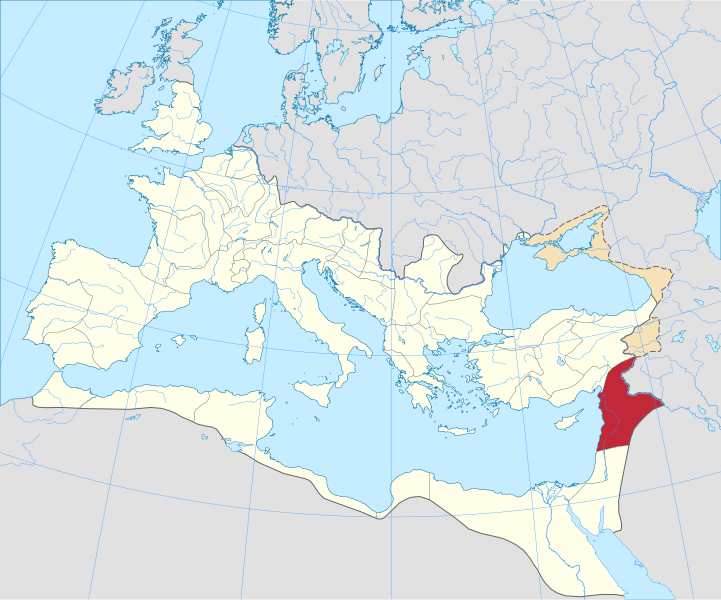
Roman Syria in 125 AD (Highlighted in red)
Roman Syria was a crucial province for the Roman Empire. In the nutshell, it served as a buffer zone against the Parthian and later Sassanid empires, while also providing vital access to the Mediterranean trade routes.
The Roman Annexation of Syria
The province of Roman Syria was annexed into the Roman Republic in 64 BC, following the successful military campaigns of Pompey the Great during the Third Mithridatic War. This annexation marked the end of the Seleucid Empire and the integration of the region into the growing Roman sphere of influence. Syria had previously been a key battleground in the power struggle between the Hellenistic kingdoms and the Parthian Empire. By the time of its annexation, Syria had come under the control of the Seleucid kings, who were weakened by internal strife and external threats. After Pompey’s victory over King Antiochus XIII Asiaticus, the last Seleucid monarch, Syria was formally brought under Roman control. Pompey deposed the last of the Seleucid kings, ensuring Roman hegemony in the region.
Following this, Pompey appointed Marcus Aemilius Scaurus as the first Roman governor of Syria, tasked with maintaining order and administering the newly acquired territory. The incorporation of Syria was significant, as it provided Rome with vital access to the eastern Mediterranean, including the prosperous cities of Antioch and Palmyra, which would become important urban centers in the Roman world.

Pompey the Great
The Transition from Republic to Empire
When the Roman Republic transitioned into the Roman Empire, Syria’s status evolved accordingly. Initially a part of the Roman East, Syria became an imperial province governed by a Legate, a key military officer with authority over both civil and military affairs.
During the early Empire, the strategic importance of Syria increased, as it formed part of the frontier between the Roman Empire and the Parthian Empire, one of Rome’s most formidable rivals in the East.
To defend against the Parthian threat, Syria was heavily garrisoned, and the Roman army stationed three legions there, supported by auxiliary troops. This military presence played a crucial role in securing the borders and maintaining Roman authority over the region.
The Integration of Judea and the Surrounding Territories
In 6 AD, Emperor Augustus took direct control over Judea, a territory that had been a client kingdom under the Herodian dynasty. Augustus deposed Herod Archelaus, the ethnarch of Judea, and united Judea, Samaria, and Idumea into a single Roman province.
The newly formed province was placed under the direct authority of the Legate of Syria, Publius Sulpicius Quirinius. This move was part of Augustus’s broader policy of consolidating control over key regions in the Roman East. As a result, Syria’s authority over the neighboring territories grew, and by the 1st century AD, regions such as Iturea and Trachonitis were absorbed into the province of Syria.
Despite the centralization of power in Rome, there were periods when parts of Syria, such as Judea, were briefly separated and governed as client kingdoms. The most notable of these was the reign of Herod Agrippa I, who ruled over a client kingdom that encompassed Judea and parts of Syria from 37 to 41 AD. Following his death, his territories were re-incorporated into the Roman Empire, and Syria regained control over these regions.

Emperor Augustus
The Jewish Revolts and Roman Military Involvement
Roman Syria played a significant role in the suppression of the Jewish Revolts, a series of uprisings that occurred in the 1st century AD. The First Jewish–Roman War (66–70 AD) was one of the most critical conflicts in Roman Syria’s history.
In 66 AD, the Syrian governor, Cestius Gallus, led a Roman military campaign to quell the Jewish revolt in Judaea. However, Gallus’s forces were ambushed and defeated at the Battle of Beth Horon, which was a stunning setback for the Roman Empire.
The defeat prompted the Roman leadership to send General Vespasian to lead the campaign. Vespasian’s forces, which included Syrian legions, eventually succeeded in crushing the revolt and capturing Jerusalem in 70 AD. The success of Vespasian in suppressing the Jewish rebellion later paved the way for his rise to the throne as emperor.
The Division of Syria and the Rise of Coele Syria and Syria Phoenice
In the late 2nd century AD, during the reign of Emperor Septimius Severus, Syria was administratively divided into two provinces: Coele Syria and Syria Phoenice. This division was part of a broader reorganization of the Roman Empire’s provinces, aimed at improving governance and military control.
Coele Syria, with its capital at Antioch, was located in the northern part of the province, while Syria Phoenice, with its capital at Tyre, encompassed the Phoenician coastal regions in the south. Each of these new provinces was assigned its own governor and military forces, with Coele Syria receiving two legions and Syria Phoenice one.
This division marked a significant shift in the governance of Syria. The Syrian governor, once one of the most powerful and influential figures in the Roman military hierarchy, saw his authority diminish. The Roman emperor, Severus, took decisive steps to prevent the province from becoming a source of rebellion, as had occurred in the past. By splitting the province, Severus ensured that no single governor could accumulate enough power to challenge the central authority of Rome.
Major Accomplishments of Septimius Severus, the first African to become emperor of Rome
The Crisis of the Third Century
The Crisis of the Third Century (235–284 AD) was a period of political instability, military conflict, and economic decline for the Roman Empire. During this tumultuous period, Syria was of crucial strategic importance.
In 244 AD, the emperor Philip the Arab, born in the Syrian city of Philippopolis (modern Shahba), became the ruler of the Roman Empire. Philip’s reign marked a brief period of stability, but Syria’s position on the eastern frontier meant that it was repeatedly threatened by external forces, particularly the Persian Sassanid Empire.
In 252 AD, Syria was invaded by the forces of Shapur I, the Sassanid king, who defeated a Roman field army at the Battle of Barbalissos. The Sassanids advanced into Roman territory, and the region suffered extensive raids and destruction.
In 259 AD, Shapur I captured the Roman emperor Valerian at the Battle of Edessa, further destabilizing the region. The loss of territory and resources to the Persians was a significant blow to Roman authority in Syria.

The Palmyrene Empire and the Fall of Roman Syria
Between 268 and 273 AD, parts of Syria, particularly the region around the city of Palmyra, were part of the Palmyrene Empire. Palmyra, once a prosperous trading city, had become increasingly powerful and assertive in its relations with Rome.
The Palmyrene queen, Zenobia, led a revolt against Roman rule, claiming independence and briefly establishing an empire that stretched from Egypt to Anatolia. However, the Palmyrene Empire was short-lived. In 273 AD, the Roman emperor Aurelian defeated Zenobia’s forces and reasserted Roman control over Syria.
Despite the reconquest of Palmyra, the region continued to face instability due to external threats and internal divisions. The province was continually impacted by the Sassanid invasions, which weakened the Roman Empire’s hold over the region.

Bust of Zenobia
Despite frequent conflicts and external threats, Syria remained an important center of Roman administration, culture, and military power for several centuries.
READ ALSO: Everything you need to know about Palmyrene Art and Architectural Marvels
The Byzantine Period and the Continued Importance of Syria
Following the reforms of Emperor Diocletian in the late 3rd century, Syria became part of the Diocese of the East. By the 4th century AD, the Roman Empire had split into the Western and Eastern Roman Empires, with Syria becoming a crucial part of the Eastern Roman Empire, later known as the Byzantine Empire.
During the reign of Emperor Justinian I (527–565 AD), Syria was further subdivided into smaller provinces. The province of Euphratensis was created from the territory of Coele Syria, while the coastal regions of Syria were placed under the control of new administrative units. Syria continued to be a vital region for the Byzantine Empire, but it faced increasing pressures from external invaders.
In 609 AD, the Sassanid Persians invaded Syria, capturing key cities such as Antioch. The Byzantine emperor Heraclius eventually reconquered the region, but the arrival of Islamic forces in the 7th century AD would lead to the loss of Syria to the Arab Caliphate.
Demographic and Cultural Diversity
Roman Syria was home to a diverse population. In the rural inland areas, Aramaic was widely spoken, while Arabs inhabited regions such as Hauran, Trachonitis, and Emesa. The Phoenician coastal cities, including Tyre, Sidon, and Berytus, maintained a strong Phoenician cultural identity well into the Roman period. Greek culture also flourished in the Hellenistic urban centers, including Antioch, Apamea, and the cities of the Decapolis.
Despite this cultural diversity, the region was unified under Roman rule through the imposition of Greek civic structures and Roman administrative systems. The term “Syrian” itself was primarily a geographic designation, as the region lacked a unified cultural identity. The Greek and Roman influences were the dominant cultural forces, but older traditions, such as those of the Arameans, Phoenicians, and other Semitic peoples, persisted in various forms.
Frequently Asked Questions
What year did Pompey annex Syria to the Roman Republic?
In 64 BC, Pompey annexed Syria to the Roman Republic after defeating King Antiochus XIII Asiaticus and ending the Seleucid dynasty.
What was the role of Marcus Aemilius Scaurus in the early Roman administration of Syria?
Marcus Aemilius Scaurus was appointed by Pompey as the first Roman governor of Syria after its annexation.
How did Syria’s governance change after the fall of the Roman Republic?
After the fall of the Republic, Syria became an imperial province governed by a Legate, overseeing both military and civil matters.
Major Provinces and their Annexation Timeline in the Roman Republic
What territories were incorporated into Syria during the reign of Augustus?
In 6 AD, Augustus united Judea, Samaria, and Idumea into the province of Judea, which was placed under the authority of the Legate of Syria.
What was the significance of the First Jewish–Roman War for Syria?
The First Jewish–Roman War (66–70 AD) saw the Syrian army, led by Cestius Gallus, attempt to quell the Jewish revolt, ultimately leading to Roman victory under Vespasian.
How did Septimius Severus reorganize Syria in the 2nd century AD?
Septimius Severus divided Syria into two provinces: Coele Syria, with Antioch as its capital, and Syria Phoenice, with Tyre as its capital.
What was the impact of the Crisis of the Third Century on Syria?
The Crisis of the Third Century saw invasions from the Sassanid Empire, including the defeats at Barbalissos and Edessa, weakening Roman control over Syria.
What role did Palmyra play in Roman Syria?
Palmyra was a prosperous trading city and briefly became the center of the Palmyrene Empire during Zenobia’s revolt against Rome from 268 to 273 AD.
How did the Byzantine Empire restructure Syria?
Under Diocletian’s reforms, Syria was incorporated into the Diocese of the East, and further subdivisions occurred under Justinian, including the creation of the province of Euphratensis.
What was the demographic makeup of Roman Syria?
Roman Syria had a diverse population, including Aramaic speakers, Arabs, Phoenicians, and Greeks, with varying cultural influences across regions.
How did Greek and Roman culture shape Syrian identity?
Syrians adopted Greek customs while maintaining elements of Near Eastern culture, and the term “Syrian” primarily denoted a geographic identity influenced by Roman rule.
What was the fate of Syria after the Islamic conquest in the 7th century?
Following the Battle of Yarmouk in 636 AD, Syria fell to the Arab Caliphate, marking the end of Byzantine rule in the region.
What was the strategic importance of Roman Syria?
Roman Syria was a critical frontier province, offering access to vital Mediterranean trade routes and serving as a buffer zone against Parthian and later Sassanid invasions.





