Sacred Ibis in Ancient Egypt
The sacred ibis was deeply revered in ancient Egypt, primarily due to its association with Thoth, the god of wisdom, knowledge, writing, and mathematics. Thoth, often depicted with the head of an ibis, played a crucial role in Egyptian mythology as the divine scribe and mediator. As a result, the sacred ibis was not merely an animal but a living representation of this powerful deity on Earth.
The veneration of the ibis extended beyond symbolic representation; it was central to religious rituals, particularly in the practice of mummification as a votive offering to Thoth. This widespread devotion led to the burial of millions of ibises in vast necropolises across Egypt, making the bird one of the most frequently mummified animals in the civilization’s history. The practice of mummifying ibises continued for centuries, from at least 1,100 BCE until approximately 30 BCE, coinciding with the Late Period and the Ptolemaic era.
The Connection Between Thoth and the Sacred Ibis
Thoth held a prestigious position in the Egyptian pantheon. He was believed to be the creator of writing, the keeper of knowledge, and the deity who measured and recorded time. He was also associated with justice and order, often playing a role in guiding the deceased through the afterlife.
The sacred ibis, with its elegant black and white plumage and distinctively curved beak, was believed to embody Thoth’s qualities of intelligence and perception. Its presence in marshlands and its behavior of dipping its beak into water was metaphorically linked to the act of writing, reinforcing its connection to the god of wisdom.
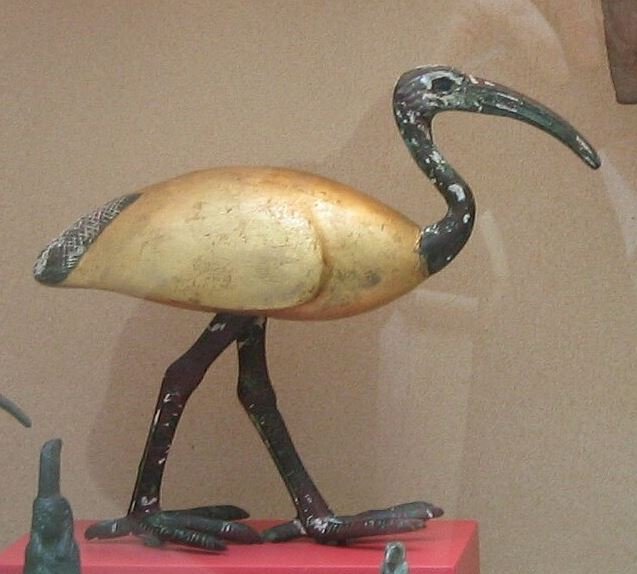
A statue of the Sacred Egyptian Ibis in Copenhagen Museum.
Ibis Mummification as a Votive Offering
Pilgrims from various regions of Egypt would travel to temples dedicated to Thoth to offer sacred ibis mummies as a token of devotion and a plea for divine favor. These mummies were often deposited in immense catacombs, some of which were operational for over 650 years. The scale of this practice was extraordinary; estimates suggest that around 8.5 million ibises were mummified and buried over time.
The temples responsible for the mummification and burial of these birds functioned as centers of religious and economic activity. The demand for ibis mummies was so high that temple workers and priests had to ensure a constant supply of birds.
The Role of Ibis Breeding Farms
For centuries, it was believed that the high demand for ibises led to the establishment of dedicated breeding farms, known as ibiotropheia (a term used by the Greek historian Herodotus). These farms were thought to have been widespread, producing thousands of birds annually.
However, recent mitochondrial DNA studies challenge this assumption, revealing that many of the mummified birds came from wild populations. While temple-based breeding programs likely existed to some extent, they appear to have been supplemented, if not largely replaced, by the capturing of wild ibises.
Despite this, the ibises held in temple flocks were carefully managed. The birds selected for mummification were usually young, and they were often killed by breaking their necks.
The Mummification Process
The mummification of sacred ibises varied in complexity. In some cases, entire birds were preserved, while in others, only select parts such as a leg or an eggshell were used. The level of preservation depended on the wealth of the devotee making the offering.
The mummies were often wrapped in linen, sometimes intricately decorated, and placed inside various containers. These included ceramic jars, wooden boxes, or even elaborate stone sarcophagi. Some were positioned with their heads tucked between their tail feathers, and a final touch of reverence included placing a small offering, often a snail, within the bird’s bill.
Special ibises, considered more sacred than others, were treated with greater care. Unlike standard offerings sourced from temple flocks, these birds were often transported from distant regions and given more elaborate burials.
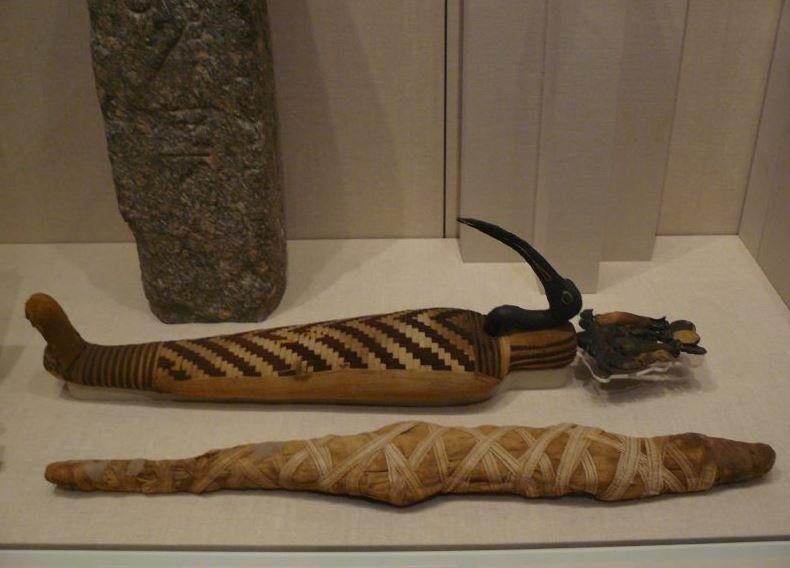
A mummified Ibis at Brooklyn Museum in the US.
Regional Differences in Ibis Worship and Burials
Though the veneration of the sacred ibis was widespread, different regions had their own variations in ritual practices. Certain temples were particularly famous for their ibis necropolises, such as those at Saqqara and Tuna el-Gebel. These sites housed massive underground galleries filled with rows of mummified birds.
Despite variations in practice, the overarching theme remained consistent: ibises were deeply intertwined with the worship of Thoth, and their preservation in mummified form was seen as a powerful means of securing divine favor.
The practice of mummifying ibis as offerings to Thoth was one of the most widespread and enduring religious customs in Egypt.
The Decline of Ibis Mummification
By the time of the Roman conquest of Egypt in 30 BCE, the tradition of mummifying ibises had largely diminished. The decline was likely due to a combination of factors, including changes in religious beliefs, shifts in political power, and the eventual adoption of Christianity, which led to the decline of Egyptian polytheistic practices.
The Sacred Ibis in Classical Writings
The sacred ibis also captured the imagination of ancient Greek and Roman authors. Herodotus described a legend in which ibises defended Egypt against invasions of “winged serpents” from Arabia. According to this account, each spring, these serpents attempted to cross into Egypt but were met by flocks of ibises, which prevented their passage by killing them.
Pliny the Elder recounted that sacrifices of the ibis could ward off pestilence, a belief that further cemented the bird’s sacred status. Claudius Aelianus, citing earlier sources, even claimed that the ibis was a virgin creature, reproducing through its bill—a notion that Aristotle later dismissed.
Interestingly, some medieval European scholars misinterpreted Herodotus’ writings and believed that the sacred ibis had human feet, a myth that persisted into the early 18th century.
The Ibis in Ancient Medicine and Science
In addition to religious associations, the sacred ibis was credited with medicinal and scientific knowledge. Pliny and the famous physician Galen suggested that the bird inspired the invention of the enema, as it was believed to cleanse itself using its beak. The notion persisted for centuries, with the 17th-century scientist Claude Perrault claiming to have discovered a specialized hole in the ibis’s bill that supported this idea.
Beyond its spiritual significance, the ibis was deeply embedded in mythology, classical literature, medicine, and even early scientific thought.
The Ibis and the Worship of Isis in Rome
By the first century BCE, the worship of Isis, a major Egyptian goddess, had spread to Rome. Alongside her worship, the sacred ibis became an emblematic bird in Roman religious practices. Frescoes and mosaics from the ruins of Pompeii and Herculaneum depict ibises, reflecting their status as sacred animals beyond Egypt’s borders.
Did you know…?
The sacred ibis appears in some translations of the Septuagint, the Greek version of the Hebrew Bible. It is listed among the unclean birds forbidden for consumption in Leviticus 11:17 and Deuteronomy 14:16. The bird’s inclusion in this list suggests that it was both well-known and viewed with a certain degree of caution in the ancient Near East.
The Legacy of the Sacred Ibis
Even after the decline of Egyptian polytheism, the sacred ibis remained an object of curiosity and scholarly interest. Napoleon’s expedition to Egypt in the late 18th century brought back mummified ibises to Europe, where they became subjects of early debates on evolution and natural history.
Today, the sacred ibis no longer inhabits Egypt, having disappeared from the region due to habitat loss and environmental changes. However, its legacy endures through archaeological discoveries and modern Egyptology. The vast catacombs of mummified ibises continue to provide valuable insights into the religious, economic, and environmental aspects of ancient Egyptian civilization.
Frequently Asked Questions about the African sacred ibis
What is the African sacred ibis?
The African sacred ibis (Threskiornis aethiopicus) is a wading bird native to much of Africa and parts of the Middle East. It belongs to the family Threskiornithidae and is best known for its association with the Egyptian god Thoth.

Thoth is portrayed holding a book and stylus, adorned with a crown resembling the moon.
How is the African sacred ibis classified taxonomically?
It is closely related to the black-headed ibis and the Australian white ibis, forming a superspecies complex. Some ornithologists consider these species conspecific due to their similarities and hybridization in mixed flocks.
Why was the African sacred ibis important in Ancient Egypt?
The bird was sacred to Thoth, the god of wisdom and writing. It was commonly mummified and offered in vast numbers at temples as a votive sacrifice. This practice continued for centuries until the Roman period.
READ MORE: Animal Sacrifice in Ancient Egypt
What does the African sacred ibis look like?
It has a white body with black plumes on its rump, a bald black head and neck, and a long, curved black bill. It has a wingspan of 112-124 cm and weighs between 1.35 and 1.5 kg. Juveniles have some feathering on their necks and duller plumage.

A view of a real life African sacred Ibis.
Where is the African sacred ibis found today?
It is widespread in sub-Saharan Africa and parts of the Middle East, particularly in Iraq and Iran. However, it has disappeared from Egypt, where it was once abundant.
How has the African sacred ibis adapted to modern environments?
It has benefited from irrigation and agricultural changes, expanding its range in southern Africa. It often feeds in human-modified landscapes, including refuse sites and farmlands.
Why is the species considered invasive in some regions?
Introduced populations have established in Europe, the UAE, and Taiwan, where they compete with native species. Invasive populations have been culled in countries such as France and Spain due to ecological concerns.
What does the African sacred ibis eat?
Its diet includes insects, crustaceans, fish, frogs, reptiles, small mammals, carrion, and even bird eggs. It is an opportunistic feeder, often foraging in wetlands and farmlands.
How does the African sacred ibis reproduce?
It nests in colonies, often alongside other wading birds. The female lays 1-5 eggs, which both parents incubate for about 21-29 days. Chicks fledge after 35-40 days and become independent shortly afterward.
What is the conservation status of the African sacred ibis?
The species is classified as “Least Concern” by the IUCN, with a population estimated between 220,000 and 450,000 individuals. However, habitat loss and hunting threaten some local populations.





