The Red Chapel of Hatshepsut
The Red Chapel of Hatshepsut, also known as the Chapelle Rouge, is a significant architectural and religious relic from Ancient Egypt. Built during the reign of Pharaoh Hatshepsut in the 18th Dynasty (circa 1479–1458 BCE), this barque shrine once served a central role in the religious life of the Karnak temple complex. Though dismantled in antiquity, the chapel was reconstructed in 1997 using its original blocks, providing modern viewers a glimpse into its original splendor.
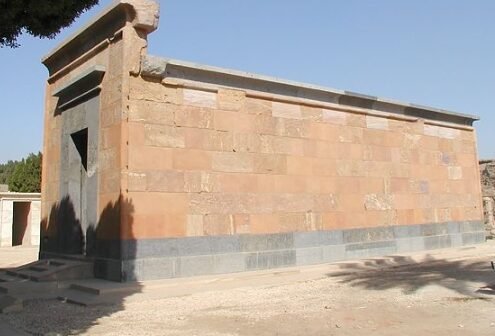
The Red Chapel of Hatshepsut at Karnak, near Thebes, viewed from the east, showcases its architectural alignment and prominence within the temple complex, highlighting its religious significance as a barque shrine dedicated to Amun.
Origins and Purpose
The Red Chapel was originally constructed to house the sacred barque of Amun, a small gilded wooden boat used to transport the statue of the deity during festivals. Ancient Egyptians believed that Amun, the sun deity, traversed the heavens and underworld in a nightly barque journey. Barques symbolized divine journeys and played a central role in religious ceremonies, including processions where the statue of Amun was carried on the shoulders of priests.
The chapel itself, likely situated in the central court of the Karnak temple near the obelisks of Hatshepsut, served as a resting place for the barque when not in ceremonial use.
Design and Structure
The Red Chapel measures approximately 18 meters in length, 6 meters in width, and 5.5 meters in height. It was constructed using a combination of red quartzite, black granite, and grey diorite, giving the structure a striking appearance. The upper portion of the chapel, crafted from red quartzite, inspired its name.
The chapel’s central feature was its function as the repository for the Userhat-Amun, the sacred barque of Amun.
The chapel consists of two open courts. The first court features a central basin, likely used to hold the barque model, while the inner court includes stone slabs marking positions for statues or barques. The chapel was raised on a diorite platform and accessed via short ramps on either side.
Positioned within the Karnak temple complex, the chapel stood adjacent to smaller cult shrines collectively called the “Hatshepsut Suite.” These shrines depicted the pharaoh presenting offerings to various deities. The chapel’s central feature was its function as the repository for the Userhat-Amun, the sacred barque of Amun.
The Role of the Barque in Egyptian Rituals
The Userhat-Amun represented Amun’s divine presence and was carried in grand processions during festivals, such as the Opet Festival and the Beautiful Feast of the Valley. These events symbolized Amun’s journey from his temple at Karnak to other significant locations. When not in use, the barque rested within its dedicated shrine in the Red Chapel.
Barque shrines became increasingly significant during the New Kingdom, and Hatshepsut’s chapel reflected the growing importance of this tradition. The chapel’s reliefs depicted key moments in these rituals, providing invaluable insight into the religious practices of the era.
Construction Under Hatshepsut
Hatshepsut began work on the chapel in the seventeenth year of her reign. It formed part of the Palace of Ma’at, a sanctuary honoring Ma’at, the ancient Egyptian concept of truth and cosmic order. The original suite of rooms in the same area may have been dismantled to accommodate the new chapel.
It is believed that the decoration of the chapel was incomplete at the time of Hatshepsut’s death. Upper sections of the chapel display reliefs featuring Thutmose III, her successor, suggesting that he completed parts of the structure.
Artistic and Religious Depictions
The reliefs on the Red Chapel highlight significant events during Hatshepsut’s reign. Some scenes depict priests carrying the barque through Thebes during religious festivals, while others show Hatshepsut in royal garb participating in her Heb-Sed festival, a ceremonial rejuvenation of the pharaoh’s rule.
A particularly intriguing inscription on Block 287 mentions a divine oracle proclaiming Hatshepsut as pharaoh. Scholars debate whether this event occurred during her father Thutmose I’s reign or during the early reign of Thutmose III, further complicating the chronology of her ascent to power.
The Red Chapel of Hatshepsut embodies the ingenuity and spiritual devotion of ancient Egyptian civilization.
Reliefs also feature Neferure, Hatshepsut’s daughter, performing duties as God’s Wife of Amun, a powerful religious role. These scenes underscore the importance of women in religious and political spheres during Hatshepsut’s reign.
Other carvings detail Hatshepsut’s expedition to Aswan to quarry stone for obelisks. These obelisks were transported on massive wooden barges and erected at Karnak as dedications to Amun. Such reliefs provide archaeologists with valuable insights into ancient construction techniques and religious symbolism.
Modifications by Thutmose III
Thutmose III, Hatshepsut’s stepson and co-regent, initially preserved her architectural contributions. He enhanced the chapel with additional reliefs, some depicting his role in Amun’s ceremonies. However, later in his reign, a campaign to erase Hatshepsut’s legacy began. Reliefs featuring her name and image were chiseled away or replaced, and some blocks were reused in other constructions at Karnak.
Destruction and Reuse
After Hatshepsut’s death, the Red Chapel was dismantled. Scholars debate whether this was a deliberate act to erase her memory or a practical decision to make room for larger structures. Many of the chapel’s blocks were repurposed in other building projects, including the construction of the Third Pylon by Amenhotep III.
Interestingly, some carvings survived intact because they were hidden within the walls of later structures. These preserved blocks offer a unique glimpse into the artistry and theological significance of Hatshepsut’s reign.
Rediscovery and Reconstruction
In the 1950s, over 300 blocks from the chapel were rediscovered during excavations at Karnak. These blocks were cataloged and studied, allowing archaeologists to piece together the chapel’s original design.
In 1997, French and Egyptian restoration experts reconstructed the Red Chapel at Karnak’s Open-Air Museum. Today, visitors can explore this remarkable structure, which stands as a testament to the architectural and religious achievements of Hatshepsut’s reign.
Though dismantled and obscured for centuries, its rediscovery and reconstruction ensure that the legacy of Hatshepsut continues to inspire and educate future generations.

From its role as a barque shrine in grand religious festivals to its intricate reliefs depicting key moments of Hatshepsut’s reign, the chapel offers invaluable insights into New Kingdom theology, politics, and art. Image: Thutmose III follows Hatshepsut in Red Chapel detail, highlighting restoration efforts.