Mortuary Temple of Hatshepsut
The Mortuary Temple of Hatshepsut, known as Djeser-Djeseru (“Holy of Holies”), was commissioned by Pharaoh Hatshepsut, one of ancient Egypt’s most remarkable rulers. Built during her reign in the 18th Dynasty of the New Kingdom, the temple was constructed at Deir el-Bahari, near Luxor, on the Nile’s west bank. Its design, overseen by the architect Senenmut, aimed to legitimize her position as a female pharaoh in a traditionally male-dominated role. Inspired by the nearby Temple of Mentuhotep II, it symbolized her divine birth, royal lineage, and close association with the god Amun-Re.
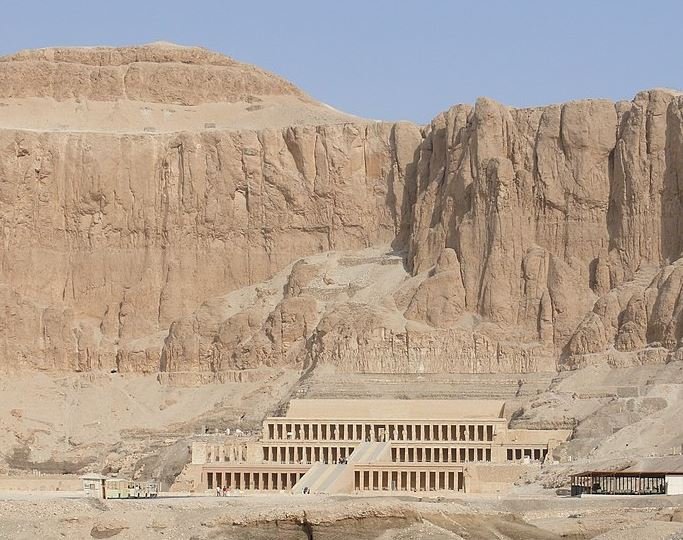
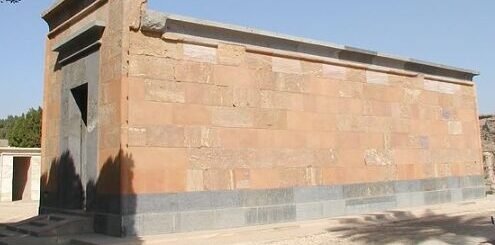
Image: Front view of the Mortuary Temple of Hatshepsut.
READ MORE: Major Accomplishments of Pharaoh Hatshepsut
Architectural Design
The temple features three massive terraces connected by ramps, ascending toward the dramatic cliffs of the Theban necropolis. The central axis reflects dual purposes:
- The east-west axis aligns with the sun and the Beautiful Festival of the Valley, during which Amun-Re’s barque was transported from Karnak to Deir el-Bahari.
- The north-south axis symbolizes Hatshepsut’s life cycle, from coronation to divine rebirth.
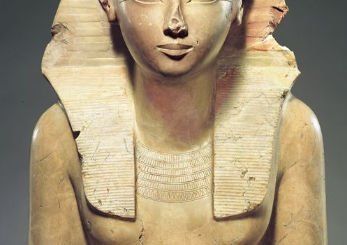
Constructed primarily of limestone, the temple includes the sanctuary of Amun, shrines to Hathor (goddess of love and music), and Anubis (god of embalming), gardens with exotic plants, and intricately decorated porticoes. It was a fusion of innovation and tradition, integrating elements of earlier Egyptian architecture with Minoan influences, demonstrating the era’s cultural connectivity.
Amun: Origin Story, Family, Meaning, Symbols, Power, & Facts
Historical Context
Hatshepsut’s temple was completed over 13 years (7th to 20th regnal years) and functioned as a funerary complex honoring her and her father, Thutmose I. It served as a ritual site for the pharaoh’s cult and the annual procession of the Beautiful Festival of the Valley, during which offerings were made to the gods and the deceased.
The design and iconography underscored her legitimacy as a ruler. Reliefs on the southwest portico depicted her famous expedition to the Land of Punt, emphasizing prosperity through exotic trade goods like myrrh, ivory, and incense. The northwest portico illustrated her divine birth, linking her directly to Amun-Re and asserting her divine right to rule.
Damages and Erasures
After Hatshepsut’s death, her successor, Thutmose III, ordered her images and cartouches to be erased. This campaign, conducted nearly 20 years later, may have aimed to solidify his lineage or eliminate the precedent of female kingship. However, the erasures were only partially completed.
During the Amarna Period, under Akhenaten’s religious reforms, depictions of Amun-Re were also damaged. Additionally, an earthquake during the Third Intermediate Period caused structural harm. Despite these events, significant portions of the temple have survived, preserving its historical legacy.
Rediscovery and Restoration
The temple was rediscovered in 1737 by Richard Pococke, with systematic excavations beginning in the 19th century under Auguste Mariette and the Egypt Exploration Fund. In the 20th century, further efforts by Herbert Winlock of the Metropolitan Museum and Émile Baraize of the Egyptian Antiquities Service revealed more of the temple.
Since 1961, the Polish Centre of Mediterranean Archaeology has led extensive restoration efforts, consolidating the temple’s structure and recovering its decorative elements. As of 2023, it remains open to visitors as a testament to Hatshepsut’s reign.
Cultural and Religious Significance
The Mortuary Temple of Hatshepsut reflects ancient Egypt’s funerary traditions and evolving religious beliefs. It honored Amun-Re, the state god, while celebrating Hatshepsut’s divine kingship and achievements. Its design embodied the spiritual journey of life, death, and rebirth, linking the living pharaoh to the gods and the afterlife.
The temple also highlights Egypt’s international trade networks, as seen in the depiction of the Punt expedition. This mission symbolizes prosperity and cultural exchange, essential elements of Hatshepsut’s reign.

Image: Osirian statues at the Temple of Hatshepsut.
Iconography and Art
The temple’s reliefs are among the most detailed of ancient Egyptian art. They provide insights into Hatshepsut’s propaganda, portraying her as Amun-Re’s chosen ruler. The Punt expedition scenes stand out for their vivid depiction of ships, goods, and Puntite people. The divine birth scenes emphasize her legitimacy through royal and divine lineage.
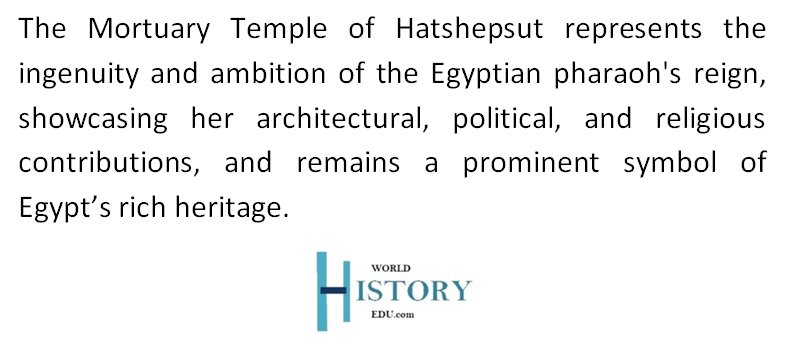
The temple also features statues of Hatshepsut, often in the guise of a male pharaoh, reflecting the challenges she faced in presenting herself as king.
Later Modifications
During the Ptolemaic era, parts of the sanctuary were repurposed, and additional structures were added, including chapels to Greek deities like Asklepios and Hygieia. Later, in the Coptic period, a monastery was established at the site, and Christian imagery was painted over some original reliefs.
Modern Significance
Today, the Mortuary Temple of Hatshepsut is considered one of ancient Egypt’s greatest architectural wonders. It represents Hatshepsut’s visionary leadership, her contributions to art, religion, and politics, and her ability to challenge societal norms. The temple continues to inspire scholars, architects, and visitors, standing as a symbol of Egypt’s enduring cultural legacy.
Frequently Asked Questions about the Mortuary Temple of Hatshepsut

Image: Aerial view of the temple.
What is the Mortuary Temple of Hatshepsut also called?
It is also known as Djeser-Djeseru, meaning “Holy of Holies.”
Where is the temple located?
The temple is situated at Deir el-Bahari, near Luxor, on the west bank of the Nile.
What is the architectural significance of the temple?
It is celebrated as a masterpiece of New Kingdom architecture, with a unique three-tiered design integrated into the dramatic cliffs of the Theban necropolis.
What are the key features of its design?
The temple comprises three ascending terraces connected by ramps, flanked by porticoes, and includes a sanctuary of Amun, shrines to Hathor and Anubis, and meticulously planned gardens.
What are the dual symbolic axes of the temple?
- The east-west axis aligns with the sun’s path and the Beautiful Festival of the Valley procession.
- The north-south axis represents the life cycle of the pharaoh, from coronation to rebirth.
How does the temple reflect Hatshepsut’s legitimacy?
Reliefs on the porticoes illustrate her divine birth, portraying her as Amun’s chosen offspring, and her expedition to Punt, highlighting her capability and prosperity.
What inspired the temple’s design?
It was inspired by the nearby Temple of Mentuhotep II, though it surpasses it in complexity and integrates Minoan architectural influences.
What damage has the temple sustained over time?
- Posthumous erasure by Thutmose III targeted Hatshepsut’s images and name.
- Akhenaten’s reforms during the Amarna Period damaged depictions of Amun.
- Later, it was altered during the Ptolemaic era and used as a Coptic monastery.
Who rediscovered and excavated the temple?
British traveler Richard Pococke rediscovered it in 1737. Systematic excavations were conducted in the 19th and 20th centuries, notably by the Polish Centre of Mediterranean Archaeology since 1961.