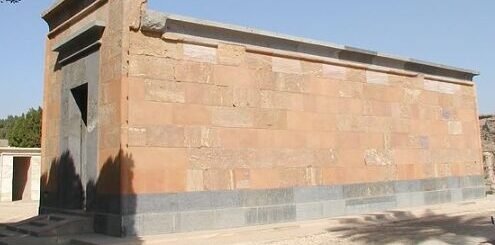
Statues of Egyptian Pharaoh Hatshepsut
The statuary of Maatkare Hatshepsut, one of ancient Egypt’s most remarkable female pharaohs, represents a unique chapter in the evolution of Egyptian royal art and ideology.
Hatshepsut, who ruled as king during the 18th Dynasty (c. 1479–1458 BCE), commissioned an extensive and varied array of sculptures that visually articulated her authority, divine legitimacy, and role within the traditional framework of Egyptian kingship. These statues, found primarily in her mortuary temple at Deir el-Bahari, reveal how she navigated the complexities of ruling as a woman in a role traditionally reserved for men.
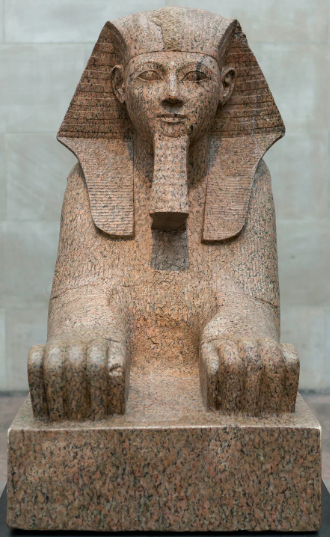
Sphinx of pharaoh Hatshepsut.
READ MORE: How did Queen Hatshepsut become pharaoh of Egypt?
Context and Historical Significance
Hatshepsut’s reign followed a period of instability and was marked by economic prosperity, ambitious building projects, and successful foreign expeditions. She initially ruled as regent for her stepson, Thutmose III, but later assumed full pharaonic authority, adopting the complete royal titulary and iconography of a king. This transition is reflected in her statuary, which evolved from representations of a female queen to those of a fully male pharaoh, aligning her with the visual and ideological traditions of Egyptian kingship.
Her statues serve as an essential visual record of her reign and demonstrate the strategic use of art to solidify her political position. Hatshepsut commissioned an extraordinary number of statues—more than any previous ruler—ranging from sphinxes and seated figures to standing colossi and Osiride representations. These statues were strategically placed within temples and public spaces to reinforce her divine authority and legitimacy as ruler.

Hatshepsut – Kneeling figure of Queen Hatshepsut, from Western Thebes, Deir el-Bahari, Egypt, c. 1475 BC. Neues Museum
Artistic Evolution and Iconography
Hatshepsut’s statuary is characterized by a gradual shift in artistic representation. Early in her reign, statues depicted her in a feminine form, wearing a tight-fitting dress with delicate facial features, reflecting her biological identity as a woman. However, as she consolidated her power, her statues began to depict her with traditionally male attributes, such as the nemes headdress, false beard, and shendyt kilt. This transformation was not merely an artistic choice but a deliberate political and religious strategy.
By adopting male regalia, Hatshepsut aligned herself with the conventions of Egyptian kingship, which was inherently male-oriented. Her statues, however, often retained subtle traces of her feminine identity, such as a more delicate facial structure or slender proportions. These hybrid representations suggest an attempt to navigate both her biological identity and the expectations of her office. In some inscriptions, she is even referred to using both male and female pronouns, further illustrating the fluidity of her self-presentation.
Types of Statuary
Hatshepsut’s statuary encompassed a wide variety of forms, each serving a specific purpose within the religious and political landscape of her reign. These statues can be broadly categorized into several types:
Seated and Standing Statues
Many of Hatshepsut’s statues depict her in a seated or standing pose, wearing the traditional garments of a pharaoh. These statues, often found at Deir el-Bahari, emphasize her role as a ruler offering to the gods. Some standing statues depict her with a scepter and ankh, symbols of power and life.
Osiride Statues
A significant portion of Hatshepsut’s statuary consists of Osiride figures, where she is depicted in the mummiform pose of the god Osiris. These statues, commonly placed within her mortuary temple, emphasize her divine association and role in the afterlife. The Osiride statues also reinforced the concept of renewal and rebirth, essential themes in Egyptian kingship.

Osirian statues of Hatshepsut at her tomb, one stood at each pillar of the extensive structure, note the mummification shroud enclosing the lower body and legs as well as the crook and flail associated with Osiris—Deir el-Bahri
Sphinxes
Hatshepsut commissioned numerous sphinx statues, blending the body of a lion with a human head, symbolizing strength and divine protection. These sphinxes, some colossal in size, were prominently displayed in temple processions and along the causeways leading to her temples. Some were later defaced or repurposed by subsequent rulers, particularly Thutmose III.
Offering Bearer Statues
Another unique aspect of Hatshepsut’s statuary includes representations of her as an offering bearer, kneeling and presenting gifts to the gods. These statues underscore her devotion to the divine and reinforce the king’s role as the intermediary between the gods and the people.
Material and Craftsmanship
Hatshepsut’s statues were crafted from a variety of materials, including limestone, granite, and sandstone. The choice of material often depended on the intended location and purpose of the statue. Red granite was frequently used for more formal representations, while limestone was preferred for painted statues within temple settings.
The craftsmanship of her statues is remarkable, showcasing the high level of skill achieved by Egyptian sculptors during the 18th Dynasty. The statues exhibit a refined attention to detail, particularly in facial features and inscriptions. Many of her statues were meticulously inscribed with her royal titulary, reinforcing her divine legitimacy and right to rule.
Through a careful blend of traditional and innovative artistic strategies, Queen Hatshepsut navigated the complexities of kingship and solidified her place in history.
Function and Placement
The placement of Hatshepsut’s statues was carefully considered to maximize their impact. Many were positioned along processional routes, within temple courts, and in sanctuaries, ensuring that her image was omnipresent in sacred and public spaces. The statues at Deir el-Bahari, in particular, played a crucial role in her mortuary cult, ensuring her continued veneration and divine protection in the afterlife.
Her statues were not merely decorative but served a ritualistic and ideological function. By depicting herself in various forms—as a sphinx, as Osiris, or as a traditional king—Hatshepsut reinforced her connection to Egypt’s religious and political traditions. These statues also functioned as a means of asserting her legitimacy, particularly in the face of opposition from those who may have questioned her right to rule.
Destruction and Reuse
Despite the grandeur and significance of Hatshepsut’s statues, many were systematically destroyed or repurposed after her death, particularly during the reign of Thutmose III. This destruction was likely part of a broader attempt to erase her legacy and restore the traditional line of male succession. Many of her statues were broken, buried, or re-carved to depict other rulers.
Some scholars argue that this erasure was not necessarily an act of personal animosity but rather a political move to realign the dynastic narrative. The destruction of her images was selective, with some statues being left intact while others were meticulously defaced. This suggests a complex and nuanced approach to historical revisionism, rather than outright condemnation.
Legacy and Modern Rediscovery
Hatshepsut’s statuary was rediscovered in the 19th and 20th centuries, with many pieces now housed in museums around the world, including the Metropolitan Museum of Art in New York and the Egyptian Museum in Cairo. These statues provide invaluable insights into the artistic conventions, political strategies, and religious ideologies of her time.
The rediscovery and restoration of her statues have allowed scholars to reconstruct her reign and challenge earlier narratives that depicted her as an anomaly or usurper. Instead, modern research highlights her as a capable and innovative ruler who skillfully utilized art and architecture to shape her legacy.

How did Hatshepsut’s successors attempt to erase her legacy?
Frequently asked questions about the Statuary of Maatkare Hatshepsut
How did Hatshepsut use art to define her kingship?
As a female ruler in a traditionally male role, Hatshepsut relied heavily on art to legitimize her authority. She commissioned statues that depicted her in traditional male pharaonic poses, allowing her to align with the visual conventions of kingship while reassuring her subjects of her legitimacy.
How did Hatshepsut’s artistic representations evolve over time?
Initially, her statues depicted her with feminine features, wearing a sheath dress typical of royal women. Over time, she adopted male regalia, including the nemes headdress, shendyt kilt, and false beard. The transition was gradual, with some statues blending both masculine and feminine traits.
Did Hatshepsut completely erase her feminine identity in her artwork?
No, despite adopting a male identity for political purposes, elements of her femininity remained evident. Even in statues where she appears fully male, inscriptions refer to her as “Daughter of Re” and “Lady of the Two Lands,” indicating that she did not entirely discard her female identity.
What positions did Hatshepsut hold before becoming pharaoh?
She was the daughter of Pharaoh Thutmose I and first served as the God’s Wife of Amun, a powerful religious title. She later became queen by marrying her half-brother, Thutmose II.
How did Hatshepsut become pharaoh?
When Thutmose II died around 1478 BCE, his only male heir, Thutmose III, was still a child. Hatshepsut initially ruled as regent but later declared herself pharaoh around 1473 BCE, establishing a co-regency in which she took senior authority.
Why did Hatshepsut need to justify her rule?
As a woman in a traditionally male role, her kingship was unprecedented. While there were no laws against a female pharaoh, ruling over a male heir was highly unconventional. She used art to reinforce her legitimacy and present herself as a capable leader.
What are some examples of her artistic depictions?
Early statues show her in female clothing but wearing pharaonic symbols like the nemes headdress. Later, her statues depict her with a masculine torso, bare chest, and kilt. Eventually, she was fully represented as a male pharaoh, often in devotional poses, offering to the gods, or as a sphinx.
What is the significance of the Osiride statues of Hatshepsut?
Found at her mortuary temple at Deir el-Bahari, these statues depict her as the god Osiris—bearded, mummified, and standing in a divine pose. They emphasize her association with the afterlife and divine kingship.
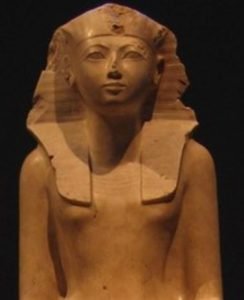
What unique artistic choices did Hatshepsut make in her depictions?
Some statues were painted with an unusual orange skin tone, blending the deep red typically used for men and the lighter yellow associated with women, suggesting she experimented with her artistic presentation.
Did her artistic representations reflect how she looked in real life?
No, Egyptian art was highly idealized. Hatshepsut likely did not walk around bare-chested or with a false beard. These elements were symbolic, used to communicate her legitimacy and strength as a ruler.

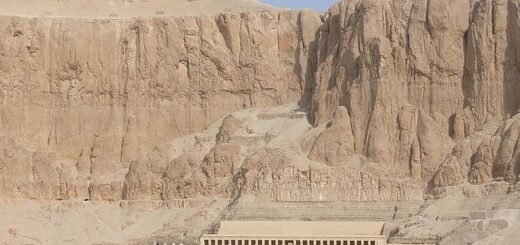
A view of the mortuary temple of Hatshepsut.
Why were many of her statues destroyed?
After her death, Thutmose III likely ordered the destruction of her statues to reinforce male succession and traditional kingship. Despite this, many pieces survived, offering insight into her reign and political strategy.
READ MORE: What is the meaning of the Latin phrase “Damnatio memoriae”?
What does her surviving artwork reveal about her rule?
Her statues and inscriptions highlight her intelligence, innovation, and political acumen. They demonstrate how she skillfully used art to navigate the challenges of being a female ruler in ancient Egypt.
Hatshepsut’s ability to manipulate artistic conventions to suit her needs remains one of the most fascinating aspects of her rule, marking her as one of ancient Egypt’s most remarkable and influential pharaohs.