Heracles and Lichas in Greek Mythology
In Greek mythology, the story of Heracles and Lichas is a dramatic tale intertwined with themes of loyalty, betrayal, and tragic consequences. Heracles, also known as Hercules in Roman mythology, is one of the most celebrated heroes in ancient mythology, famed for his incredible strength, numerous labors, and extraordinary feats. His story is rich with adventure, but it also includes moments of suffering and personal turmoil. One of the pivotal episodes in Heracles’ life involves Lichas, his devoted servant, whose fate is tied to an unfortunate misunderstanding.

In Greek mythology, Lichas was the servant of the demigod Heracles. Image: Detail from Hercules and Lichas (1795), by Italian sculptor Antonio Canova
The Background of Heracles’ Marriage
Heracles’s marriage to Deianira, a princess of Calydon, set the stage for the tragic events involving Lichas. Deianira was aware of Heracles’ history with other women and feared losing his affection. This fear became especially pronounced when Heracles became infatuated with Iole, a beautiful woman he had taken as a captive. Deianira’s jealousy over Heracles’ interest in Iole would ultimately lead to unintended consequences that involved Lichas and sealed the hero’s fate.

Portrait of Deianira by Evelyn De Morgan
The Role of Nessus and the Poisoned Garment
The origin of the poisoned garment lies in an earlier encounter Heracles and Deianira had with Nessus, a centaur. While helping them cross a river, Nessus attempted to assault Deianira, prompting Heracles to shoot him with a poisoned arrow dipped in the venomous blood of the Lernaean Hydra.

Deianira and the dying centaur Nessus, by Howard Pyle
As Nessus lay dying, he cunningly told Deianira that his blood would act as a potent love charm. Deianira, unaware of the deception, collected some of his blood, thinking it would ensure Heracles’ fidelity should she ever need it.
Lichas and the Delivery of the Garment
Years later, when Deianira feared losing Heracles to Iole, she decided to use the so-called love charm. She entrusted Lichas, Heracles’ faithful servant, with the task of delivering the garment to Heracles. Lichas had no knowledge of the garment’s true nature or the deadly properties it possessed. Following Deianira’s instructions, he presented the robe to Heracles, believing he was serving his master loyally.

Lichas bringing the garment of Nessus to Hercules, engraving of German painter Hans Sebald Beham for the “Labors of Hercules” (1542–1548)
Heracles’ Agony and Lichas’ Fate
When Heracles donned the garment, the Hydra’s venom infused into the fabric began to burn through his skin, causing him unbearable pain. The poison acted relentlessly, and no matter what he did, Heracles could not remove the garment.
Enraged by the torment and the betrayal he perceived, Heracles turned his fury toward Lichas, whom he believed was complicit in the scheme. In a fit of uncontrollable rage, Heracles grabbed Lichas and hurled him into the sea.
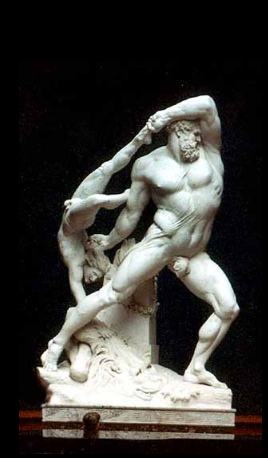
Hercules and Lichas (1795), by Italian sculptor Antonio Canova
According to the myth, Lichas was flung with such force that his body became the Lichadian islands, a group of small islets located between Euboea and the coast of Locris. This act not only sealed Lichas’ tragic fate but also left a permanent mark on the geographical landscape, forever linking his name to the region.
The Aftermath and Heracles’ Realization
After Lichas’ death, Heracles’ agony continued, and he realized that the garment was not an act of malice by Lichas but rather the result of Deianira’s misguided attempt to secure his love.
Consumed with remorse and pain, Heracles sent for his son, Hyllus, and instructed him to build a funeral pyre on Mount Oeta. Heracles, recognizing that death was the only escape from his suffering, lay on the pyre and awaited his end.
Zeus, Heracles’ father, intervened at the last moment, granting him immortality and a place among the gods on Mount Olympus.

Death of Hercules, Scorched by the Centaur Nessus Tunic – Francisco de Zurbarán (1598-1664) – PD-art-100
Literary References
The story of Heracles and Lichas is recounted in classical works that explore themes of loyalty, tragic error, and the unintended consequences of well-meaning actions.
Sophocles’ play Women of Trachis provides a dramatic retelling of the events leading to Heracles’ demise and highlights Deianira’s internal struggle and eventual regret upon realizing the devastating impact of her actions.
Ovid’s Metamorphoses also references the episode, showcasing the moment Heracles hurls Lichas into the sea.
These literary accounts emphasize the complexity of human emotions and the potential for even the best intentions to lead to catastrophic outcomes. Lichas, while a minor character in the grand narrative of Heracles’ life, serves as a symbol of the unintended victims caught in the crossfire of greater conflicts.
READ MORE: The Three Most Acclaimed Ancient Greek Tragedians
Did you know…?
According to Roman poet Ovid, Cape Lichada is said to be the location where Heracles threw Lichas into the sea, tying his name to the surrounding area. Also known as Mount Lichada, Cape Lichada forms the northwest tip of Euboea, Greece, previously called Kenaion (Latinized as Cenaeum). A village named Lichada lies on its slopes, near the ancient town of Dium.
The mountain stands 677 meters (2,221 ft) high. On its summit, there was an altar dedicated to Zeus Kenaios. According to Sophocles, Heracles built altars to Zeus Patroos there, performed sacrifices.
Themes and Symbolism
The story of Heracles and Lichas encapsulates the themes of loyalty, loyalty’s repercussions, and the tragic consequences of deception. Lichas’ fate is a testament to how acts of service, when combined with misjudgment and misunderstanding, can lead to unintended suffering. The myth also underscores the destructive power of unchecked emotions. Heracles’ rage and Deianira’s jealousy contribute to a series of irreversible events, reminding readers and audiences of the inherent fragility in human relationships.
The tale of Heracles and Lichas stands as an allegory for loyalty, the consequences of deception, and the emotional volatility that can lead to tragedy.
Heracles’ ultimate ascension to godhood adds a layer of redemption to the story, symbolizing that suffering and atonement can lead to transformation and transcendence. This arc reinforces the ancient Greek belief in the duality of heroism: it involves not only triumphs and feats of strength but also struggles, vulnerability, and the capacity for growth.
Legacy
The myth of Heracles and Lichas has endured through centuries as part of the rich tapestry of Greek mythology. It continues to be studied and referenced as an example of how myths convey deep human truths through narrative drama. The tragic elements within the story serve as a powerful reminder that even heroes are not immune to errors and their devastating consequences.
Frequently Asked Questions
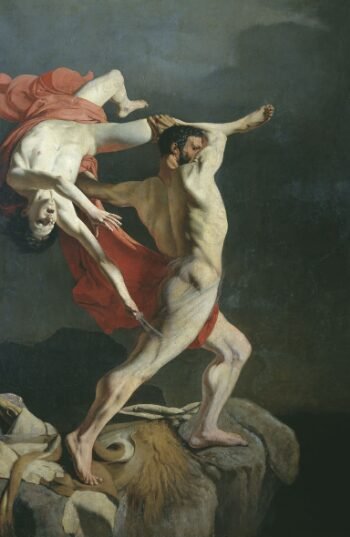
Hercules wore the deadly Shirt of Nessus, delivered by his servant Lichas. Upon realizing the shirt’s lethal nature, Heracles, in his agony, threw Lichas into the sea. Hercules and Lichas (Pavel Sorokin, 1849).
Who was Lichas in Greek mythology?
Lichas was the servant of Heracles who played an inadvertent role in Heracles’ demise.
What task did Deianira give to Lichas?
Deianira sent Lichas to deliver a poisoned garment soaked in the blood of the centaur Nessus to Heracles, believing it to be a love charm.
Why did Deianira send the poisoned garment to Heracles?
Deianira, out of jealousy over Iole, sent the poisoned garment in an attempt to reclaim Heracles’ love.
What was the result of Heracles wearing the poisoned garment?
The garment caused Heracles excruciating pain and suffering.
How did Heracles react to the betrayal involving the poisoned garment?
Enraged by the pain and betrayal, Heracles hurled Lichas into the sea.
What geographical feature is associated with Lichas’ fate?
The Lichadian islands, located between Euboea and the coast of Locris, are said to be named after Lichas.
In which classical works is the story of Lichas recounted?
The story is detailed in Sophocles’ Women of Trachis and Ovid’s Metamorphoses.
What themes are illustrated by the story of Lichas and Heracles?
The story highlights themes of loyalty, tragic error, and the unintended consequences of deception.





