History of Mecca
Mecca, officially known as Makkah al-Mukarramah, is the capital of Mecca Province in the Hejaz region of western Saudi Arabia. It is the holiest city in Islam and a major religious, historical, and cultural center.
Located inland from the Red Sea, Mecca has a population of over 2.5 million people and hosts millions of pilgrims annually during Hajj.
In the article below, World History Edu explores Mecca’s history, religious significance, governance, and modern development.
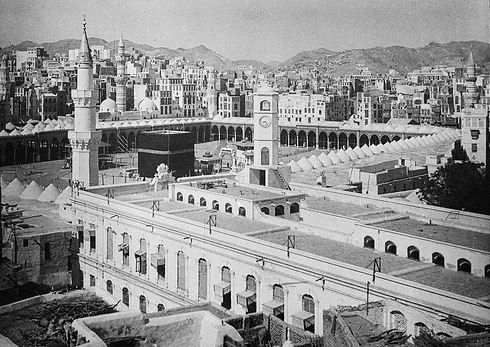
A 1910 photo of Mecca.
Historical Significance
Mecca is regarded as the birthplace of Prophet Muhammad and the site of the first revelation of the Quran. The city is home to the Great Mosque, Masjid al-Haram, which houses the Ka’bah, the most sacred site in Islam. Islamic tradition holds that the Ka’bah was originally built by Prophet Abraham and his son, Ishmael.
READ MORE: Most Famous Prophets in Islam
Early History
Mecca has been inhabited since antiquity. It is mentioned in the Quran as Bakkah and is believed to have been a center of trade and religious activity long before Islam. The Quraysh tribe, to which Prophet Muhammad belonged, controlled Mecca and its economy, benefiting from the annual pilgrimage to the Ka’bah even before Islam.
Masjid al-Haram is Islam’s holiest mosque, accommodating millions of worshippers and serving as the site for key Hajj and Umrah rituals.

An aerial view of Masjid al-Haram
The Islamic Era
In 610 CE, Prophet Muhammad received his first revelation in the Cave of Hira near Mecca. After facing persecution, he and his followers migrated to Medina in 622 CE. However, in 630 CE, Muhammad and his followers conquered Mecca, cleansing the Ka’bah of idols and establishing Islam as the city’s dominant faith.
Medieval and Ottoman Period
Mecca remained a center of Islamic scholarship and pilgrimage through the medieval period. The city saw fluctuating control between various Islamic caliphates, including the Umayyads, Abbasids, and later, the Ottoman Empire. The Ottomans played a significant role in maintaining the city’s infrastructure and ensuring safe passage for pilgrims.
READ MORE: Rashidun Caliphate and the First Four Muslim Caliphs of the Islamic World
Modern History
In 1925, Ibn Saud conquered Mecca, incorporating it into the newly formed Kingdom of Saudi Arabia. The Saudi government has since undertaken extensive modernization projects, including the expansion of the Masjid al-Haram to accommodate the growing number of pilgrims.
Religious Importance of Mecca
Mecca is the spiritual heart of Islam, with the Ka’bah serving as the qibla (direction of prayer) for Muslims worldwide. The city hosts the annual Hajj pilgrimage, one of the Five Pillars of Islam, which is obligatory for all able Muslims at least once in their lifetime. Additionally, the Umrah pilgrimage, which can be performed at any time of the year, attracts millions of visitors.
The Ka’bah and Masjid al-Haram
The Ka’bah, a cube-shaped structure at the center of Masjid al-Haram, is considered the most sacred site in Islam. Pilgrims perform the Tawaf, a ritual involving circumambulation of the Ka’bah, as part of Hajj and Umrah. The mosque itself has undergone numerous expansions to accommodate millions of worshippers.

The Ka’bah during Hajj is a profound sight, surrounded by millions of pilgrims dressed in white.
Other Holy Sites
- Zamzam Well: A well believed to have been provided by Allah to Hagar and her son Ishmael.
- Safa and Marwa: Two hills between which Hagar ran in search of water, commemorated in the Sa’ee ritual.
- Jabal al-Nour: The mountain where Prophet Muhammad received his first revelation.
- Mina, Muzdalifah, and Arafat: Key sites in the Hajj pilgrimage.
Governance and Administration of Mecca
Mecca is governed by the Mecca Regional Municipality under the Saudi government. The mayor, known as the Amin, is appointed by the government, and the city serves as the capital of the Mecca Province. The administration is responsible for infrastructure, public services, and ensuring the smooth operation of the Hajj pilgrimage.
Did you know…?
- Mecca has a diverse population, with many residents originating from different parts of the Muslim world. The city’s population surges during Hajj, often exceeding three million people. Non-Muslims are strictly prohibited from entering Mecca.
- Mecca’s culture reflects its religious significance. Traditional Islamic values influence daily life, and the city is home to many religious scholars and institutions. The presence of international pilgrims contributes to Mecca’s cosmopolitan atmosphere.
Economic Importance
While Saudi Arabia’s economy is largely dependent on oil, Mecca’s economy thrives on religious tourism. Pilgrims contribute significantly to local businesses, including hotels, transportation, and food services. The Hajj season alone generates billions of dollars in revenue, supporting thousands of jobs.
Key Economic Sectors
- Hospitality and Accommodation: Numerous hotels cater to pilgrims.
- Retail and Commerce: Markets and shopping malls serve visitors and locals alike.
- Transportation: The Haramain High-Speed Railway connects Mecca with Medina and Jeddah.
- Infrastructure Development: Ongoing projects include the expansion of Masjid al-Haram and other facilities to improve pilgrim services.
While modernization efforts have transformed Mecca, balancing development with heritage preservation remains a key challenge.
Modernization and Urban Development
The Saudi government has invested heavily in Mecca’s development. Projects like the Abraj Al Bait Towers, one of the tallest buildings in the world, and the expansion of transportation networks have transformed the city’s skyline.
Major Development Projects
- Masjid al-Haram Expansion: Increasing the mosque’s capacity to accommodate more pilgrims.
- Abraj Al Bait Towers: A massive complex housing hotels, shopping centers, and the Mecca Clock Tower.
- Haramain High-Speed Rail: A high-speed railway linking Mecca with Medina and Jeddah.
- Jabal Omar Project: A luxury development project near Masjid al-Haram.

Challenges
- Overcrowding during Hajj: Managing millions of pilgrims poses logistical challenges.
- Infrastructure Strain: Continuous expansion is required to meet growing demand.
- Preservation of Heritage: The rapid modernization has led to the demolition of historic sites, sparking controversy.
Future Prospects
The Saudi government aims to further expand Mecca’s infrastructure and services. With initiatives like Vision 2030, Mecca’s role as a global religious tourism hub is expected to grow. Planned projects include new transportation links, smart city initiatives, and enhanced facilities for pilgrims.
Frequently Asked Questions
What is the significance of Mecca in Islam?
Mecca is the holiest city in Islam, the birthplace of Prophet Muhammad, and the site of the Ka’bah in Masjid al-Haram, the direction of Muslim prayer and pilgrimage.

The gates of the Prophet’s Mosque in Medina bear the inscription, ‘Muhammad, the Messenger of God.’
Why is the Ka’bah important?
The Ka’bah is believed to have been built by Prophet Abraham and Ishmael and serves as the focal point for Muslim prayer and pilgrimage rituals.
What is the Hajj pilgrimage?
Hajj is an obligatory pilgrimage for all able Muslims, performed annually, involving rituals in Mecca, Mina, Muzdalifah, and Arafat.
Mecca’s economy is primarily driven by religious tourism, with millions of pilgrims contributing to hospitality, retail, and transportation sectors.
What role does the Saudi government play in Mecca’s administration?
The Saudi government oversees Mecca through the Mecca Regional Municipality, managing infrastructure, public services, and Hajj logistics.
What are some key modernization projects in Mecca?
Major projects include the expansion of Masjid al-Haram, the Abraj Al Bait Towers, the Haramain High-Speed Rail, and the Jabal Omar Development.
Why are non-Muslims prohibited from entering Mecca?
Islamic law designates Mecca as a sacred city, restricting entry to Muslims to preserve its religious sanctity.
How does Mecca accommodate the massive influx of pilgrims?
The city expands its infrastructure yearly, providing additional lodging, transport, and crowd management measures during Hajj.
Mecca’s history includes its conquest by Prophet Muhammad in 630 CE, Ottoman rule, and its incorporation into Saudi Arabia in 1925.
What is the significance of Jabal al-Nour?
Jabal al-Nour houses the Cave of Hira, where Prophet Muhammad received his first revelation from the Angel Jibreel.

A view of the Jabal al-Nour.
What transportation options connect Mecca to other cities?
Mecca is connected by highways, the Haramain High-Speed Rail, and is accessible via King Abdulaziz International Airport in Jeddah.





