Sandro Botticelli’s Primavera
Sandro Botticelli’s Primavera, painted in the late 1470s or early 1480s, is one of the most celebrated and extensively analyzed paintings in Western art. The large panel painting, executed in tempera, embodies the intellectual and artistic vigor of Renaissance Florence. The painting’s enigmatic iconography, classical influences, and intricate botanical details have intrigued scholars and audiences alike for centuries. Currently housed in the Uffizi Gallery in Florence, Primavera remains a significant example of mythological and allegorical painting, reflecting Renaissance Neoplatonism and the patronage of the Medici family.

A close view of the “Primavera”
Composition and Figures
The painting portrays a collection of figures from classical mythology set within an abundant garden. The composition, often interpreted from right to left, is carefully arranged to create a sense of harmony and movement. The scene is dominated by Venus (Aphrodite in Greek mythology), positioned centrally, with a red-draped garment and standing within an arch formed by the trees. Above her, Cupid (Roman god of love), blindfolded, aims his arrow towards the dancing Three Graces (i.e. the Charites in Greek mythology), a group of three lightly clad women representing beauty, charm, and joy. Mercury, the god of communication and protector of boundaries, stands on the far left, dressed in red and raising his caduceus toward the sky.
To the right, Zephyrus, the wind god, pursues the nymph Chloris. According to mythology, Zephyrus transforms Chloris into Flora, the goddess of spring, as indicated by the flowers flowing from her mouth. Flora, now fully adorned in a floral dress, scatters blossoms across the ground, symbolizing fertility and renewal. The depiction of flowers in the painting is particularly remarkable, as it contains over 500 plant species, meticulously detailed to emphasize the vibrancy of spring.

A self-portrait of Sandro Botticelli.
READ MORE: 14 Major Ancient Roman Gods and Goddesses
Symbolism and Interpretations
The central theme of the painting is the arrival of spring, conveyed through the depiction of growth, transformation, and love. Scholars generally agree that Primavera is an allegory of fertility and the rejuvenation of nature. Venus, standing at the heart of the composition, represents harmony and the guiding force of love. The Three Graces are often linked to concepts of virtue and the ideal qualities of a well-formed soul in Neoplatonic philosophy.
The figures on the right depict a narrative of change and transformation, reinforcing the cyclical nature of seasons. The presence of Zephyrus and Chloris evolving into Flora signifies the awakening of nature under the influence of divine forces. Meanwhile, Mercury, often associated with intellect and enlightenment, dispels the last remnants of winter clouds with his caduceus, ensuring the arrival of a fruitful season.
The painting’s garden, depicted with exceptional botanical accuracy, further underscores its theme. The inclusion of oranges is thought to allude to the Medici family, suggesting a connection between the renewal of nature and Medici power.

Literary and Classical Influences
Botticelli’s work reflects a deep engagement with classical texts, particularly the poetry of Ovid and Lucretius. The story of Chloris and Zephyrus is drawn from Ovid’s Fasti, which describes the transformation of Chloris into Flora.
Additionally, the painting is believed to incorporate elements from De Rerum Natura by Lucretius, where Venus is depicted as the bringer of life and fertility. These literary references suggest the influence of Florentine intellectuals such as Poliziano, a poet at the Medici court, who may have contributed to the painting’s allegorical framework.
Neoplatonism, a philosophical movement that sought to reconcile classical thought with Christian ideals, plays a critical role in Primavera. The painting embodies Neoplatonic concepts of love, with Venus serving as the mediator between earthly desires and divine intellect. This dual nature of Venus mirrors the Virgin Mary, a connection reinforced by her modest posture and welcoming hand gesture, which resembles depictions of the Annunciation.

A closer view of Venus, depicted on the “Primavera”.
Patronage and Historical Context
The exact origins of Primavera remain uncertain, though it is widely believed to have been commissioned by the Medici family. Specifically, Lorenzo di Pierfrancesco de’ Medici, a cousin of Lorenzo de’ Medici (Lorenzo the Magnificent), is thought to have commissioned the work, possibly as a wedding gift. The painting was later documented in an inventory of his collection in 1499, where it was described as hanging above a lettuccio, a type of Renaissance bench.
During the 16th century, Primavera was moved to the Villa di Castello, a Medici estate outside Florence, where Giorgio Vasari first documented it in 1550. Vasari’s description contributed significantly to the painting’s legacy, as he named it Primavera and recognized its artistic and intellectual depth. Over the centuries, the painting remained within the Medici collections, eventually being transferred to the Uffizi Gallery in 1919.
Artistic Style and Technique used by Botticelli
Botticelli’s artistic approach in Primavera is distinctively linear and decorative, emphasizing the fluidity of contours and the elegance of figures. Unlike the robust, naturalistic forms seen in High Renaissance works, Botticelli’s figures possess an ethereal quality, characterized by elongated proportions and graceful gestures. The composition adheres to a Gothic-like arrangement, where figures are aligned in a horizontal sequence rather than a fully developed spatial setting.
The painting also exhibits influences from Flemish tapestries, particularly in its detailed floral background. The extensive botanical accuracy aligns Primavera with the tradition of millefleur tapestries, which were prized for their decorative and symbolic richness. The figures’ attire, though inspired by classical themes, reflects contemporary Florentine fashion, particularly the elaborate, almost theatrical drapery seen in civic celebrations and masquerades of the period.
Primavera’s artistic style combines Gothic influences with Renaissance realism, featuring intricate floral details, complex figure interactions, and a tapestry-like composition.
Botticelli’s use of tempera, a medium that involves pigment mixed with egg yolk, contributes to the painting’s luminosity and fine detailing. The technique allows for delicate transitions in shading, visible in the soft rendering of skin tones and the intricate floral embellishments in Flora’s dress. The lack of strong chiaroscuro, a defining feature of later Renaissance works, gives the painting a dreamlike quality, reinforcing its mythological and allegorical nature.
Influence and Legacy
Primavera has had a lasting impact on the history of art, inspiring numerous interpretations and artistic references. Its idealized figures and harmonious composition influenced later Renaissance and Mannerist artists who sought to combine classical themes with innovative artistic expressions. The painting’s mythological subject matter, relatively rare at the time, contributed to a broader acceptance of classical themes in Renaissance art, paving the way for future works that blended mythology, allegory, and portraiture.
During the 19th and early 20th centuries, the painting was rediscovered and admired by the Pre-Raphaelite artists, who sought to revive the aesthetic qualities of early Renaissance painting. Its influence can be seen in the works of artists such as Edward Burne-Jones and Dante Gabriel Rossetti, who embraced its linear grace and thematic depth.
Conservation and Display of Botticelli’s Primavera
Over the centuries, Primavera has undergone several conservation efforts to maintain its vibrancy and structural integrity. The painting has darkened over time, affecting the brightness of its original colors. A significant restoration in 1978 helped stabilize its condition and improve its visibility.
Today, Primavera remains one of the most visited artworks in the Uffizi Gallery, continuing to captivate audiences with its timeless beauty and complex symbolism.
Frequently Asked Questions about Primavera
What figures appear in Primavera?
The painting features Venus at the center, with Zephyrus pursuing Chloris, who transforms into Flora. The Three Graces dance nearby, Mercury disperses clouds, and Cupid aims an arrow.
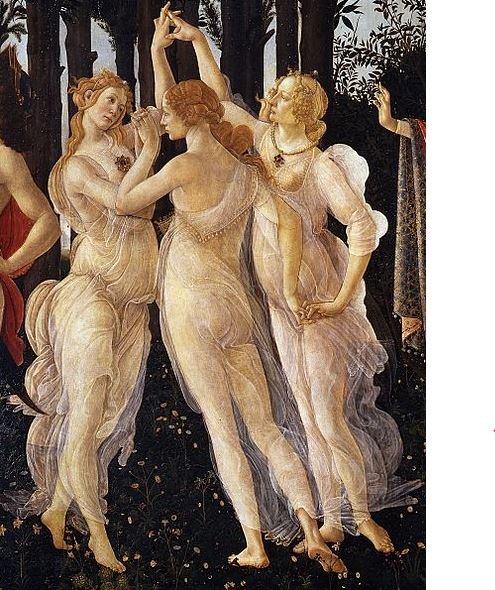
A closer look at the The Three Graces, as featured on the “Primavera”.
What is the painting’s main theme?
It is an allegory of spring’s fertility and renewal, possibly influenced by Neoplatonism, symbolizing the harmony between earthly love and divine beauty.
Who commissioned Primavera?
It was likely commissioned by Lorenzo di Pierfrancesco de’ Medici for his marriage in 1482, though its exact origins remain uncertain.

A portrait of Lorenzo di Pierfrancesco de’ Medici.
What literary sources influenced Primavera?
The painting draws from Ovid’s Fasti, Lucretius’ De rerum natura, and possibly poems by Poliziano, a Medici court poet.
Why is Venus central to the painting?
Venus, presiding over the garden, symbolizes love and harmony, framed in an arch resembling religious depictions of the Virgin Mary.
How does Primavera relate to The Birth of Venus?
Both paintings, housed in the Uffizi Gallery, depict classical mythology on a grand scale and were linked to Medici patronage.





