The Fall of Constantinople in 1453
The Fall of Constantinople, also known as the conquest of Constantinople, was a defining moment in world history. The capture of the Byzantine capital by the Ottoman Empire on May 29, 1453, marked the culmination of a 55-day siege that began on April 6 of the same year. Led by the young and ambitious Sultan Mehmed II, the Ottoman forces outnumbered the defenders of Constantinople, who were under the command of the last Byzantine Emperor, Constantine XI Palaiologos. After its conquest, Mehmed II made Constantinople the new capital of the Ottoman Empire, replacing Adrianople.
The event is widely regarded as a watershed of the Late Middle Ages, marking the effective end of the Roman Empire, which had endured for nearly 1500 years. It also signaled the beginning of the early modern period and changed the course of military history, particularly with the introduction of gunpowder-based siege tactics.
In the article below, World History Edu explores the historical background, siege, and impact of the fall of Constantinople.
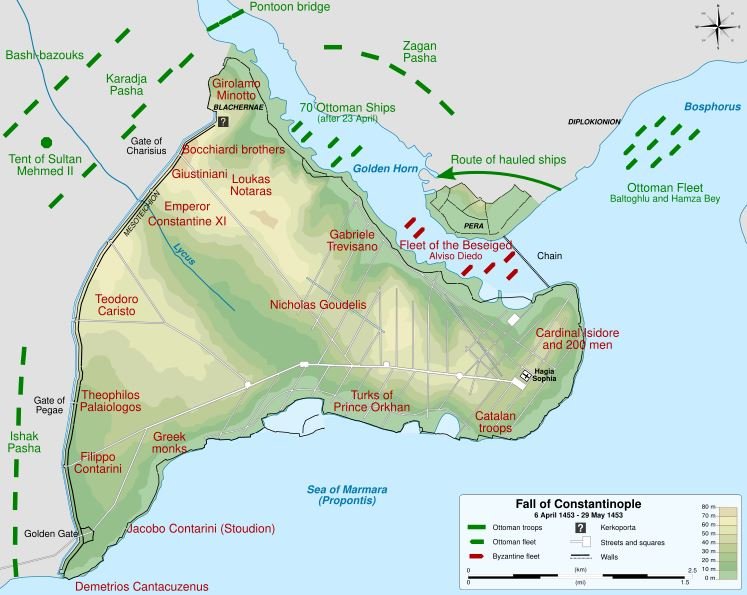
Map of Constantinople showcasing the strategic positions of both the defending and attacking forces.
Background
Constantinople had been a prominent imperial capital since its founding by Emperor Constantine the Great in 330 AD. Despite numerous sieges over the centuries, the city had fallen only once before—to the Crusaders in 1204 during the Fourth Crusade.
The Latin Crusaders ruled the city for nearly 60 years, while the Byzantine Empire fragmented into successor states such as Nicaea, Epirus, and Trebizond. In 1261, the Nicaean forces recaptured Constantinople, restoring Byzantine rule under the Palaiologos dynasty.
Constantinople was the capital of the Byzantine Empire and a major cultural, economic, and military center for over a thousand years.
However, the empire never regained its former strength. Throughout the 14th and 15th centuries, it faced constant threats from the Ottomans, Latins, Serbs, and Bulgarians.
Additionally, the Black Death, which swept through the city between 1346 and 1349, drastically reduced the population, further weakening the empire.
By 1450, the Byzantine Empire had shrunk to a few territories, including the city of Constantinople, the Princes’ Islands, and the Peloponnese. The Ottomans, by contrast, had become a formidable power in the region, with Constantinople as their next logical target.
Ottoman Preparations
When Mehmed II ascended the Ottoman throne in 1451 at the age of 19, many European powers underestimated him. However, Mehmed was determined to complete the conquest of Constantinople, a goal that had eluded previous Ottoman rulers. In preparation, he ordered the construction of Rumeli Hisarı, a fortress on the European side of the Bosphorus, which, along with Anadolu Hisarı on the Asian side, enabled the Ottomans to control naval traffic through the strait.
Mehmed also strengthened the roads leading to Constantinople to accommodate the transport of heavy cannons. Among these was the massive bombard designed by the Hungarian engineer Orban, which was capable of firing massive cannonballs capable of breaching the city’s formidable walls. Additionally, Mehmed strategically blocked the Byzantine-controlled Peloponnese to prevent reinforcements from reaching the capital.
Byzantine Defense and European Support
Realizing the imminent danger, Emperor Constantine XI sought help from Western Europe. However, deep divisions between the Eastern Orthodox and Roman Catholic Churches, exacerbated by past conflicts, hindered meaningful support. While Pope Nicholas V endorsed military aid, Western rulers were largely preoccupied with their own conflicts, including the Hundred Years’ War and internal struggles within the Holy Roman Empire.
READ ALSO: 10 Most Influential Catholic Popes from the Middle Ages
Despite this, some individual Western volunteers came to assist the Byzantines. Notably, Giovanni Giustiniani, a Genoese commander, arrived with a contingent of 700 men. Venice and Genoa sent limited reinforcements, while a few ships arrived with supplies. However, these efforts were insufficient to counter the superior Ottoman numbers and weaponry.
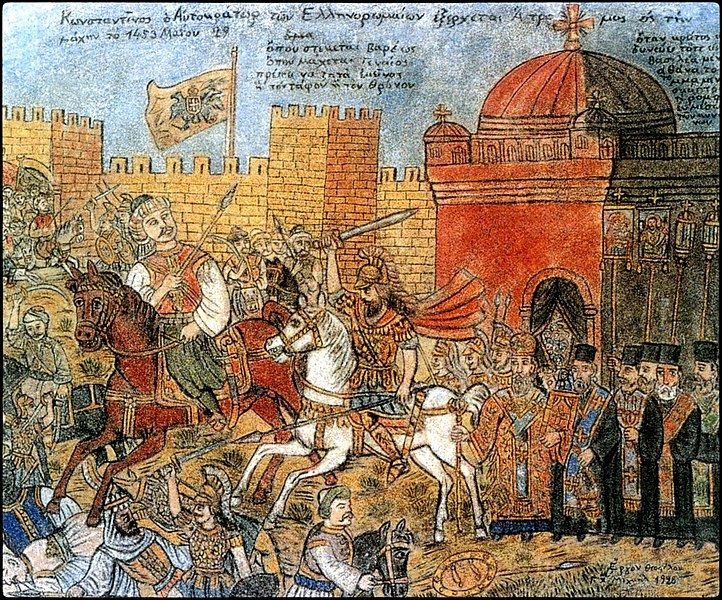
A painting by Greek painter Theophilos Hatzimihail, depicting the Fall of Constantinople.
Siege of Constantinople
The siege began on April 6, 1453. Mehmed’s forces, estimated at between 55,000 and 80,000 men, surrounded the city. The defenders, numbering only around 7,100, relied on the city’s formidable Theodosian Walls, which had protected Constantinople for centuries.
Early Assaults and Ottoman Strategies
The Ottomans initiated bombardments using their large cannons, including Orban’s bombard, which created breaches in the walls. Mehmed also ordered a naval blockade to prevent supplies from reaching the city. However, on April 20, four Genoese ships managed to break through, temporarily boosting Byzantine morale.
To bypass the defensive chain that blocked Ottoman ships from entering the Golden Horn, Mehmed executed an ingenious plan: he ordered his fleet to be dragged overland on greased logs, successfully positioning his ships inside the harbor by April 22. This move further weakened Byzantine defenses and demonstrated Mehmed’s military ingenuity.
Final Assault
After weeks of bombardment and failed attempts to breach the walls, Mehmed ordered a final assault on the night of May 28-29. The attack began before dawn, with successive waves of troops storming the walls. The Janissaries, the elite Ottoman forces, delivered the decisive blow. Giustiniani was severely wounded during the battle, leading to panic among the defenders.
With the walls breached, the Ottomans poured into the city. Constantine XI, refusing to flee, fought alongside his men before reportedly falling in battle. By midday, the Ottomans had taken full control of Constantinople.
How did Constantine XI Palaiologos die during the fall of Constantinople?
Aftermath
Following the capture, Mehmed II allowed his troops three days of looting, a common practice in medieval warfare. Many inhabitants were either killed or enslaved. However, after three days, Mehmed ordered the restoration of order and declared himself the ruler of Constantinople.
Mehmed converted the Hagia Sophia into a mosque but also allowed the Greek Orthodox Church to continue under the newly appointed Patriarch Gennadius Scholarius. This was part of his broader strategy to maintain stability by respecting the religious traditions of the conquered population.
READ ALSO: Most Famous Mosques from the Ottoman Empire
Impact on Europe and the Islamic World
The fall of Constantinople shocked Europe. Many saw it as the end of Christian dominance in the East and a call for a new Crusade. Pope Pius II attempted to rally European leaders, but no significant military response materialized.
The event also solidified Ottoman dominance in the region and led to further conquests, including the fall of Trebizond in 1461. Mehmed II continued to expand Ottoman territory, earning the title “The Conqueror.”
The Fall of Constantinople in 1453 reshaped Europe and the Islamic world, influencing religion, politics, and culture for centuries.
Military and Technological Implications
The fall of Constantinople marked a turning point in military history, demonstrating the effectiveness of gunpowder artillery in siege warfare. It also signified the decline of medieval walled cities as effective defensive structures, paving the way for modern fortifications.
Influence on the Renaissance
The migration of Greek scholars and texts to Italy following the fall of Constantinople played a crucial role in the Renaissance. These scholars brought with them classical knowledge, which contributed to the revival of Greek and Roman learning in Western Europe.
Ultimately, the conquest of Constantinople in 1453 remains one of the most significant milestones in global history.
Timeline of the conquest of Constantinople (1453)
- 6 April 1453: Sultan Mehmed II begins the siege of Constantinople with a massive Ottoman army, outnumbering the defenders.
- Mid-April: The Ottomans bombard the city using massive cannons, breaking parts of the Theodosian Walls.
- 20 April: A small fleet of Christian ships enters the Golden Horn, boosting Byzantine morale.
- 22 April: Ottomans transport ships over land into the Golden Horn, bypassing the defensive chain.
- 16–25 May: Byzantine forces counter Ottoman mining efforts with counter-mines, preventing a breach.
- 28 May: Byzantines hold final religious ceremonies as Ottoman forces prepare for an all-out assault.
- 29 May (Pre-Dawn): Ottomans launch their final attack; elite Janissaries break through after Giovanni Giustiniani is wounded.
- Midday: Constantine XI reportedly dies in battle; Ottoman forces overrun the city.
- Post-Siege: Mehmed II enters Hagia Sophia, declaring the city the new Ottoman capital.

Ottoman Sultan Mehmed II was famously known as Mehmed the Conqueror
Brief History of Istanbul and its Most Famous Historical Sites
Frequently Asked Questions about the Fall of Constantinople (1453)
Who led the Ottoman and Byzantine forces during the siege?
Sultan Mehmed II commanded the Ottomans, while Emperor Constantine XI Palaiologos led the Byzantine defense.
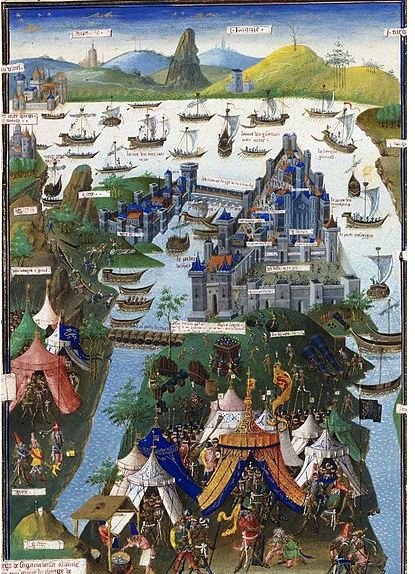
A painting entitled “The siege of Constantinople” by Jean Le Tavernier.
What role did cannons play in the siege?
The Ottomans used massive cannons, including one built by Orban, to breach the Theodosian Walls, marking a turning point in siege warfare.
Did Constantinople receive European aid?
Some Venetian and Genoese forces assisted, but major European powers, weakened by conflicts like the Hundred Years’ War, provided little help.
How did the Ottomans bypass Constantinople’s naval defenses?
Mehmed II ordered his ships to be transported overland on greased logs to bypass the chain blocking the Golden Horn.
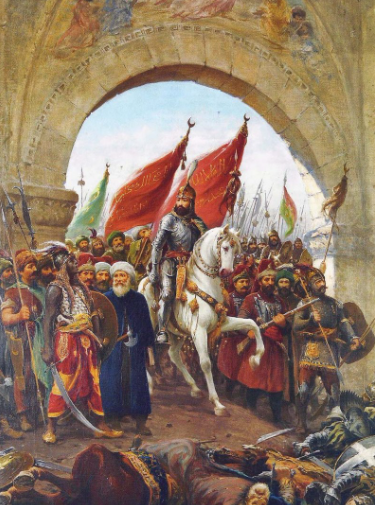
The entry of Sultan Mehmed II into Constantinople. This painting was created by Italian painter Fausto Zonaro (1854–1929)
What happened to the population after the city’s fall?
Many residents were enslaved, killed, or fled. The city was looted for three days before Mehmed restored order.
Why is the fall of Constantinople considered the end of the Middle Ages?
It marked the collapse of the last remnant of the Roman Empire and led to shifts in trade, warfare, and European thought.
How did the fall impact the Renaissance?
Greek scholars fleeing the city brought classical knowledge to Western Europe, accelerating the Renaissance.





