
The map shows the boundaries of the Roman province of Syria Palaestina, with a dashed green line separating Byzantine Palaestina Prima (modern Jund Filastin) from Palaestina Secunda (modern Jund al-Urdunn), and Palaestina Salutaris (modern Jebel et-Tih and the Jifar).
The region of Palestine, often referred to as historic Palestine, is a geographical area in West Asia that encompasses modern-day Israel and Palestine, along with parts of northwestern Jordan in some definitions. It has been historically known by various names, including Canaan, the Promised Land, the Land of Israel, and the Holy Land. Over millennia, Palestine has been a center of cultural, religious, and political evolution, playing a significant role in the histories of Judaism, Christianity, and Islam.
Etymology and Early Mentions
The earliest recorded mention of Palestine as a geographical region dates back to the 5th century BCE in the writings of Herodotus. He referred to the area as Palaistine, likely derived from Philistia, the coastal territory of the Philistines. Egyptian and Assyrian inscriptions from as early as 1140 BCE mention terms such as “Peleset” and “Palashtu,” believed to be references to the same region.
During the Roman period, the region was known as Judaea. Following the Bar Kokhba revolt in 132 CE, the province was renamed Syria Palaestina by Emperor Hadrian, presumably as a punitive measure to sever Jewish ties to the land.
Byzantine rule later divided it into three provinces: Palaestina Prima, Secunda, and Tertia. After the Muslim conquest in the 7th century, the region was administered as Jund Filastin.

Emperor Hadrian
Palestine’s history is marked by successive civilizations, conquests, and cultural exchanges. Despite ongoing political conflicts, it remains a region of deep historical and religious significance.
Ancient History
Palestine was home to numerous ancient civilizations. During the Bronze Age, the Canaanites established independent city-states, influenced by neighboring cultures such as the Egyptians, Mesopotamians, and Phoenicians. Around 1200 BCE, the Israelites emerged in the central hill country, leading to the formation of the Kingdoms of Israel and Judah.
The Kingdom of Israel became a dominant power in the 10th century BCE before falling to the Neo-Assyrian Empire in 722 BCE. The Kingdom of Judah persisted until it was destroyed by the Neo-Babylonians in 586 BCE, leading to the Babylonian Exile of the Jewish population.
The Achaemenid Persians ruled the region after conquering Babylon in 539 BCE, allowing exiled Jews to return and rebuild the Second Temple in Jerusalem.
Alexander the Great took control in 332 BCE, initiating the Hellenistic period, during which the region changed hands between the Ptolemies and the Seleucids.
The Hasmonean revolt (167–160 BCE) led to a brief period of Jewish independence before Rome annexed the territory in 63 BCE.
Roman rule saw major Jewish revolts, including the Great Revolt (66–73 CE), which resulted in the destruction of the Second Temple. The Bar Kokhba revolt (132–136 CE) ended in widespread devastation, leading to the renaming of the province to Syria Palaestina.
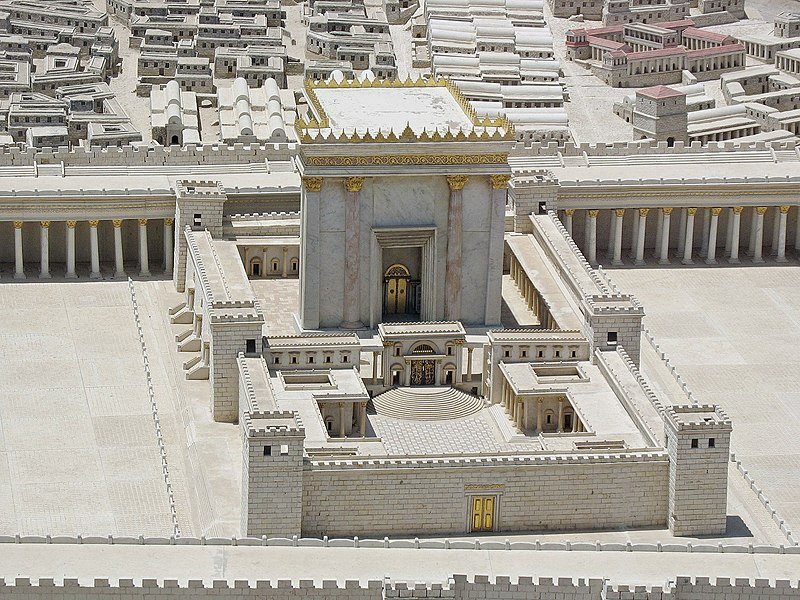
A model of the Second Temple in Jerusalem, reconstructed by Herod, which was destroyed by the Romans in 70 CE during the First Jewish-Roman War.
Medieval Period
Under Byzantine rule, Palestine became a major center of Christianity. Numerous churches and monasteries were established, including the Church of the Holy Sepulchre in Jerusalem. The region remained under Byzantine control until the early 7th century.
In 636 CE, the Rashidun Caliphate conquered Palestine following the Battle of Yarmouk. The Umayyad Caliphate (661–750 CE) ruled from Damascus, emphasizing Jerusalem’s religious significance by constructing the Dome of the Rock in 691 CE. The Abbasids, Fatimids, and Seljuks later controlled the region, each leaving distinct cultural and architectural influences.
READ MORE: Rashidun Caliphate and the First Four Muslim Caliphs of the Islamic World
The Crusaders established the Kingdom of Jerusalem in 1099, ruling for nearly a century. In 1187, Saladin, founder of the Ayyubid dynasty, recaptured Jerusalem, restoring Muslim control. Subsequent crusades failed to reclaim the region permanently.
The Mamluks governed Palestine from 1260 to 1516, emphasizing trade and religious scholarship. In 1516, the Ottomans conquered Palestine, ruling for four centuries. During this period, administrative divisions fluctuated, and Palestine was generally considered part of the larger province of Syria.
Jerusalem is a holy city for Judaism, Christianity, and Islam; its status remains a major point of conflict in Israeli-Palestinian negotiations.
Modern History
British Mandate and Partition
Following World War I, Britain occupied Palestine, and in 1922, the League of Nations established the British Mandate. The mandate aimed to create a Jewish homeland while protecting Arab interests, leading to escalating tensions.
The 1947 United Nations Partition Plan proposed dividing Palestine into Jewish and Arab states. The 1948 Arab-Israeli War erupted after Israel declared independence, leading to the displacement of hundreds of thousands of Palestinian Arabs. Israel expanded its territory, while Jordan and Egypt controlled the West Bank and Gaza, respectively.
Ongoing Conflict and Territorial Disputes
The Six-Day War in 1967 resulted in Israel occupying the West Bank, Gaza Strip, and East Jerusalem. Efforts to resolve the Israeli-Palestinian conflict, including the Oslo Accords (1993), have seen limited success.
Today, Palestine remains a complex geopolitical issue, with the West Bank and Gaza under varying degrees of Palestinian self-rule and Israeli control.
Geography and Demographics
Palestine encompasses coastal plains, central highlands, the Jordan Rift Valley, and the Negev Desert. The Mediterranean climate influences the coastal regions, while the interior experiences a more arid climate.
Historically, Palestine has been home to diverse ethnic and religious groups. In ancient times, it housed Canaanites, Israelites, Philistines, and various Assyrian, Babylonian, and Persian settlers. Under the Islamic caliphates, a predominantly Muslim population developed, with Christian and Jewish minorities.
Today, Palestinians constitute the majority in the West Bank and Gaza, while Israel has a Jewish majority with significant Arab minorities.
Cultural and Religious Significance
Palestine holds immense religious significance for Judaism, Christianity, and Islam. The Western Wall in Jerusalem is a sacred site for Jews, the Church of the Holy Sepulchre is central to Christianity, and Al-Aqsa Mosque is revered in Islam.
Arabic is the predominant language among Palestinians, while Hebrew is spoken in Israel. Palestinian culture is characterized by traditional crafts, literature, and cuisine, blending Arab, Mediterranean, and indigenous influences.
Understanding Palestine’s complex past and evolving present is essential for appreciating its role in world history and contemporary geopolitics.
Timeline of Palestine Region
- 12th–7th century BCE: Philistia, a coastal state, exists in the region.
- 5th century BCE: Herodotus refers to the area as “Palaistine.”
- 6 CE: Rome establishes the province of Judaea.
- 135 CE: Following the Bar Kokhba revolt, Rome renames the province Syria Palaestina.
- 390 CE: The Byzantine Empire divides Palestine into three provinces.
- 636 CE: Muslim forces conquer the region, establishing Jund Filastin.
- 1099–1291: Crusaders establish the Kingdom of Jerusalem; later defeated by the Ayyubids and Mamluks.
- 1516–1917: The Ottoman Empire rules Palestine.
- 1917–1948: Britain governs Mandatory Palestine after World War I.
- 1947–1949: Israel is established; the region is divided after war.
- 1967: Israel occupies the West Bank and Gaza Strip.
- 1987–1993: First Palestinian Intifada leads to the Oslo Accords.
- 2005: Israel withdraws from Gaza.
- 2012: The UN recognizes Palestine as a non-member observer state.
Frequently asked questions
What are some historical names for Palestine?
Palestine has been known as Canaan, the Promised Land, the Land of Israel, the Holy Land, Judea, and Syria Palaestina, among others.
When was the term “Palestine” first recorded?
The earliest known reference to “Palestine” comes from Herodotus in the 5th century BCE, who called the region “Palaistine.”
How did the Romans influence the name “Palestine”?
After the Bar Kokhba Revolt (132–136 CE), the Romans renamed the province of Judaea as “Syria Palaestina” to minimize Jewish ties to the land.
What major empires ruled Palestine?
Palestine was ruled by the Egyptians, Assyrians, Babylonians, Persians, Greeks, Romans, Byzantines, various Muslim Caliphates, Crusaders, Mamluks, Ottomans, and the British.
What was the British Mandate for Palestine?
From 1920 to 1948, Britain governed Palestine under a League of Nations mandate, overseeing significant Jewish and Arab nationalist movements.
What led to the Israeli–Palestinian conflict?
Tensions between Jewish and Arab populations escalated during the British Mandate, culminating in the 1947 UN partition plan, the 1948 war, and ongoing territorial disputes.
What happened in the 1948 Arab–Israeli War?
Israel declared independence in 1948, leading to war with Arab states; Israel expanded its territory, while Jordan and Egypt controlled the West Bank and Gaza Strip.
What are the 1967 borders?
In the Six-Day War (1967), Israel captured the West Bank, East Jerusalem, Gaza, and the Golan Heights, establishing military control over the Palestinian territories.
Who governs the Palestinian territories today?
The Palestinian Authority (PA) governs parts of the West Bank, while Hamas controls Gaza; Israel maintains security control over much of the West Bank.
What is the two-state solution?
The two-state solution envisions an independent Palestinian state alongside Israel, with borders based on pre-1967 lines, but negotiations remain stalled.
What is the significance of the 2012 UN recognition of Palestine?
In 2012, the UN General Assembly recognized Palestine as a non-member observer state, strengthening its diplomatic status but not granting full UN membership.
What is the demographic composition of Palestine?
Palestinians are primarily Arab Muslims, with Christian minorities; Jewish populations reside mainly in Israeli settlements in disputed territories.
How has archaeology contributed to the history of Palestine?
Archaeological findings confirm the presence of Canaanite, Israelite, Philistine, Greek, Roman, and Islamic civilizations, shaping the historical narrative of the region.





