Zeno of Citium

Through his teachings and example, Zeno of Citium demonstrated the transformative power of philosophy in achieving a life of wisdom and virtue. Image: Modern bust of Zeno in Athens
Zeno of Citium (c. 334–262 BCE) was a prominent Hellenistic philosopher, founder of the Stoic school of thought, and one of the most influential thinkers in Western philosophy. Much of what we know about him comes from Diogenes Laertius’s Lives and Opinions of Eminent Philosophers, which provides biographical sketches and summaries of various philosophers’ teachings. Zeno’s life and thought are intricately tied to the early development of Stoicism, a philosophy centered on virtue, rationality, and harmony with nature.
Zeno’s Background and Life
Zeno was born in Citium, a city in Cyprus, a place heavily influenced by both Greek and Phoenician cultures. This dual heritage may have shaped his open-minded approach to philosophy. Zeno was reportedly a merchant in his early years, following his father, who was engaged in trading. According to Diogenes Laertius, Zeno’s life took a decisive turn after a shipwreck, which left him in Athens. There, he was exposed to philosophy, an encounter that ultimately defined his intellectual pursuits.
Zeno’s philosophical journey began when he stumbled upon a bookshop in Athens and read about Socrates in Xenophon’s Memorabilia. Inspired by what he read, Zeno asked the bookseller where he could find men like Socrates. The bookseller pointed to Crates of Thebes, a Cynic philosopher. Zeno became Crates’ student, marking the start of his transformation from merchant to philosopher. However, Zeno’s temperament reportedly clashed with the Cynic emphasis on shamelessness and asceticism, prompting him to explore other schools of thought.
Zeno studied under a variety of philosophers, including:
- Stilpo of the Megarian school, known for his focus on logic and ethical rigor.
- Xenocrates and Polemo, leaders of the Platonic Academy.
- Diodorus Cronus, an influential logician.
These varied influences enriched Zeno’s philosophical perspective, blending Cynic ethics with Megarian logic and elements of Platonism. Around 300 BCE, Zeno began teaching in the Painted Stoa (Stoa Poikile) in Athens, which gave Stoicism its name.
Zeno’s Character and Conduct
Diogenes Laertius portrays Zeno as a man of great self-discipline and moral integrity. He was noted for his austere lifestyle, frugality, and consistency in practicing what he preached. Zeno’s personal ethos reflected Stoic ideals of living in accordance with reason and nature. He was respected by his contemporaries for his sincerity and wisdom.
Anecdotes about Zeno highlight his virtue. For instance:
- Generosity and gratitude: Zeno repaid debts and showed respect to his teachers, particularly Crates.
- Self-restraint: Despite his fame, Zeno maintained a modest lifestyle.
- Resilience: His teachings emphasized the importance of enduring hardships with equanimity, a trait he modeled in his own life.
Zeno’s Philosophical System
Zeno’s philosophy, as outlined in Diogenes Laertius, laid the foundation for Stoicism, a school concerned with ethics, logic, and physics. His teachings emphasized the pursuit of virtue as the highest good and the means to achieve a harmonious life.
Logic
Zeno was deeply interested in logic, which he regarded as a tool for clear thinking and rational discourse. Diogenes Laertius credits Zeno with refining earlier logical theories, particularly those of the Megarian school. Key elements of Zeno’s logic include:
- Propositions and syllogisms: Zeno contributed to the study of propositional logic, emphasizing the role of coherent reasoning in achieving wisdom.
- Dialectical methods: He used dialogue and questioning to explore and clarify philosophical problems.
Zeno’s logical approach was not purely academic; it served a practical purpose in helping individuals distinguish between truth and falsehood.
Physics
Zeno’s understanding of physics was rooted in a belief in the interconnectedness of all things. He saw the universe as a single, rational organism governed by logos (reason or divine rationality). Key ideas include:
- Materialism: Zeno argued that only physical things truly exist. Even the soul, according to him, was material, composed of a finer substance akin to breath or fire.
- Pantheism: He identified God with nature and reason, positing that the cosmos itself was a living, rational entity.
- Determinism: Zeno believed that everything in the universe occurs according to a divine, predetermined plan. Human freedom lay in accepting and aligning with this natural order.
Ethics
Ethics was the centerpiece of Zeno’s philosophy. He argued that virtue is the sole good and sufficient for happiness. His ethical teachings can be summarized as follows:
- Living in accordance with nature: This meant aligning one’s actions with the rational order of the universe.
- Virtue as knowledge: Zeno believed that moral virtue arises from knowledge and that ignorance leads to vice.
- Indifference to externals: Zeno categorized external goods (wealth, health, pleasure) as “indifferents,” neither inherently good nor bad. The wise person remains indifferent to these and focuses on cultivating inner virtue.
Cardinal Virtues
Zeno identified four cardinal virtues essential to a virtuous life:
- Wisdom: The ability to discern what is truly good and act accordingly.
- Courage: The strength to face adversity with resilience.
- Justice: Treating others fairly and upholding social harmony.
- Temperance: Exercising self-control and moderation.
Influence and Legacy
Zeno’s teachings gained widespread recognition during his lifetime. He attracted a diverse group of students, including Cleanthes (his successor) and Chrysippus (the systematizer of Stoicism). These followers expanded and refined Stoicism, ensuring its survival as a major philosophical movement.
Zeno’s reputation for wisdom and virtue earned him respect in Athens. Diogenes Laertius recounts how the Athenians honored him with a golden crown and a tomb in the Ceramicus, a testament to his impact on the city.
Anecdotes and Sayings
Diogenes Laertius preserves various anecdotes and sayings attributed to Zeno, illustrating his wit and philosophical insights:
- When asked what a friend is, Zeno replied, “Another self.”
- On being criticized for his plain lifestyle, he remarked, “I am content with less, for philosophy teaches self-sufficiency.”
- He described reason as “a divine spark within us.”
Such remarks reflect Zeno’s commitment to rationality and ethical living.
Criticism and Controversies
While Diogenes Laertius offers a largely favorable account of Zeno, he also mentions criticisms. Some contemporaries mocked Zeno for his austere practices or found Stoic doctrines overly rigid. Nevertheless, Zeno’s ideas inspired debate and dialogue, enriching the philosophical landscape.

Zeno of Citium, as depicted by Diogenes Laertius, was a philosopher of profound intellectual and moral integrity. His Stoic philosophy, emphasizing virtue, rationality, and harmony with nature, laid the groundwork for one of antiquity’s most enduring schools of thought. Image: Zeno, portrayed as a medieval scholar in the Nuremberg Chronicle
READ MORE: Most Famous Stoic Philosophers of the Ancient World
Frequently asked questions
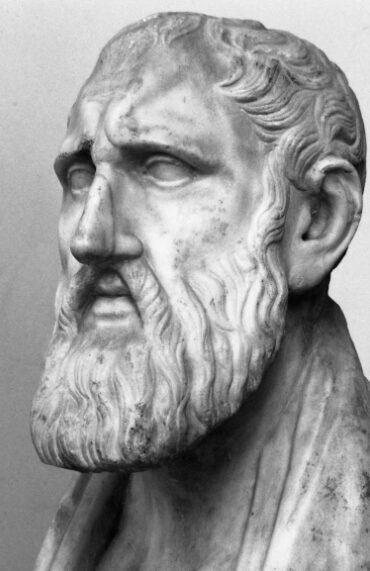
Zeno of Citium was the founder of the Stoic School of philosophy in Athens. His primary teaching emphasized the Logos, or Universal Reason, as the highest good in life, advocating that living in accordance with reason was the ultimate purpose of life. Image: Zeno of Citium. Bust in the Farnese collection, Naples. Photo by Italian photographer Paolo Monti, 1969.
Where and when was Zeno born, and how was his early life influenced?
Zeno was born in the Phoenician-Greek city of Citium on Cyprus around 336 BCE, the same year Alexander the Great became king of Macedonia. His father, a merchant who frequently traveled to Athens, influenced Zeno to adopt the same profession.
How did Zeno become interested in philosophy?
At the age of 22, Zeno was shipwrecked and stranded in Athens. There, he read Xenophon’s Memorabilia, which portrayed Socrates. Deeply inspired, Zeno abandoned his mercantile career to dedicate himself to philosophy.
What does Zeno’s statement, “I made a prosperous voyage when I was shipwrecked,” signify?
This statement reflects Zeno’s belief that his shipwreck was a transformative event that led him to discover philosophy, giving his life purpose and discipline.
What were some of Zeno’s core philosophical beliefs?
Zeno argued that virtue, not pleasure, was the only true good and that natural law governed the universe. He believed in living according to reason and advocated for temperance, integrity, and consistency in one’s principles.
How did Zeno influence Athenian society?
Zeno was admired in Athens for his temperance, moral integrity, and positive influence on the youth. His teachings, rooted in virtue, earned him respect as a philosopher who practiced what he preached.
How did Zeno die, and what were his final words?
Zeno likely died by suicide after breaking his toe while leaving a school. He quoted a line from Timotheus’ Niobe: “I come of my own accord; why call me thus?” and interpreted the accident as a divine sign to end his life.
Who chronicled Zeno’s life and teachings?
The 3rd-century CE biographer Diogenes Laertius documented Zeno’s life and teachings in his work Lives and Opinions of Eminent Philosophers.
What did the Stoics, under Zeno’s guidance, believe about truth and logic?
The Stoics believed that truth follows truth, as “It is light” follows “It is day,” and that falsehood could never stem from truth. Their logical systems supported their broader aim of understanding universal and moral laws.
What were the primary ethical topics explored in Stoicism?
Stoic ethics covered topics such as inclination, passions, virtue, and the chief good. They emphasized living in harmony with nature and reason, asserting that self-preservation and rational actions were fundamental to moral behavior.
How did Zeno and his successors define living according to nature?
Living according to nature meant living virtuously and in harmony with universal and individual nature, guided by rational actions aligned with natural law.
What were the Stoic views on virtue and happiness?
Stoics considered virtue the essence of happiness and a harmonious life. They believed virtue was a consistent alignment of mind and action with reason, immune to external influences like pleasure or fear.
How did the Stoics categorize virtues and vices?
Virtues were divided into primary (prudence, courage, justice, temperance) and subordinate traits (endurance, magnanimity). Vices, such as folly and cowardice, were seen as ignorance of virtues.
Did the Stoics believe virtue could be taught?
Yes, the Stoics believed virtue could be taught, citing examples like Socrates, who achieved moral transformation through philosophical discipline.
What was Zeno’s lasting legacy in philosophy?
Zeno’s philosophy, centered on virtue, reason, and living in harmony with nature, laid the foundation for Stoicism. His teachings influenced subsequent thinkers and established him as a pivotal figure in ancient philosophy.
READ MORE: Major Works of Greek Philosophy





