King Minos in Greek Mythology
In Greek mythology, Minos was one of the most prominent kings of Crete, son of the god Zeus and the mortal Europa. His legacy spans various mythological stories, from his tyrannical reign over Crete to his eventual role as a judge of the dead in the underworld. The myths surrounding Minos, his family, and his rule are foundational to Greek mythology, with significant literary and cultural references that have shaped both ancient and modern interpretations.
READ ALSO: 9 Most Famous Sons of Zeus: From Ares to Perseus
Early Life and Reign
Minos is introduced in Greek literature as the king of Crete, a title he inherited after the death of King Asterion, who had adopted him and his brothers, Rhadamanthus and Sarpedon.
In some versions of the myth, Minos’ ascension to the throne is marked by a divine sign. Minos, seeking proof of his right to rule, prayed to Poseidon, who sent a magnificent white bull from the sea. Minos, however, chose not to sacrifice the bull as he had promised, deciding instead to keep it for himself. Angered, Poseidon cursed Minos’ wife, Pasiphaë, causing her to fall in love with the bull. This unnatural union led to the birth of the Minotaur, a half-man, half-bull monster, which would become a central figure in Minos’ myth.
Minos’ rule was marked by a strong naval presence, which made Crete a dominant power in the Aegean. According to ancient historians like Thucydides, Minos is credited with being the first to build a powerful navy, which would later serve as a symbol of Cretan superiority.
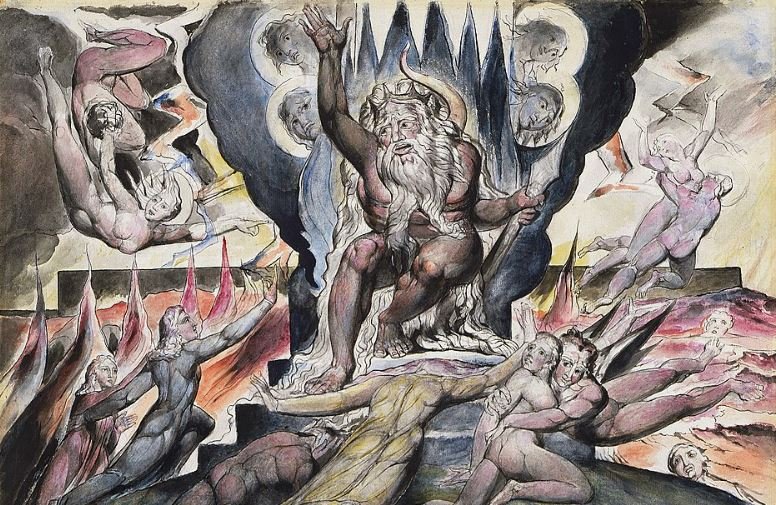
A depiction of Minos by English artist William Blake
The Minotaur and the Labyrinth
Minos’ most famous myth involves the Minotaur, the monstrous offspring of Pasiphaë and the Cretan Bull. To contain this terrifying creature, Minos commissioned the craftsman Daedalus to build a labyrinth, a maze so intricate that no one could escape it once inside. This labyrinth became the prison of the Minotaur, and every nine years, Minos demanded that Athens send seven young boys and seven young girls to Crete as tribute to be sacrificed to the creature.
The story of the Minotaur and its eventual defeat by the Athenian hero Theseus is one of the most famous episodes in Greek mythology. Theseus, with the help of Minos’ daughter Ariadne, who provided him with a ball of thread to trace his way out of the labyrinth, succeeded in killing the Minotaur. The myth of Theseus and the Minotaur, while portraying Minos as a tyrant who exacted cruel tributes, also paints him as a figure tied to complex family dynamics and divine punishment.
Minos in Greek Literature
Minos’ portrayal in Greek literature is multifaceted. In Homer’s Iliad and Odyssey, he is a wise and powerful king, but also a figure who can be both just and cruel. Minos’ character fluctuates between a ruler whose laws are divinely inspired and a tyrant who forces Athens to send youths to their deaths.
The complexities of his rule are highlighted in various myths, including his relationship with his son Androgeus. After Androgeus was killed in a competition in Athens, Minos sought revenge by waging war against the city. This episode led to the imposition of the tribute of youths to be sent to the Minotaur, further solidifying Minos’ image as a vengeful and ruthless king.
The ancient Greek playwrights also offered differing views of Minos. On the Athenian stage, he was often portrayed as a figure of tyrannical cruelty, but at the same time, his wisdom and respect for the gods were acknowledged. This dichotomy of Minos’ character has intrigued scholars and poets for centuries, leading to the interpretation that he was a complex figure, not wholly evil but also not purely benevolent.
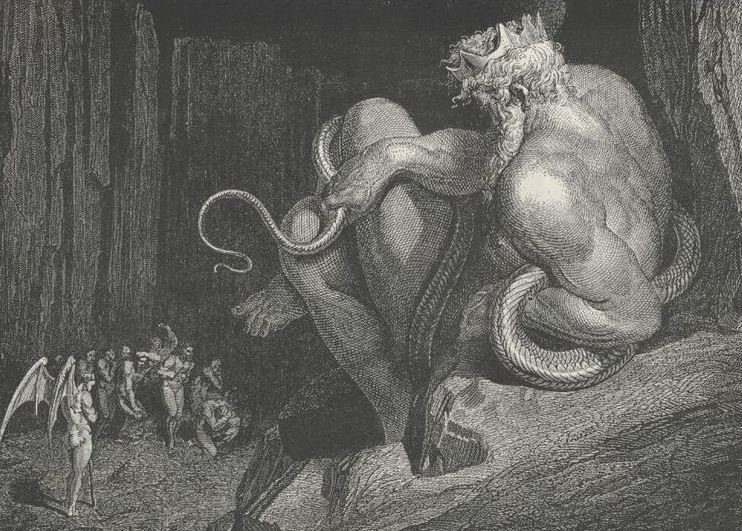
An illustration of Minos by French artist Gustave Doré.
Later Rationalization: Two Kings Named Minos
To reconcile the contradictions in Minos’ character and the span of time during which he supposedly ruled, later Greek writers like Diodorus Siculus and Plutarch suggested that there were two kings named Minos. The first Minos, or “Minos I,” was a just and revered ruler, held in such high esteem by the gods that he was made one of the three judges of the dead after his death. His reign was characterized by wisdom, fairness, and the establishment of Cretan laws. He was also said to be the father of Lycastus, who succeeded him on the throne.
The second Minos, or “Minos II,” was considered a more colorful and tyrannical ruler. This “bad” Minos is the one featured in the myths of the Minotaur, Daedalus, and Theseus. Minos II fathered many children, including Androgeus, Phaedra, and Ariadne, the latter of whom would play a pivotal role in the defeat of the Minotaur. Minos II’s reign was marked by more intense family dramas and political conflicts, including his infamous conflict with Athens, which eventually led to the ritual sacrifice of youths.
Family and Offspring
Minos’ family was notable for its complexity and tragic elements. His wife, Pasiphaë, was the daughter of the sun god Helios, and together they had several children, including the aforementioned Androgeus, Ariadne, Phaedra, and Glaucus. Each of these children plays a role in various myths that are intertwined with the fate of Crete.
Minos, the son of Zeus and Europa, was the King of Crete and the most renowned of the three underworld judges.
One of the most tragic episodes in Minos’ family history involves the death of his son Glaucus. Glaucus, playing with a ball, mysteriously disappeared, and Minos sent the seer Polyidus to find him. Polyidus discovered the boy’s body in a wine cellar, and through divine intervention, Glaucus was brought back to life. However, despite this miraculous act, Minos kept Polyidus on Crete and forced him to teach Glaucus the art of divination. This bizarre episode ends with Glaucus forgetting all that he had learned, a fittingly tragic coda to the family’s tragic tales.

Minos and the Underworld
After his death, Minos was transformed from a mortal king into a figure of cosmic importance. In the afterlife, he became one of the three judges of the dead, alongside his brothers Rhadamanthus and Aeacus. While Rhadamanthus judged the souls of those from Asia and Aeacus judged those from Europe, Minos held the deciding vote in cases where there was uncertainty. This role as a judge in the underworld solidified Minos’ importance in Greek mythology, further elevating his status as a figure of divine authority and moral judgment.
Minos’ role in the afterlife was depicted in various works of art, including Dante Alighieri’s Divine Comedy, where he is shown as a fearsome judge, sitting at the entrance to the second circle of Hell. Here, he is portrayed as a creature with a tail, symbolizing his role in judging the damned. This image of Minos has persisted throughout the centuries, reinforcing his association with divine judgment and the eternal consequences of mortal actions.
The Death of Minos
Minos’ death is as dramatic as his life. In his search for Daedalus, whom he blamed for the creation of the labyrinth and the Minotaur, Minos traveled to Sicily. There, King Cocalus, knowing that Daedalus was in his court, tricked Minos by first asking him to solve a riddle involving a spiral seashell. When Minos finally solved the riddle, Cocalus arranged for Daedalus to be brought out and, in a cunning twist, caused Minos’ death by scalding him with boiling water. This final act of betrayal and vengeance marks the end of Minos’ long and storied reign.
Minos in Art and Popular Culture
Minos’ depiction in art has varied throughout history, with ancient and later artists interpreting his image in different ways. In Greek art, he is often shown as a dignified figure, crowned and bearded, a representation of royal authority.
In Michelangelo’s The Last Judgment, Minos is portrayed as the judge of the damned, his tail wrapped around him as he directs the souls to their eternal fates. This image of Minos as an underworld judge has been influential in shaping modern perceptions of the mythological figure.
In Virgil’s Aeneid, Minos is again depicted as a judge of the dead, assisting in determining the fate of the souls. In Dante‘s Inferno, Minos’ role is further elaborated as he assigns souls to their punishments by wrapping his tail around his body. These portrayals reinforce Minos’ dual identity as both a king and a cosmic figure, one who wields power over the living and the dead alike.
Frequently Asked Questions
What is the significance of Minos in Greek mythology?
Minos is a prominent king of Crete, son of Zeus and Europa. He is best known for his creation of the labyrinth to house the Minotaur and for his role as a judge of the dead in the underworld.
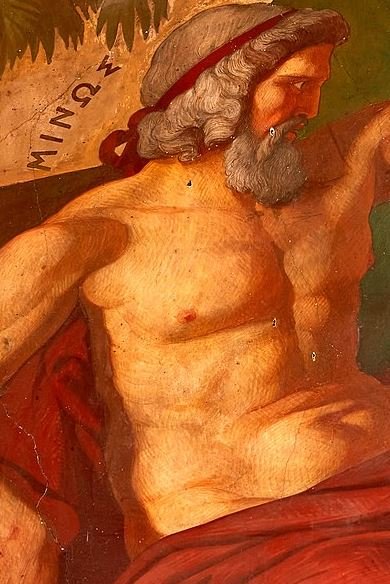
A mural of King Minos situated at the National and Kapodistrain University of Athens, Greece.
Who were Minos’ parents and family?
Minos was the son of Zeus and Europa. He had two brothers, Rhadamanthus and Sarpedon, and was adopted by King Asterion of Crete. Minos’ wife was Pasiphaë, and they had several children, including Ariadne, Androgeus, and Phaedra.
What was Minos’ role in the myth of the Minotaur?
Minos, in his anger over the death of his son Androgeus, demanded a tribute from Athens, sending seven young boys and girls every nine years to be sacrificed to the Minotaur, a creature born from his wife Pasiphaë’s union with a bull.

Zeus’ statue
How did Minos contribute to the naval power of Crete?
Minos is credited with building the first great navy, which established Crete’s dominance in the Aegean. This naval supremacy made him a powerful ruler and a key figure in the ancient Mediterranean world.
Minos judged the souls of the deceased, determining their fate based on their actions in life. The virtuous were sent to Elysium, while the wicked were condemned to Tartarus.
What was the relationship between Minos and Daedalus?
Minos employed Daedalus, a skilled craftsman, to build the labyrinth that housed the Minotaur. After the Minotaur’s defeat, Minos imprisoned Daedalus and his son Icarus to keep the secrets of the labyrinth. Daedalus later escaped using wings he had invented.
How did Minos’ son Androgeus die, and how did Minos respond?
Androgeus was killed in Athens after winning the Panathenaic Games. Minos, seeking revenge, waged war on Athens, which led to the yearly tribute of Athenian youths to the Minotaur.
What was Minos’ role after his death in Greek mythology?
After his death, Minos became one of the three judges of the dead in the underworld, alongside his brothers Rhadamanthus and Aeacus, where he judged the souls of the deceased and had the deciding vote in uncertain cases.
How did Minos die?
Minos was killed in Sicily after searching for Daedalus. King Cocalus, with the help of Daedalus, trapped Minos and had him scalded to death with boiling water, marking the tragic end of his life.
The myth of Sarpedon, the son of Zeus who died fighting in the Trojan War





