Tityos in Greek Mythology
Tityos, also spelled Tityus, was a formidable giant in Greek mythology. Known for his chthonic origins and tragic mythological tale, his story intertwines with the divine, the mortal, and the punitive forces of the Greek mythological cosmos. Tityos is remembered for his punishment in Tartarus, which highlights themes of divine justice, hubris, and the often cruel fates of those who defied or offended the gods.
READ MORE: Most Famous Punishments in Tartarus
Family and Origins
Tityos was the son of Elara, a mortal princess, and Zeus, the king of the gods. Elara’s liaison with Zeus is significant, as it sets the stage for the giant’s extraordinary birth. Zeus, fearing the wrath of his wife, Hera, concealed Elara deep within the Earth. This decision not only shielded Elara but also connected Tityos to Gaia, the primordial goddess of the Earth, who later played a crucial role in his development. Due to his immense size, Tityos outgrew Elara’s womb, and Gaia herself took over as his surrogate mother, nurturing him to term.
Tityos also became a progenitor, with a daughter named Europa, who coupled with Poseidon, the god of the sea. Their union produced Euphemus, one of the Argonauts, creating a link between Tityos and the celebrated heroes of Greek mythology.
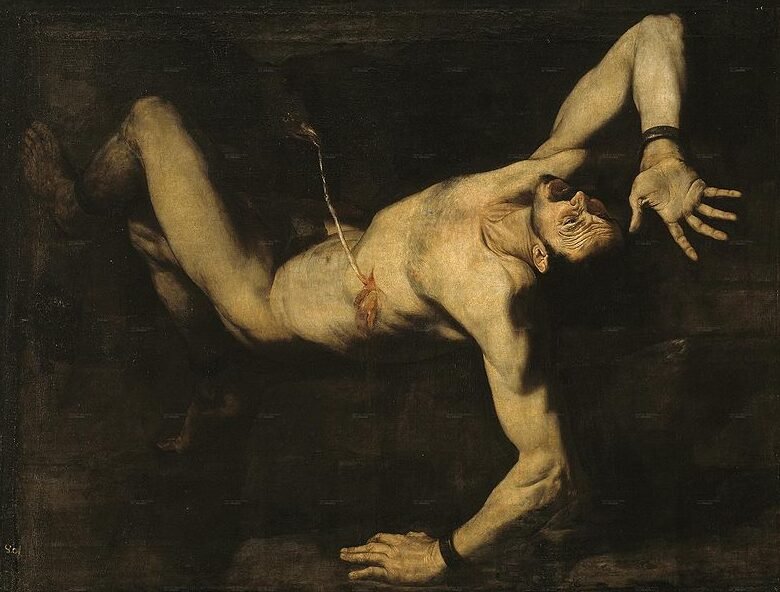
Image: A painting of Tityos by Spanish artist Jusepe de Ribera.
READ MORE: 9 Most Famous Sons of Zeus: From Ares to Perseus
Mythological Narrative
Tityos’s life is best remembered for his assault on Leto, the mother of Artemis and Apollo, a deed orchestrated by Hera, who often targeted Zeus’s lovers and their offspring. Leto was traveling to Pytho (Delphi) when Tityos attempted to rape her. In response, Leto’s children, Artemis and Apollo, intervened, swiftly killing him. Some versions of the myth attribute his death to Zeus, who struck him down with a thunderbolt, reaffirming the god’s role as the ultimate arbiter of divine justice.
Punishment in Tartarus
After his death, Tityos was consigned to Tartarus, the deepest abyss of the Greek underworld reserved for the most egregious offenders. His punishment was eternal and particularly gruesome: he was bound and stretched across nine acres, with two vultures perpetually feeding on his regenerating liver.
The above form of torment echoes the punishment of Prometheus, whose liver was also eternally consumed by an eagle as a consequence of defying Zeus. The liver, symbolically associated with emotions and desires in Greek thought, underscores the nature of Tityos’s crime, which was rooted in uncontrolled lust and sacrilege.
Homer’s Odyssey vividly describes Tityos’s suffering, painting him as a figure sprawled across vast lands, unable to fend off the relentless vultures. To the Olympian worshippers, Tityos represented the vilest criminal, a defiler of divine sanctity, and his fate served as a cautionary tale against transgressing the gods’ boundaries.
READ MORE: The Twelve Olympian Gods and Goddesses
Hero Cult and Local Traditions
Despite his demonization in Olympian mythology, Tityos had a hero cult in Panopeus, as observed by the geographer Strabo in the early first century. Local legends persisted, identifying caves and shrines connected to Tityos and his mother, Elara. These sites were believed to retain traces of the hero’s former reverence before the dominance of the Olympian gods supplanted his cult.
This duality of Tityos as both a vilified figure and a local hero highlights the transition from pre-Olympian to Olympian religious frameworks in ancient Greek culture. Comparisons to other chthonic giants like Orion further emphasize his ambiguous role as a figure bridging the terrestrial and the divine.
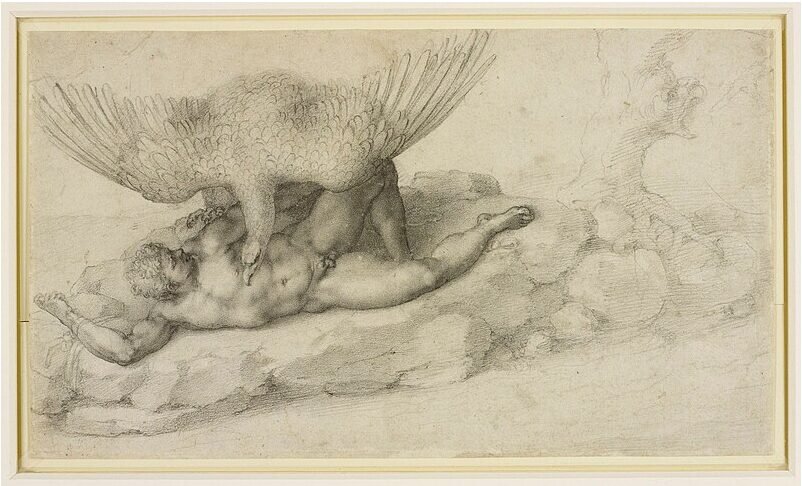
Image: A painting by Italian artist entitled “The Punishment of Tityus”.
READ MORE: Greatest Heroes in Greek Mythology
Tityos in Literature and Art
The myth of Tityos resonated deeply with ancient and later writers, artists, and philosophers. The Roman poet Lucretius in De Rerum Natura reimagined Tityos not as a punished giant in Tartarus but as a symbolic figure representing the torments of unfulfilled desire. His liver, instead of being consumed by vultures, was metaphorically consumed by love’s anguish, with winged cupids as tormentors. This demythologized interpretation transformed Tityos into a broader allegory for human suffering and passion.
Virgil, in the Aeneid, alluded to Tityos’s torment in his depiction of Dido, whose unrequited love for Aeneas consumed her, likening her emotional pain to Tityos’s eternal punishment. Similarly, Pausanias, a traveler and geographer of the 2nd century CE, recorded seeing a depiction of Tityos in a painting at Delphi. This artwork portrayed him as a diminished and mutilated phantom, suggesting the long-term effects of his unending torture.
Artists from later periods, such as Michelangelo, also explored Tityos’s story. In Michelangelo’s The Punishment of Tityus (c. 1532), the visceral agony of Tityos is captured in harrowing detail, emphasizing the physical and emotional dimensions of his suffering.
Influence on Culture
Tityos’s myth has persisted beyond antiquity, referenced in works like Dante Alighieri’s Inferno. In this text, Dante places Tityos among the mythological giants frozen outside Hell’s Circle of Treachery. Though not central to the narrative, his inclusion underscores the lasting impression of his punishment and its symbolic weight as a representation of divine retribution.
Themes and Symbolism
Tityos’s story embodies several recurring themes in Greek mythology, including the dangers of hubris, the consequences of unchecked desires, and the moral authority of the Olympian gods. His punishment serves as a vivid reminder of the gods’ power and the inescapable nature of their judgment. At the same time, his association with chthonic forces and hero cults hints at a more complex and layered identity, blending pre-Olympian traditions with Olympian narratives.