Fourth Dynasty of Egypt
The Fourth Dynasty of ancient Egypt, spanning approximately from 2613 to 2494 BC, is widely considered a “golden age” within the Old Kingdom period. Marked by political stability, economic prosperity, and unprecedented architectural and artistic achievements, this era saw the culmination of early Egyptian statecraft. It was during this time that pyramid building reached its zenith, and religious and administrative institutions matured.
Through powerful rulers, monumental construction, and significant cultural transformations, the Fourth Dynasty laid foundational elements that would resonate throughout Egypt’s long history.
Political Stability and Economic Prosperity
The hallmark of the Fourth Dynasty was the long period of peace and internal stability that began under the reign of Sneferu. There were no significant invasions or internal revolts recorded during this time. This stability created the conditions necessary for the flourishing of architectural, economic, and religious development.
Egypt’s economy during this period was bolstered by centralized planning and access to labor, both voluntary and conscripted. With abundant resources and strong leadership, large-scale projects such as pyramid construction became feasible. Trade with neighboring regions—like Nubia to the south and Byblos in the Levant—flourished. These external relations ensured a steady supply of goods like cedar wood, gold, turquoise, and incense, which further enriched the Egyptian state.
The Rise of Monumental Architecture
One of the most iconic legacies of the Fourth Dynasty is its contribution to monumental architecture, particularly pyramids. This era is often called the “Age of the Pyramids” for good reason. Building on the developments of the Third Dynasty, the kings of the Fourth Dynasty refined and perfected the art of pyramid construction.
The transformation from step pyramids to smooth-sided pyramids is credited largely to Sneferu, who conducted architectural experiments resulting in several important pyramids, including the Bent Pyramid and the Red Pyramid at Dahshur. These architectural marvels not only demonstrated the pharaoh’s divine power but also reflected a deepening understanding of engineering, labor organization, and symbolic religious beliefs.
Rulers of the Fourth Dynasty
Below are some of the notable pharaohs of the ancient Egypt’s fourth dynasty:
Sneferu (2613–2589 BC)

Limestone sculpture of Sneferu, housed in the Egyptian Museum.
Sneferu was the founder of the Fourth Dynasty and remains one of the most admired pharaohs in Egyptian history. Revered for his charm and considered a “Bringer of Beauty” and “Master of All Justice,” Sneferu broke with older traditions by publicly identifying himself as the living embodiment of the sun god Ra, rather than solely as a manifestation of Horus.
He is best known for commissioning three major pyramids: the Meidum Pyramid (which collapsed), the Bent Pyramid (whose angle shift mid-way through construction shows experimental methods), and the Red Pyramid, considered Egypt’s first successful smooth-sided pyramid. His reign marked a turning point in royal funerary architecture.
Sneferu also led military and economic expeditions into Nubia and Libya, primarily to acquire labor and building materials. These efforts ensured a steady supply of stone and manpower, vital for the construction projects that defined his reign.
READ ALSO: Who were the Nubian Rulers of Ancient Egypt?
Khufu (2589–2566 BC)

Statue of Khufu
Khufu, also known by his Greek name Cheops, succeeded Sneferu and built the Great Pyramid of Giza—the largest and most famous of all Egyptian pyramids. Despite his architectural legacy, little is known about his reign outside of this monumental achievement.
Ancient Greek sources portray Khufu negatively, describing him as tyrannical. However, no contemporary Egyptian records support this view. His court likely continued the centralized administration and religious traditions established by his father. The precision and scale of the Great Pyramid suggest an advanced bureaucracy and a skilled labor force.
Khufu’s only surviving three-dimensional statue is a small ivory figure, found at Abydos, a symbol of the sparse physical evidence regarding his life and rule beyond the pyramid complex.
READ ALSO: What were the Great Five Names used by Egyptian Pharaohs?
Djedefre (2566–2558 BC)

Head of Djedefre
Djedefre was Khufu’s successor. He reigned for approximately eight years and introduced notable changes in royal tradition. His pyramid was built at Abu Rawash, north of Giza, possibly to distance himself from his father’s legacy, though some scholars argue his choice reflected a connection with Heliopolis, the religious center of the sun god Ra.
He is believed to have introduced the title “Son of Ra” into royal titulary, reinforcing the monarch’s divine right and closer identification with the sun god. This change signaled a stronger solar cult influence and prefigured religious developments in the Fifth Dynasty.
Djedefre married Hetepheres II, a daughter of Khufu and widow of crown prince Kawab. Her depiction as a sphinx in a statue from his pyramid may represent the first example of a human-headed lion figure in Egyptian art.
Khafre (2558–2532 BC)

Khafre
Khafre, traditionally considered a son of Khufu, followed Djedefre and constructed the second pyramid at Giza, just slightly smaller than Khufu’s but built on higher ground to appear taller. His complex included the Valley Temple and the iconic Great Sphinx, which many scholars attribute to him based on facial resemblance and spatial arrangement.
Khafre’s statues emphasize his divine affiliation, particularly with Horus, as seen in sculptures where the falcon god appears behind his head, signifying protection and unity with the divine. Khafre’s rule saw artistic flourish and an expanded religious role for the king, further integrating pharaonic authority with theological symbolism.
Menkaure (2532–2503 BC)
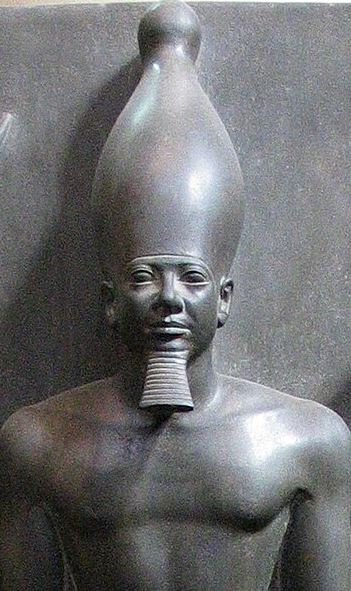
Statue of Menkaure at the Egyptian Museum in Cairo.
Menkaure, Khafre’s successor, is best remembered for his pyramid, the smallest of the three main pyramids at Giza. Despite its modest size, his mortuary complex was exquisitely decorated, with statues showing the king accompanied by divine personifications, signaling a more intimate representation of the ruler and gods.
Menkaure’s reign is generally viewed as benevolent, and Greek traditions, in contrast to those about Khufu and Khafre, describe him as a just and kind ruler. The quality and detail of the statuary from his reign reflect a deep respect for religious rituals and artistic finesse.
Shepseskaf (2503–2496 BC)

Head of Shepseskaf
Shepseskaf was the final confirmed ruler of the Fourth Dynasty. This Egyptian king broke with the pyramid-building tradition by constructing a large mastaba at South Saqqara, called the Mastabat al-Fir’aun. This choice may reflect religious changes or practical constraints, such as economic limits or a brief reign.
His relatively short and poorly documented reign marked the end of a remarkable era. The abandonment of pyramid construction by Shepseskaf suggests a transition in ideology or administrative priorities.

Other Prominent Figures Beyond the Kings
Baka / Bikheris
Some ancient sources suggest the existence of a ruler between Khafre and Menkaure, possibly named Baka or Bikheris. However, archaeological and textual evidence remains inconclusive. He may have had a very brief reign or may represent confusion in later king lists.
Khentkaus I
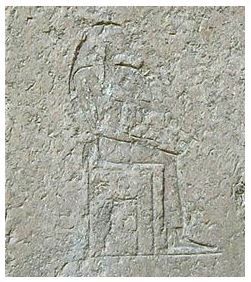
A depiction of Khentkaus I on her tomb.
Khentkaus I, daughter of Menkaure, holds a unique position in the Fourth Dynasty. Her tomb at Giza, built near her father’s causeway, features inscriptions and imagery suggesting that she may have ruled as a pharaoh. Titles on her tomb can be interpreted in multiple ways, including “King of Upper and Lower Egypt and Mother of Two Kings,” which has led to debates over her political role. She is one of the earliest women potentially to have exercised pharaonic power.
Cultural and Religious Shifts
The Fourth Dynasty was a time of significant religious transformation. The cult of Ra, the sun god, gained prominence, partially due to Sneferu’s identification with the deity and Djedefre’s establishment of Heliopolis as a major religious center. This solar theology increasingly merged with the concept of kingship, solidifying the ruler’s divine status.
The king began to be viewed not merely as the incarnation of Horus but as the living son of Ra, bridging earth and the divine realm. The funerary practices reflected this shift: tombs no longer merely served as resting places but as eternal abodes connecting the deceased to the gods.
This period also witnessed the theological evolution of the afterlife. Rather than a distant celestial realm, the afterlife began to be conceptualized as a continuation of earthly life, complete with familiar landscapes and routines.
The Fourth Dynasty of ancient Egypt was a time of peace, prosperity, and monumental achievements. Trade expanded, government became more centralized, and pyramid construction reached its peak, marking it as the cultural and architectural height of the Old Kingdom.
Developments in Funerary Practices
During the Fourth Dynasty, funerary customs became increasingly elaborate. The mummification process grew more sophisticated, involving removal of internal organs, use of natron to dehydrate the body, and intricate wrappings often coated in resin or stucco. Specialized embalmers emerged as vital participants in royal and elite burials.
Tombs shifted in both design and symbolism. Superstructures became grander, but interiors began to incorporate more intricate layouts, deeper burial chambers, and provisions for the deceased’s journey in the afterlife. Artistic elements, like statuary and offering scenes, played a role in maintaining the soul’s vitality.
Although hieroglyphic inscriptions became more common later, the Fourth Dynasty tombs favored architecture and sculpture to communicate religious meaning. After the Giza pyramids, elite tombs began to favor functionality and intimacy over sheer scale.
Governmental Structure and Administrative Innovations
The Fourth Dynasty refined Egypt’s bureaucratic system. Power was centralized under the pharaoh but administered through a hierarchy of officials, such as viziers, nomarchs, and priests. These individuals managed resources, collected taxes, and oversaw construction projects.
While kings maintained ultimate authority, the efficiency of state institutions allowed for large-scale planning and execution of complex endeavors like pyramid construction. The organization of labor, procurement of materials, and logistical planning required a level of statecraft and administrative cohesion that the Fourth Dynasty achieved with remarkable success.
Trade and Foreign Relations
Trade expeditions during this era were vital for securing exotic goods and materials. Sneferu led campaigns into Nubia and Libya to obtain labor and building materials. Egyptian expeditions to Sinai for turquoise and to Byblos for cedar are well-documented, indicating extensive foreign connections.
These expeditions served both economic and political purposes—demonstrating Egyptian dominance and acquiring resources that enhanced the state’s prestige. Artifacts from distant lands found in royal tombs show the breadth of Egypt’s trade networks.
Important Questions and Answers on Egypt’s Fourth Dynasty (Dynasty IV)
Why is Sneferu significant in pyramid development?
Sneferu revolutionized tomb construction by evolving the step mastaba into smooth-sided pyramids. He built the Bent Pyramid, the Red Pyramid (the first successful “true” pyramid), and possibly the Meidum Pyramid, setting the standard for future royal tombs.

The Bent Pyramid
What is Khufu best known for?
Khufu, Sneferu’s successor, is renowned for building the Great Pyramid of Giza—the largest pyramid in Egypt and one of the Seven Wonders of the Ancient World.
Why did Djedefre build his pyramid away from Giza?
Djedefre constructed his pyramid at Abu Rawash, possibly due to a family rift or his devotion to Ra, locating his tomb near Heliopolis, a major center of sun worship.
What distinguishes Khafre’s reign?
Khafre built the second pyramid at Giza and is associated with the Great Sphinx. His statues emphasize a divine connection with Horus, and his reign was marked by extensive royal portraiture.
How did religious beliefs change during this dynasty?
The Fourth Dynasty saw a rise in solar worship, especially of Ra. Kings began identifying as living deities, and the afterlife was imagined as an earthly continuation, influencing pyramid rituals and iconography.
READ MORE: 10 Most Revered Gods and Goddesses in Ancient Egypt
What role did Khentkaus I play in the dynasty?
Khentkaus I, daughter of Menkaure, may have ruled as a king. Her tomb bears royal titles and kingly regalia, suggesting she either reigned or held significant dynastic authority as mother of two kings.
How did funerary customs evolve in this period?
Tombs became larger and more elaborate. Mummification practices advanced, pyramid construction peaked, and burial architecture shifted from simple mastabas to highly symbolic structures representing divine order and earthly power.





Raising Stone 2: The Almighty Pulley of Fourth Dynasty Egypt is available now, 2026, in eBook format.