Ancient City of Kadesh
Kadesh, or Qadesh, was an ancient city situated near the headwaters or a ford of the Orontes River in the Levant. It held strategic importance during the Late Bronze Age and is frequently mentioned in historical records, including the Amarna letters. The city is most famously known as the site of the Battle of Kadesh, which took place between the Egyptian and Hittite empires in the 13th century BCE.
Below, World History Edu delves into the city’s name, location, historical significance, and the impact of the famous battle fought there.
Name and Location
The name “Kadesh” originates from the West Semitic (Canaanite) root “Q-D-Š,” meaning “holy.” The Egyptians referred to it as “Qdšw,” while the Hittites called it “Kadeš.” In Akkadian, it had various spellings, including “Kinza,” “Kidša,” and “Gizza.”
Kadesh is identified with the ruins at Tell Nebi Mend, located approximately 15.5 miles (25 kilometers) southwest of Homs, near al-Qusayr. It was adjacent to the present-day Syrian village of Tell al-Nabi Mando. Historical inscriptions place Kadesh near Tunip, within the territory of the Amurru kingdom, assumed to be close to the Orontes River, possibly near Tell Salhab.
Some scholars also associate Kadesh with “Kadytis,” a city mentioned by the Greek historian Herodotus, though this identification remains debated.
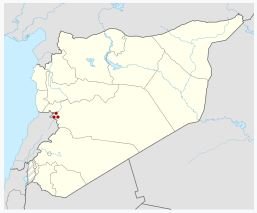
A map of Syria showing the exact location of Kadesh.
Early Bronze Age
During the late Early Bronze Age, Kadesh was known for its production of White-on-Black ware, which appeared in the transitional EB III/IV phase. This pottery style flourished and was widely traded across the Orontes Valley, extending to the Antioch Plains and eastern North Syria during the EB IVA phase. The ceramic tradition continued into the EB IVB period but eventually disappeared in the transitional phase leading to the Middle Bronze Age.
Middle Bronze Age
Kadesh first entered the historical record in the 18th century BCE when mentioned in the archives of Mari. At the time, King Ishi-Addu of Qatna used the city as a military headquarters to suppress a rebellion in the southern region. The Middle Bronze Age in Inner Syria concluded with the military campaigns of Mursili I of Hatti (c. 1591 BCE), transitioning into the Late Bronze Age.
Kadesh played a pivotal role in the geopolitical struggles of the Late Bronze Age, serving as a battleground between the Egyptians and Hittites.
Late Bronze Age
Mitanni Period
Following the decline of the Old Hittite Kingdom and the assassination of Mursili I (c. 1586 BCE), Kadesh came under the influence of the Mitanni kingdom, which emerged from the Habur region.
Around 1521 BCE, Pharaoh Thutmose I campaigned into Syria against the Mitanni, with Kadesh and Aram forming an alliance. Under Hatshepsut, however, Egyptian military campaigns in the region ceased, focusing instead on trade.
READ MORE: How did Queen Hatshepsut become pharaoh of Egypt?
Kadesh played a key role in the Battle of Megiddo, one of history’s earliest recorded battles. The city, alongside Megiddo, led a coalition of Canaanite city-states opposing the Egyptian conquest of the Levant under Thutmose III. The defeat of the coalition resulted in Egyptian dominance over southern Syria. However, Kadesh and other cities retained a degree of independence from Egyptian rule for the following century.
Hittite Period
By 1350 BCE, Suppiluliuma I of Hatti waged military campaigns against Mitanni, eventually seizing control over territories west of the Euphrates, including Kadesh. Egypt, which had been allied with Mitanni, found itself drawn into the conflict. Local rulers, such as Aziru of Amurru and Etakkama of Kadesh, pledged allegiance to the Hittites. The fall of Qatna, a former regional capital, further solidified Hittite dominance in the region.
Correspondence between the ruler of Kadesh and Pharaoh Akhenaten is preserved in the Amarna Letters, where the city is referred to as “Qidshu.” The rulers of Kadesh known from contemporary sources include Suttarna (fl. c. 1351 BCE), Etakkama (c. 1340s BCE), and his son Ari-Teshub (fl. c. 1331-1326 BCE). Under Mursili II of Hatti, Egypt attempted to reassert influence in the region, but Hittite control remained firm.
Seti I’s Campaign

A depiction of Seti I
In 1306 BCE, Pharaoh Seti I launched a campaign into Syria, successfully capturing Kadesh from the Hittites. He erected a victory stela at the site to commemorate the triumph. However, the victory was short-lived. Once Seti I returned to Egypt, Mursili II reconquered Kadesh, making it a key Hittite stronghold.
The Battle of Kadesh

An illustration depicting Ramses II during the Battle of Kadesh.
By the time of Ramesses II, Kadesh had been under Hittite control for decades. The city lay on the contested frontier between Egypt and the Hittite Empire. In response to Hittite expansion, Ramesses II embarked on an aggressive military campaign, recapturing the coastal state of Amurru.
In 1274 BCE, during the fifth year of Ramesses II’s reign, the Egyptian army marched approximately 1,600 kilometers to reclaim Kadesh. The battle that ensued is considered the largest chariot engagement in history, involving between 5,000 and 6,000 chariots.
Initially, Hittite spies misled the Egyptian forces, allowing the Hittite army to launch a surprise attack on Ramesses II’s camp. The Egyptian forces narrowly avoided defeat thanks to reinforcements from Amurru. The battle ended in a tactical stalemate, with both sides claiming victory.
Despite Egyptian claims of success, Kadesh remained under Hittite control. Amurru also returned to Hittite allegiance, and the Hittite army continued its campaigns southward. The ongoing conflict between the two empires eventually led to the signing of one of the earliest recorded peace treaties between Ramesses II and Hittite King Hattusili III.
How the Battle of Kadesh produced the First Peace Treaty in World History
End of Kadesh
Around 1179 BCE, the Sea Peoples invaded the Levant, leading to the destruction of Kadesh. Though the city disappeared from historical records, evidence suggests that Hellenistic remains were found at the site. The settlement remained occupied through the Byzantine and Islamic periods, with the name “Nebi Mend” being associated with a local saint.
Tell Nebi Mend
Tell Nebi Mend, the archaeological site identified as ancient Kadesh, consists of an upper mound (450 x 200 meters) and a lower tell. It spans approximately 11 hectares and rises 30 meters above the surrounding plain. A Middle Bronze Age enclosure wall encompasses around 40 hectares, indicating the city’s significant size.
Situated at the confluence of the Orontes and Mukadiya Rivers, the site was occupied continuously from the Neolithic through the Iron Age and into the Hellenistic and Roman periods.
The first excavations at Tell Nebi Mend were conducted by a French team led by Maurice Pezard in 1922-1923. Later, the University College London Institute of Archaeology, led by Peter Parr, conducted further excavations between 1975 and 1995. Discoveries included a fragmentary stela of Seti I, Syro-Hittite cylinder seals, terracotta figurines, and cuneiform tablets dating to the 14th century BCE, confirming the site’s identification as Qadesh.
Frequently Asked Questions
Why was Kadesh historically significant?
Kadesh was strategically important in the Late Bronze Age due to its location on trade and military routes. It was contested between the Egyptian and Hittite empires and was the site of the famous Battle of Kadesh in 1274 BC.
Which major battle took place at Kadesh, and who fought in it?
The Battle of Kadesh occurred in 1274 BC between the Egyptian forces of Ramesses II and the Hittite army led by Muwatalli II. It is one of the largest chariot battles in history.
The battle ended in a stalemate. While Ramesses II claimed victory, Kadesh remained under Hittite control. The conflict later led to the first recorded peace treaty between Egypt and the Hittites.

A rock relief of Muwatalli II at Sirkeli Höyük in Turkey.
How did Kadesh change hands between different empires?
Kadesh was originally under Mitanni influence but fell to the Hittites under Suppiluliuma I. Seti I of Egypt temporarily recaptured it, but the Hittites regained control, making it a key fortress.
What role did Kadesh play in Egyptian-Hittite diplomacy?
Kadesh was central to Egyptian-Hittite rivalry. After years of conflict, Egypt and the Hittites signed a peace treaty under Ramesses II and Hattusili III, marking one of the earliest diplomatic agreements in history.
When and why did Kadesh disappear from history?
Kadesh was destroyed around 1179 BC by the Sea Peoples. It never regained its former prominence, though the site remained occupied into the Byzantine and Islamic periods.
What archaeological evidence exists for Kadesh?
Excavations at Tell Nebi Mend have uncovered artifacts from multiple periods, including Middle and Late Bronze Age structures, Egyptian and Hittite inscriptions, and cuneiform tablets confirming its identification as Qadesh.





