Category: Ancient History
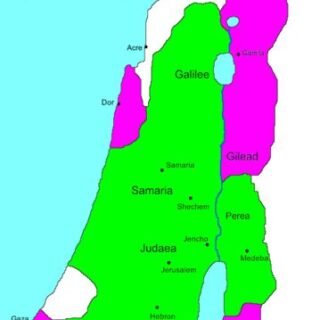
Judaea was a Roman province established in 6 CE, encompassing Judea, Idumea, Samaria, Galilee, and parts of Philistia. It was formed after the deposition of Herod Archelaus, transitioning from semi-autonomous...
The Aetolian League, or Koinon tōn Aitōlōn (Κοινὸν τῶν Αἰτωλῶν), was a significant political and military federation in ancient Greece. Centered in Aetolia in central Greece, it emerged as a...
The Anunnaki, derived from the Sumerian words “da-nuna” or “da-nuna-ke4-ne,” meaning “princely offspring” or “offspring of An,” were a group of deities central to the ancient Mesopotamian pantheon. They appeared...
Enūma Eliš, meaning “When on High,” is an ancient Babylonian creation myth that outlines the origins of the cosmos, the rise of the god Marduk, and the creation of humanity....
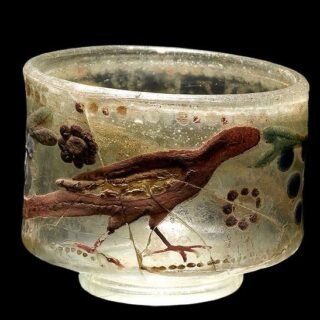
Roman glass refers to the glass artifacts produced during the time of the Roman Empire, roughly from the first century BCE to the end of the Roman Empire in the...
The Achaean League, or Koinon ton Akhaion, was a confederation of Greek city-states in the northern and central Peloponnese. Named after the region of Achaea in the northwestern Peloponnese, the...
The Hasmonean and Herodian royal winter palaces, located at Tulul Abu el-‘Alayiq near the entrance of Wadi Qelt, represent a remarkable archaeological complex from the Second Temple period. Situated in...
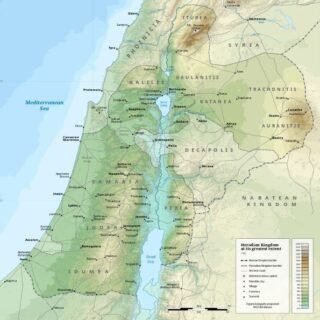
The Herodian Kingdom, ruled by Herod the Great from 37 to 4 BCE, was a client state of the Roman Republic. Herod, designated “King of the Jews” by the Roman...
The Hasmonean dynasty (c. 140 BCE to 37 BCE) emerged during the Hellenistic period of Judea’s Second Temple era. It evolved from semi-autonomous rule under the Seleucid Empire into an...
Roman wall painting, a vital aspect of Roman art, developed over centuries and evolved through various styles that offer insight into Roman culture, aesthetics, and daily life. Roman murals and...
Larsa is known in Sumerian as UD.UNUGKI and referred to as Larancha or Laranchon by the Greek historian Berossos. This ancient Sumerian city-state is located approximately 24 kilometers southeast of...
The Eridu Genesis, also known as the Sumerian Creation Myth, delves into humanity’s creation, the origins of kingship, the establishment of the first cities, and a global flood narrative. It...
Empress Helena’s religious devotion, pivotal role in relic preservation, and patronage of Christian sites solidified her legacy as an instrumental figure in the establishment of Christian traditions. Early Life and...
Qa’a, also known as Qáa or Ka’a, ruled as the final monarch of Egypt’s First Dynasty during the late 30th century BCE. His name, meaning “his arm is raised,” signifies...
Apollonius of Tyana (c. AD 15 – c. AD 100) was a philosopher, mystic, and religious leader from Tyana, Cappadocia, in Roman Anatolia. Renowned for his charisma, teachings, and reputed...