
The temple of Hatshepsut
The Temple of Hatshepsut, also known as Djeser-Djeseru (“Holy of Holies”), stands as one of the most remarkable architectural achievements of ancient Egypt. This mortuary temple, built for the female pharaoh Hatshepsut of the Eighteenth Dynasty, is located in Deir el-Bahari, on the west bank of the Nile, near the Valley of the Kings. Designed by Hatshepsut’s chief architect Senenmut, the temple is a striking example of New Kingdom temple architecture, seamlessly blending with the limestone cliffs of the Theban mountains.
The Temple of Hatshepsut was constructed not only as a funerary monument but also as a place for the veneration of the gods, particularly Amun-Ra, and to solidify Hatshepsut’s divine legitimacy as ruler of Egypt.
READ ALSO: How did the Nile make Egypt a great ancient civilization?
Historical and Political Context
Hatshepsut, one of the most extraordinary figures in Egyptian history, reigned as pharaoh from circa 1479–1458 BCE. As the daughter of Thutmose I, she was initially the queen consort to her half-brother and husband, Thutmose II. Upon his early death, his son Thutmose III was too young to rule, and Hatshepsut assumed the position of regent. However, within a few years, she took on the full powers of a pharaoh, even adopting the traditional male regalia, including the false beard, to legitimize her rule.
The construction of Djeser-Djeseru was not just an act of devotion but also a political statement. It helped reinforce her authority by linking her reign to the gods, particularly Amun, and promoting her divine birth through temple inscriptions. The reliefs and inscriptions within the temple emphasize her legitimacy, divine conception, and the prosperity of her reign, attempting to secure her legacy against possible erasure.

Thutmose I
Architectural Design
The Temple of Hatshepsut is unique in its design compared to other mortuary temples of the time. It was heavily influenced by the neighboring Temple of Mentuhotep II, which stood in the same valley. However, Senenmut’s design introduced new innovations that made it an architectural masterpiece.
The temple consists of three terraces rising in a linear axis against the cliffs. These terraces are connected by broad ramps, creating a grand visual approach to the sanctuary. The entire complex is nearly symmetrical, reflecting the Egyptian emphasis on order and balance (ma’at). Unlike earlier mortuary temples that were enclosed, this one was built in an open design, harmonizing with the natural landscape.
Terraces and Layout
The lowest terrace was once surrounded by lush gardens, with imported exotic trees from Hatshepsut’s trade expedition to Punt. This terrace functioned as an entryway and provided an initial impression of grandeur.
The second terrace is adorned with colonnades and reliefs that depict major achievements of Hatshepsut’s reign, including the famous expedition to the Land of Punt, which was an essential trading venture to modern-day Eritrea or Somalia. These reliefs show ships sailing to Punt, the exotic goods brought back to Egypt, and the presentation of gifts to Amun-Ra. Another key series of reliefs illustrate her divine birth, where Amun is shown as her true father, further legitimizing her rule.
The Temple of Hatshepsut stands as a powerful testament to her reign and vision. Its design, blending natural and man-made elements, represents the pinnacle of Egyptian mortuary architecture.
The third and highest terrace leads to the inner sanctuaries, including the chapel of Amun-Ra, which was the most sacred space in the temple. This part of the temple was where rituals were performed in honor of Hatshepsut and the gods.
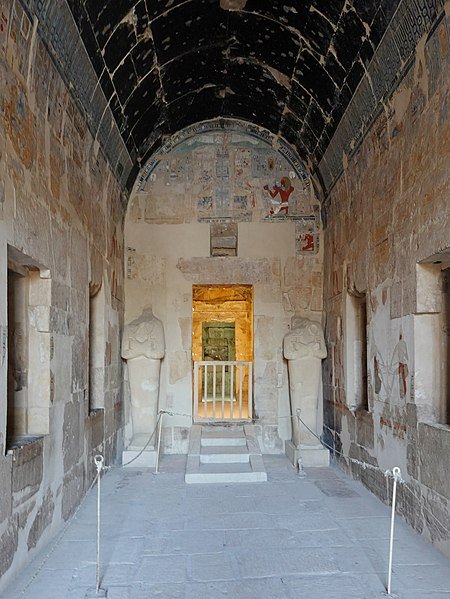
Barque hall of the shrine (to Amun)
READ ALSO: What was the Land of Punt, and why was it important to ancient Egypt?
Religious and Symbolic Functions
Djeser-Djeseru was not just a mortuary temple; it also served religious and ceremonial purposes. The temple was dedicated primarily to Amun-Ra, the chief deity of Thebes, but also contained shrines to Hathor and Anubis. The chapel of Hathor, located on the second terrace, was particularly significant, as Hathor was one of Hatshepsut’s patron deities. The imagery here includes scenes of Hatshepsut making offerings to the goddess.
The temple played an essential role in the annual Beautiful Festival of the Valley, a religious procession in which the statue of Amun was transported from Karnak to the west bank. During this festival, Hatshepsut’s temple was an important stop, reinforcing the temple’s religious prestige.
Did you know…?
- There have been some claims in modern times and ancient times that Egypt’s great structures were built by slave labor. Contrary to common belief, Egypt’s monuments were not built by slaves. Skilled and unskilled Egyptian workers carried out the construction as part of a collective effort. From the Old Kingdom to the New Kingdom, Egyptian rulers commissioned massive projects that defined the state through monumental architecture.
- The movement of large stone blocks from quarries to building sites allowed Egypt to express its unity and identity through architecture. Egyptologist Steven Snape noted that these projects played a fundamental role in the emergence of Egypt as a powerful and structured state.
Destruction and Legacy
After Hatshepsut’s death, Thutmose III—her stepson and successor—sought to erase her memory from history. Many of her images, statues, and inscriptions were defaced or removed, likely in an effort to restore the traditional male lineage of pharaohs. However, despite these acts of erasure, the temple itself survived due to its architectural grandeur.
Rediscovered in the 19th century, the temple has been the subject of extensive excavation and restoration efforts. Today, it remains one of the most visited archaeological sites in Egypt, offering insight into Hatshepsut’s reign and the artistic and religious culture of the New Kingdom.
Frequently asked questions about the Temple of Hatshepsut
What makes the mortuary temple of Hatshepsut significant?
Hatshepsut’s temple at Deir el-Bahri is one of the most impressive architectural achievements of ancient Egypt. It was inspired by the mortuary complex of Mentuhotep II but built on a much grander scale, showcasing her political strength and divine legitimacy.
Who was Mentuhotep II, and how did his temple influence Hatshepsut’s?
Mentuhotep II was the ruler who reunited Egypt and established the Middle Kingdom. His temple at Deir el-Bahri was a fusion of a tomb and a place of worship, blending into the cliffs. Hatshepsut admired this design and had her own temple constructed next to it, reinforcing her connection to Egypt’s past while surpassing previous monuments.
Monumental structures in ancient Egypt symbolized prosperity and upheld the principle of ma’at (harmony and balance).
Why did Hatshepsut build her temple next to Mentuhotep II’s?
By placing her temple beside Mentuhotep II’s, Hatshepsut linked herself to a revered ruler, reinforcing her legitimacy. At the same time, she sought to surpass his achievements, making a bold statement about her own reign.
How did Hatshepsut become pharaoh?
Hatshepsut was the daughter of Thutmose I and married her half-brother Thutmose II. When he died, she became regent for his young son, Thutmose III. Instead of relinquishing power when he came of age, she declared herself pharaoh, assuming full authority and ruling Egypt successfully.
What were the key achievements of Hatshepsut’s reign?
Her reign was marked by peace, economic prosperity, and ambitious building projects. One of her most celebrated accomplishments was her trade expedition to Punt, which brought valuable resources such as myrrh trees, incense, gold, and exotic animals.
Who designed Hatshepsut’s temple?
Her temple was designed by Senenmut, her steward and close advisor. He modeled it after Mentuhotep II’s temple but expanded and refined every aspect, making it larger, more elaborate, and more impressive.
What was unique about the design of Hatshepsut’s temple?
The temple was built in three levels, each connected by grand ramps. The lower terrace featured gardens and statues of lions, while the second level displayed reliefs of key events, including her divine birth and expedition to Punt. The third level housed the Sanctuary of Amun, carved into the cliffs.
What religious elements were included in the temple?
The temple had shrines dedicated to Amun, Hathor, and Anubis. The Sanctuary of Amun was the most sacred space, carved directly into the rock. The Hathor temple reflected Hatshepsut’s special devotion to the goddess, reinforcing her divine legitimacy.
What happened to Hatshepsut’s legacy after her death?
After her death, Thutmose III ordered her images and inscriptions removed from public monuments in an attempt to erase her from history. However, interior reliefs depicting her divine birth and expedition to Punt were left largely intact.
Did Akhenaten also alter Hatshepsut’s temple?
Yes, Akhenaten (1353–1336 BCE), known for his religious reforms, erased references to Amun from her temple, as part of his broader campaign against the powerful Amun priesthood.
What happened to Hatshepsut’s mummy?
In 2006, Egyptologist Zahi Hawass identified her mummy, proving that she died in her fifties, likely due to an abscess following a tooth extraction.
READ ALSO: Who are the most pioneering figures in Egyptology?
How was Hatshepsut’s memory rediscovered?
Her monuments were rediscovered in the 19th century by archaeologists. The deciphering of hieroglyphics by Jean-François Champollion in the 1820s revealed inscriptions that restored her name to history.
The Temple of Hatshepsut remains one of the greatest architectural achievements of ancient Egypt. Despite attempts to erase her from history, her legacy endures in the magnificence of her temple, inspiring admiration worldwide.





